RR-VLM: Prune-then-loop retrofitting and staged recovery
Paper information
| Field | Details |
|---|---|
| Paper links | arXiv 2610.22075; v1 full text |
| Original title | Retrofitting Recurrent Vision-Language Models from Pretrained Backbones |
| Company / institution | First author Madhav Iyengar: University of Tübingen / Tübingen AI Center; collaboration with KE:SAI |
| First public release | 2026-10-15; 2026-10-15T15:34:27Z |
| Author code | Official project page says Code (coming soon). No verifiable implementation or license found at review. |
| Adapter | Catalog key rr-vlm; adapter: null, no reproduction CLI or Evolve operator |
| Local implementation | src/auto_research/foundation_models/rr_vlm.py; scripts/run_oct18_foundation_components.py |
| Implementation status | component_only, L1 diagnostic; diagnostic_only: true, promotion_eligible: false |
| Full experiment | Reviewed and not reproduced because of cost; not_reproduced_high_cost |
Paper summary
Background and main changes
One can remove a span of language layers from a pretrained VLM and loop a retained shared block, but direct surgery disrupts language and image-text alignment. RR-VLM fuses prelude context and recurrent state with a linear adapter, then performs text recovery, projector alignment, and full-model instruction recovery. Text and final recovery also distill from the original unpruned teacher.
flowchart LR
  X[Text and visual projections] --> P[Prelude]
  P --> A[Concatenate context and recurrent state]
  A --> R[Linear adapter and shared core]
  R --> A
  R --> C[Coda and vocabulary output]
  T[Frozen unpruned teacher] --> D[CE plus KL recovery]
  C --> D
Original paper figure
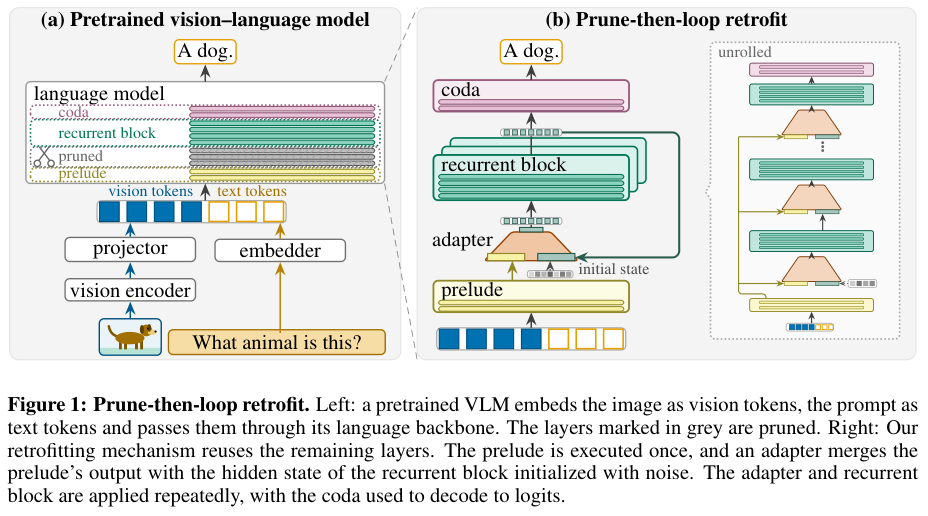
Paper Figure 1: Original versus retrofitted VLM, with contiguous pruning, prelude, adapter, shared loop, coda, and unrolling. From the original paper; copyright remains with the authors. Click the image to open its source.
Core equations
Traversal depth is \(p+rb+c\) with only \(p+b+c\) unique stored layers. Recovery loss is
The teacher is frozen and detached. Projector alignment omits KD. The full paper also discusses sharing KV across loops; that incremental-inference feature is not implemented locally.
Offline and online results reported in the paper
Pruning and looping TinyLLaVA-1.4B removes 23.3% of language parameters. Main-table aggregate score is 58.13 versus 55.80 for the unpruned baseline with the same recovery data. Parameter compression is not fewer inference FLOPs; recurrence can increase compute and KV cost. No online A/B is reported.
Local reproduction
Data protocol and execution
Seeds 42/43/44, revision synthetic-memory-spatial-vision-recurrence-and-ode@oct18-foundation-mechanisms-v1. A random six-layer width-16 causal Transformer loses two contiguous layers and keeps a 1/2/1 prelude/core/coda, with three core loops. Two synthetic text and visual inputs test structure and optimization, not capability.
PYTHONPATH=src python scripts/run_oct18_foundation_components.py \
  --papers rr-vlm --device cpu --seeds 42,43,44 \
  --output runs/oct18-components/rr-vlm-cpu.json
Results and independent comparison
CPU confirms manual unroll equals forward, the same core is called the requested times, and one-loop negative control differs. Three actual SGD stages update language adapter, visual projector, then language adapter. Stage 0 has no vision; Stage 1 omits KD. Teacher embedding, projector, every original layer, and output are independent frozen copies; outputs do not change after the three steps.
All real A100 seeds 42/43/44 passed, with zero maximum manual-unroll error and teacher change. Every stage updated at every seed. Across stages and seeds, gradient norm is at least 0.9336 and update norm at least 0.009336. Single-loop output differs by 1.0528–1.4660 from three loops. See per-seed diagnostics and GPU receipt. This is L1 execution and gradient evidence, not a vision benchmark.
Code mapping and limits
RetrofittedRecurrentVLM performs contiguous surgery and shared looping; configure_stage selects trainable parameters; teacher_logits runs the full teacher without gradients; recovery_loss implements temperature-scaled CE/KL. No TinyLLaVA, pretrained visual tower, real image/text data, author Muon, alternating vision-language data ratio, or cache sharing.
The full paper uses 60B text recovery tokens, 493K alignment and 660K instruction examples. Even if a 1.4B model fits on one card, full recovery remains expensive. Reviewed and not reproduced because of cost. No Evolve promotion.