Sink-Sparse: Static probability-mass coverage and normalizer-aware hybrid attention
Paper information
| Field | Details |
|---|---|
| Paper links | arXiv 2610.22975; pinned v1 full text |
| Original title | Sink-Sparse Hybrid Attention for Efficient Inference in T2I/T2V Diffusion Transformers |
| Company / institution | First author Bingxin Xing: Xi'an Jiaotong University; collaboration with Xiamen University and Shanghai Jiao Tong University |
| First public release | 2026-10-16 05:50:56 UTC; announced October 19, not first released then |
| Author code | No repository is listed in the abstract or v1 text. No verifiable author implementation or code license was found. |
| Local adapter / stable key | sink-sparse; adapter: null, no full DiT reproduction or Evolve operator |
| Local implementation | src/auto_research/foundation_models/sink_sparse.py; scripts/run_oct19_evening_foundation_components.py |
| Implementation status | component_only, L1 mechanism diagnostic, no end-to-end video generation speedup |
| Full experiment | Reviewed and not reproduced because of cost; not_reproduced_high_cost |
Paper summary
Background and main changes
A diffusion Transformer repeats costly attention at every denoising step. The authors observe that high-probability block relationships in some layers and heads are relatively stable across prompts and seeds. One offline calibration can therefore select a static sparse support. A lower-resolution global KV branch recovers distributed context without changing weights or the sampling schedule.
flowchart LR
  C[Independent offline calibration Q and K] --> M[Aggregate exact token probabilities into block mass]
  M --> S[Static mask from shortest mass-covering prefix per row]
  Q[New Q, K, and V] --> A[Sparse attention over selected blocks]
  S --> A
  Q --> P[Mean-pooled global K and V branch]
  A --> F[Fuse with LSE and pooling-factor correction]
  P --> F
  F --> O[Hybrid output]
Paper Figure 4 shows both stages; see Section 4.
Original paper figure
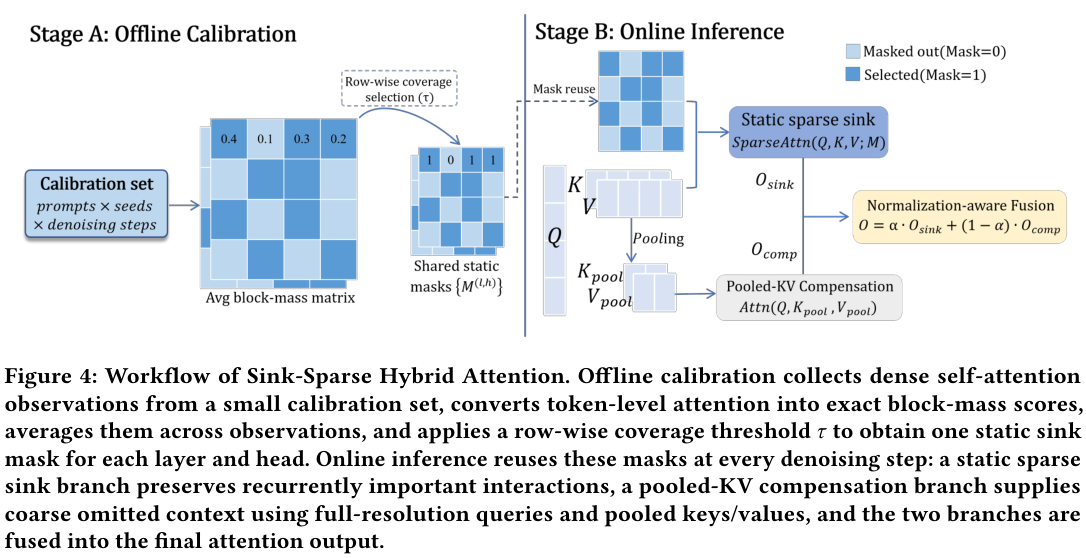
Paper Figure 4: Offline block-mass calibration and static mask, online sparse attention, and pooled-KV/LSE fusion. The white-background PDF version keeps black text readable rather than converting the transparent HTML image to RGB. From the original paper; copyright remains with the authors. Click the image to open its source.
Core equations
Using dense probabilities \(A=\operatorname{softmax}(QK^\top/\sqrt d)\), compute exact mass from each query block to each key block:
Average independent calibration observations into \(\bar m\). In each row, take the shortest descending prefix reaching \(\tau\sum_c\bar m_{rc}\). Attention over averaged Q/K is not a replacement for exact mass, and masks are not reselected on test inputs.
The sparse branch yields \(O_s\) and row log-normalizer \(\ell_s\). The compensation branch uses nonoverlapping mean-pooled KV groups of size \(g\), producing \(O_c,\ell_c\). Pool all tokens, including sink blocks, not just the omitted ones:
log(g) corrects support size rather than giving each branch a fixed half weight. Supports overlap, so hybrid and dense outputs are not generally equal. A degenerate case such as full support and gap 1 should recover dense attention.
Offline and online results reported in the paper
For Wan2.1-T2V-1.3B at 832×480 and 81 frames / 50 steps, dense attention takes 164.80 s with mean VBench 0.656. The \(\tau=.85\) hybrid takes 106.73 s (1.54×) with 0.659. At \(.70\) it takes 94.57 s (1.74×), but quality drops to 0.647. Z-Image-Turbo at 2048 image resolution takes 14.88 s versus 23.39 s (1.57×), with Soft-TIFA GM 15.21 versus 16.38 dense. These are single-A800 80 GB paper measurements, not local GPU results, and quality does not improve on every metric. No production user A/B is reported.
Local reproduction
Implementation and data protocol
The component executes exact probability-mass calibration, shortest prefixes, static-mask reuse, actual selected-block gathers, global mean pooling, and stable sigmoid fusion. Python loops check correctness rather than serve as FlashAttention/Triton production kernels. Sparsity is not converted into a measured speedup.
Pinned synthetic recipe synthetic-role-decoder-mlp-attention@oct19-evening-foundation-mechanisms-v1: six independent calibration observations and two new evaluation observations, two heads × 12 tokens, block 3 and gap 3. The two sets are independently generated, with a fixed threshold rather than hyperparameter selection from evaluation outputs. Q/K/V gradients use real Torch backward; synthetic MSE checks nonzero updates, not image-generation capability.
PYTHONPATH=src python scripts/run_oct19_evening_foundation_components.py \
  --methods sink-sparse --device cpu --seeds 42,43,44 \
  --output runs/oct19-evening/sink-sparse-cpu.json
Use --device cuda for CUDA. Existing results cannot be overwritten. Raw results retain calibration mass, mask, fusion weights, source hash, and commit; public summaries keep scalar metrics and hashes only.
Results and independent comparison
The independent reference concatenates selected token logits with all pooled logits plus log(g) and performs one softmax to compare outputs and Q/K/V gradients. A per-token scalar reference checks calibration mass. Tests cover shortest prefix, dense recovery at full support and gap 1, rejection of empty support, static-mask independence from new inputs, and real nonzero updates. Fixed averaging and omission of log(g) are negative controls.
A real A100 at frozen source 73a1e8b8 passed reference output/gradient, calibration isolation, and nonzero-update checks for seeds 42/43/44. See per-seed metrics and the GPU receipt. heldout_dense_output_rmse measures approximation error on random tensors, not VBench/GenEval or fused-kernel speed.
Cost decision and limits
The full paper needs the 1.3B video and Z-Image backbones, calibration across four prompts × two seeds × multiple denoising steps, and multi-metric, multi-method generation at 81 frames and 2048 image resolution. Even though the authors use one 80 GB card, the full evaluation is costly on the available A100/A30. The full experiment was reviewed and not reproduced because of cost. No video checkpoint was downloaded, no complete generation was run, no end-to-end speedup is claimed, and the diagnostic cannot promote Evolve.