ESC: Geometrically Consistent Novel-View Synthesis (High-Cost Reference Entry)¶
简体中文 · English
Historical backfill, not a new first release on October 18–21. The full experiments exceed the cost budget and were not reproduced (review complete). No runnable adapter or local performance metric, and no automatic training or Evolve promotion.
Paper information¶
| Field | Details |
|---|---|
| Paper | arXiv 2610.23732 v1; pinned full text |
| Original title | ESC: Escaping 2D Diffusion Ambiguity with Geometric Constraints for Consistent Novel View Synthesis |
| Affiliations | First author Ge Ya (Olga) Luo: FAIR at Meta / Mila – Québec AI Institute / Université de Montréal. The work was done at Meta. |
| First public release | 2026-10-14 21:40:55 UTC (arXiv v1) |
| Authors' code | The paper provides no verified author repository URL, and none was found or confirmed in this review. Qwen or DA3 base-model repositories are not ESC implementations. |
| Local adapter / stable key | esc; adapter: null; deferred_high_cost is a terminal not-reproduced status, not a queue for automatic training. |
| Local implementation | None; this write-up and packaged catalog metadata only. |
| Full experiments | Above the cost budget and not reproduced (review complete). |
Original paper summary¶
Background and main changes¶
When a diffusion model generates a new view from a single image, visual quality in 2D or camera-pose alignment does not guarantee 3D consistency. ESC jointly generates RGB and inverse depth, conditions Qwen MM-DiT on Plücker ray maps, and uses a bidirectional depth-reprojection constraint, PCC, to identify missing and hallucinated geometry. At inference it selects from repeated stochastic generations using PCC.
flowchart LR
  I[Source RGB and depth] --> V[Qwen VAE visual tokens]
  R[Source and target Plucker rays] --> C[Ray ControlNet]
  V --> D[Qwen MM-DiT with LoRA]
  C --> D
  D --> O[Target RGB and inverse-depth candidates]
  O --> P[Bidirectional depth-reprojection PCC]
  P --> B[Best-of-N geometric selection]
Key figure from the paper¶
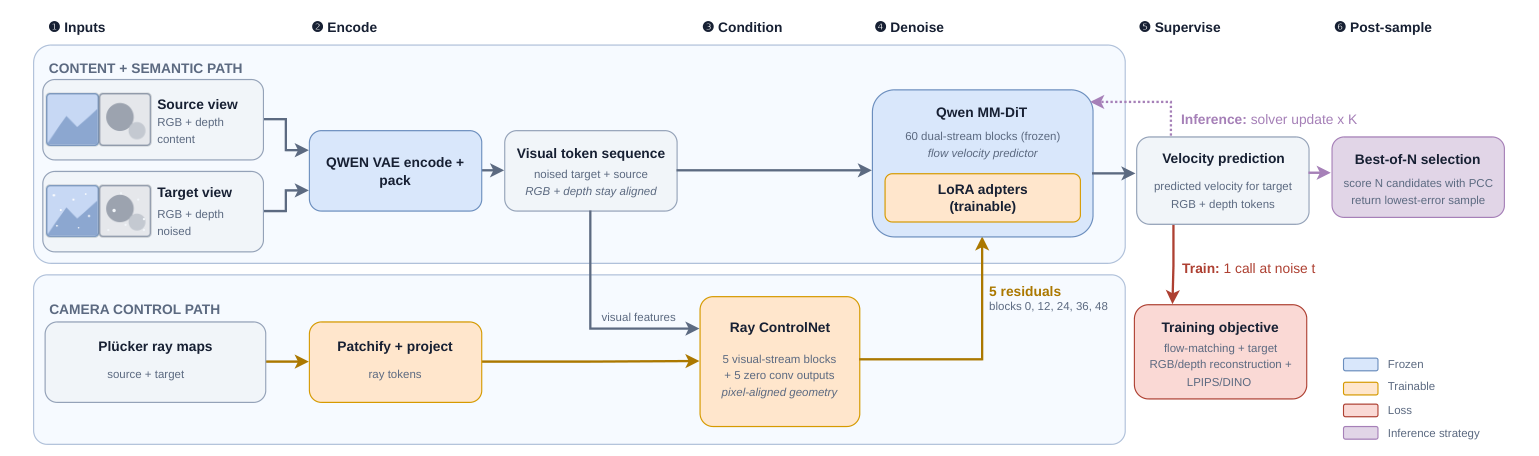
Figure 3: Visual content path, camera ControlNet, LoRA, and PCC post-sampling. The figure comes from the original paper, © the original authors. Provenance and hash.
Core equations¶
Back-project source depth into 3D points using camera intrinsics, transform and project them into the target camera using the relative pose, and resolve occlusion with a z-buffer. A valid pixel has positive depth, lies within the image, and has valid source depth:
Compute \(\Delta_s\) in the reverse direction. Positive depth differences in the two directions indicate missing and hallucinated geometry, respectively. PCC also includes a noise threshold, log compression, clipping, and normalization by valid coverage. It is not a simple RGB difference or absolute depth error. Best-of-N in §3.2 is:
Training combines RGB/inverse-depth flow matching with time-gated reconstruction, LPIPS, and DINO losses. This entry explains the definitions without substituting a simplified geometric fixture for full ESC.
Reported offline and online results¶
Table 9 reports RE10K PCC, lower is better: ESC \(0.0773\), ESC-PCC-BoN \(0.0656\). On DL3DV the values are \(0.2448\) and \(0.2257\). Image and pose metrics are not uniformly best at once; PCC alone does not establish superiority on every measure. These are paper numbers, with no local measurement. No production online A/B test was reported.
Local reproduction¶
Not implemented, trained, or GPU-verified. This round records the method and its limits, without a stand-in adapter, placeholder result JSON, or fake CUDA receipt. The pinned v1 text, method, architecture figure, and Appendix E.1 cost were checked.
Cost and decision not to reproduce¶
Appendices B/E.1 describe a Qwen-Image-Edit backbone with LoRA and a 5-layer Ray ControlNet, approximately 22B active parameters. Training uses 177K steps, global batch 128, and 2304 latent tokens per example, about \(5.2\times10^{10}\) tokens and \(6.8\times10^{21}\) FLOPs, plus DA3 pseudo-geometry, multi-scene data preparation, and multi-candidate inference. This exceeds a short single-A100/A30 budget. The expensive full experiments were not reproduced and count as review complete. No large model was downloaded and no probe was launched merely to confirm cost.