Time-JEPA: Supervising Video Representations with Training-Only Physical Time Series
简体中文 · English
Paper information
| Field | Details |
|---|---|
| Paper | arXiv 2610.23982; pinned v1 full text |
| Original title | Time-JEPA: Grounding Video World Models with Physical Time Series |
| Affiliations | First author Shenyi Li: Harbin Institute of Technology (listed first), Shanghai Artificial Intelligence Laboratory; collaboration with Tsinghua University. |
| First public release | 2026-10-14 07:29:36 UTC; newly announced on arXiv 2026-10-20, not first released that day. |
| Authors' code | Official repository includes src/app/configs/tests and evaluation scripts. MIT and Apache-2.0 files apply within their respective scopes. The full upstream training was not run. |
| Local adapter / stable key | time-jepa; adapter: null, no executable Evolve operator |
| Local implementation | src/auto_research/foundation_models/time_jepa.py; scripts/run_oct20_foundation_components.py |
| Implementation status | component_only; L1 training-mechanism and isolation diagnostic, not a pretrained video-model reproduction |
| Full experiments | Above the cost budget and not reproduced (review complete); not_reproduced_high_cost |
Original paper summary
Background and main changes
Video self-supervision need not preserve precise physical states such as speed or joint angles. Time-JEPA uses synchronized sensor readings or annotations as auxiliary targets, not encoder inputs. During training, the same online encoder processes masked context and unmasked video separately. Evaluation removes the physical-state head and still takes video only.
flowchart LR
  V[Video] --> C[Masked online encoder]
  V --> O[Same online encoder, unmasked]
  V --> E[Frozen EMA target]
  C --> P[Masked-token predictor]
  P --> J[Latent prediction loss]
  E --> J
  O --> H[Spatial pooling and per-time two-layer head]
  S[Training sensors or synchronized annotations] --> A[Align, pool valid tubelets, and normalize with train statistics]
  A --> L[Masked Smooth L1]
  H --> L
  J --> U[Jointly update online encoder]
  L --> U
Key figure from the paper
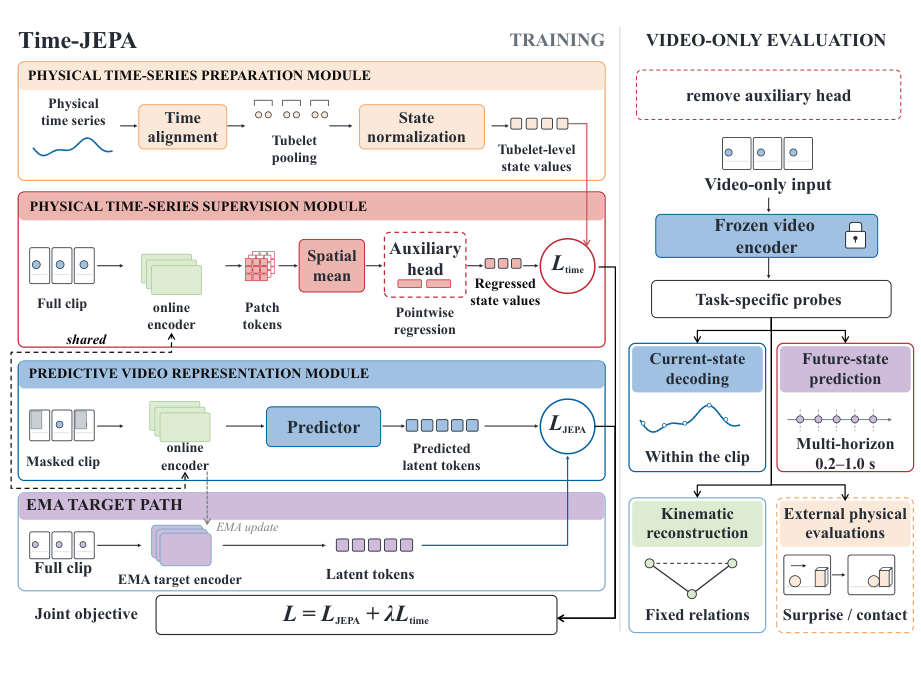
Figure 1 from the paper: Physical-sequence alignment and tubelet pooling, two training paths using masked prediction and full-video auxiliary supervision on a shared encoder, and video-only evaluation. Physical states are training targets only. The figure comes from the original paper, © the original authors. Select the image to see the source.
Core equations and isolation requirements
Appendix C.1 pools valid frames independently for each variable:
An empty tubelet remains invalid rather than becoming a valid zero label. Fit normalization statistics only on training data and freeze them. Spatially average unmasked online features, then use a pointwise MLP to obtain \(\widehat y\):
Both tasks train the online encoder together. The target encoder updates only by EMA; labels and statistics receive no gradient. The paper's multi-domain training also keeps domain-specific heads, variables, normalization, loss weights, and warmup counters. Domains do not share one unconditional label space.
Reported offline and online results
In Table 1, in-distribution current-state decoding \(R^2\) rises from matched Video FT's 0.713 to 0.849 for driving, from 0.424→0.725 for robots, and from 0.231→0.345 for humans. These are real-video probe results from the paper, not local measurements. The paper also evaluates jointly out-of-distribution conditions and variables, cross-domain transfer, and physics. No online A/B test on production users was reported, and the paper does not claim sensor-input inference.
Local reproduction
Components, execution, and verification
The implementation goes beyond a loss wrapper: nearest timestamp alignment, per-variable valid tubelet pooling, train-only statistics, an actual context self-attention encoder, masked latent predictor, unmasked two-layer physical head, frozen target, and explicit EMA. The caller sets the maximum alignment distance; ties choose the earlier measurement. That is a local alignment policy, not a claim about the original decoding pipeline for every dataset.
The small model consumes synthetic tubelet features only, with no V-JEPA weights, video decoding, or real data. Its local JEPA skeleton uses L1 and does not establish the full V-JEPA predictor architecture or capabilities. It provides a single-domain interface, not the paper's full multi-domain scheduling. The acceptance runner fixes FP64; it does not validate the paper's BF16/AMP training.
PYTHONPATH=src python scripts/run_oct20_foundation_components.py \
  --methods time-jepa --device cpu --seeds 42,43,44 \
  --output runs/oct20-foundation/time-jepa-cpu.json
The recipe fits statistics on 6 independent training examples and updates on 2 additional training minibatch examples. Being outside the statistics-fit set is not formal validation or test; no capability comparison was performed. Data ID synthetic:oct20-time-jepa-v1 has a revision bound to the runner source SHA256, with no checkpoint. CUDA requires explicit --device cuda and has no CPU fallback. Outputs cannot be overwritten.
Local results and independent checks
CPU and one real A100 completed seeds 42/43/44. Independent scalar Smooth L1/L1 references and analytic gradients checked joint loss. The A100 mean joint-loss reference error was about 2.41e-16. Latent and physical objectives gave nonzero gradients to the same online encoder, with actual SGD and EMA. Teacher/label gradients, target optimizer changes, masked-context leakage, and statistics changes were all 0. Misaligned time is a mechanism negative control, not a capability comparison. See actual metrics and the GPU receipt, tied to frozen commit 324217ed26fe2e297e25879ad092281eb0960b87. This is only an FP64 diagnostic with a randomly initialized small model.
Cost and work not reproduced
The paper uses V-JEPA 2.1 ViT-g/16, 64 frames at 5 FPS, 8 GPUs with batch 8 per GPU, 20 epochs of three-domain fine-tuning, a 15-epoch probe, and external GRASP/Physion and other evaluations. One A100, A30, or Mac is unsuitable for routine low-cost verification of this full multi-arm protocol. The full experiments were not reproduced (review complete).
No real video encoder was trained. Physical-state decoding, long-horizon prediction, robot control, and cross-domain gains were not measured. Three seeds strengthen the mechanism diagnostic without upgrading it to a formal capability comparison. Automatic Evolve promotion is disabled.