KronLSTM: Updating recurrent memory by scalar key–value association
L1 trainable mixer and memory operator; diagnostic only. No large-scale pretraining or optimized kernel.
Paper information
| Field | Details |
|---|---|
| Paper | Kronecker Delta Rule for Long Context Linear Attention |
| Affiliations | Co-first authors Anamaria-Roberta Hartl: Johannes Kepler University Linz; Levente Zólyomi: JKU and NXAI. Collaboration with NXAI GmbH. |
| First public release | 2026-10-19 17:56:52 UTC |
| Author code | The abstract announces code/models, but no verifiable repository, release location or license was found in the reviewed abstract/HTML/PDF. lm-engine/FLA are not the method source. |
| Local key | kronlstm; no adapter |
| Local code | src/auto_research/foundation_models/kronlstm.py |
| Local evidence | Local mechanism metrics; A100 validation receipt |
What the paper changes
DeltaNet updates a vector error and can disturb overlapping keys. The Kronecker rule instead corrects scalar association \(v^TSk\) along one outer-product direction \(vk^T\). In vector form \(a=v\otimes k\), the step is \(s'=(I-\beta aa^T)s+\beta ca\). Overlap depends on both key and value inner products; orthogonality of either preserves that association for the current update, not arbitrary long-sequence retention.
Original paper figure
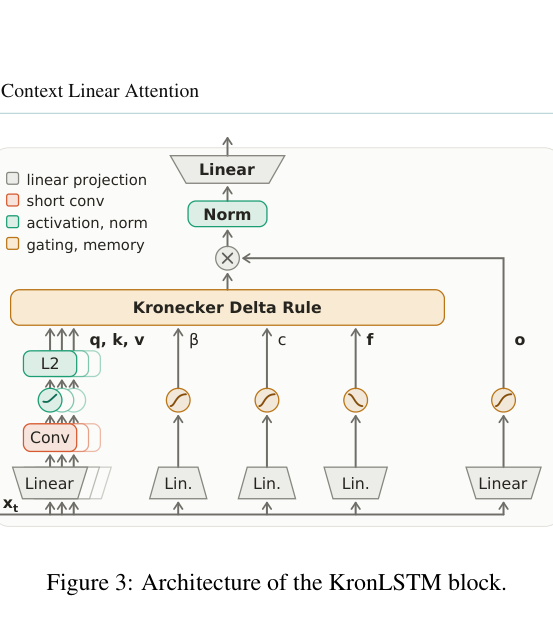
Original figure from the reviewed paper, reused without redrawing.
Core equations
KronLSTM applies channelwise forgetting on the right/key axis, then independent erase and write gates. Write is \(c\), not \(\beta c\). Q/K/V use causal short depthwise convolution, SiLU and L2 normalization. Query reads the new memory, then output gate, per-head RMSNorm and projection. An explicit vectorized matrix with repeated per-key decay independently checks the contraction.
Results reported by the authors
Table 1 1.5B/100B-token linear model: Avg-6 59.72% versus GDN-2 57.94%; LAMBADA PPL 11.72 versus 12.54. Also studies RULER, retrieval, state tracking and sliding-window hybrids. Not all tasks lead. No production A/B or local LLM results.
Local reproduction and limits
kronecker_update and TinyKronLSTM implement recurrence, projections, short convolution and four input-dependent gates. Fixture batch two, seven tokens, width 12, two heads, key/value widths three/four; FP64 only, no AMP qualification. CPU and A100 seeds 42/43/44 check explicit-vector state/readout, six projection/gate gradients, causal prefixes, segment memory, scalar association, key forgetting and actual SGD; ordinary DeltaNet is a negative control. A100 errors ~1e-16 state/readout and 1.16e-17 gradients, frozen source 324217ed26fe2e297e25879ad092281eb0960b87. No fallback, output overwrite, export, throughput or Evolve.
PYTHONPATH=src python scripts/run_oct20_foundation_components.py \
  --methods kronlstm --device cpu --seeds 42,43,44 \
  --output runs/oct20-foundation/kronlstm-cpu.json
Full experiment: not reproduced
Appendix A7 describes 1.5B on 100B FineWeb-Edu tokens, 8,192 context and 16 nodes × four GH200s, plus 400M/40B, long-context continued training and mixer comparisons. No full run, fused chunkwise kernel or automatic retry.
Additional references
Full paper · Paper section · Paper Section 2.1 · Paper Section 2.2 · Paper Section 3.1 · Paper PDF, p. 6