FLINT: Fixed-budget Late Interaction
L1 differentiable fixed-budget pooling, projection and MaxSim; diagnostic only. No full text retrieval system.
Paper information
| Field | Details |
|---|---|
| Paper | FLINT: Fixed-budget Late Interaction |
| Affiliations | First author Himank Handa: UIUC; Negar Arabzadeh and Matei Zaharia: UC Berkeley. |
| First public release | 2026-10-19 20:46:01 UTC |
| Author code | hmk55555/FLINT, MIT, 3b3f3e37d34e32ca5c92cc5b66e3f778ae4210ec; checkpoint collection, not downloaded. |
| Local key | flint; no adapter |
| Local code | src/auto_research/foundation_models/flint.py |
| Local evidence | Local mechanism metrics; A100 validation receipt |
What the paper changes
ColBERT scales with document and query token counts; ConstBERT fixes only the document side. FLINT uses separate learned query/document latent sets after a shared backbone, with shared cross-attention and FFN to emit fixed \(V\) vectors per side. This is neither first-token truncation nor averaging.
Original paper figure
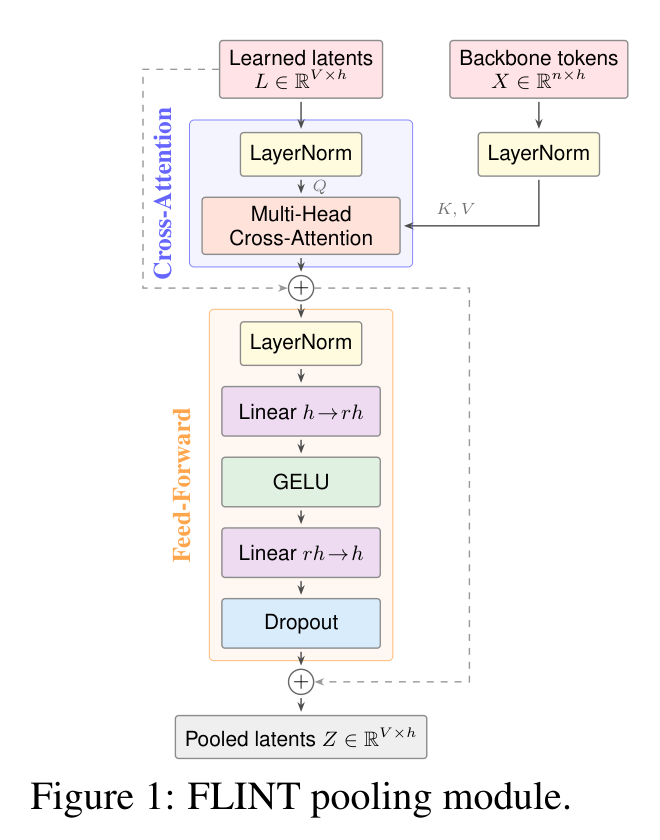
Original figure from the reviewed paper, reused without redrawing. See figure provenance.
Core equations
Mask padded keys with negative infinity. Retain both pre-LN residuals, projection bias and one cross-attention plus one pointwise FFN, no latent self-attention or post-norm. L2-normalize projected vectors and sum over query vectors after max over document vectors; score need not be symmetric. Appendix B/source: BERT uses separate bias-free projections, ModernBERT shared; shared_projection supports both. Typical V=32, heads eight, projection 128; expansion four for BERT and two for ModernBERT.
Results reported by the authors
Table 1 BERT BEIR NDCG@10 0.452 versus ConstBERT 0.469 and ColBERTv2 0.502. ModernBERT V=32 BEIR/CRUMB 0.530/0.205 versus 0.518/0.180. TREC-ToT BERT response 74.3 ms to 26.1 ms against ConstBERT. No production A/B or local score/speed.
Local reproduction and limits
FlintLatentPool and FlintFixedBudgetRetrieval take encoded tokens, apply pooling, projection and aligned-batch MaxSim. Three synthetic query/document pairs of 7/11 width-16 tokens compress to four width-eight vectors; gradients reach inputs, both latent sets and shared modules. True mask means valid; all-masked fails. Tests independent attention, residuals/no postnorm, masks/zero gradient, latent independence, projection variants, norms, MaxSim axes/gradient and gradcheck. Pool invariance does not remove backbone word order. No tokenizer, backbone, distillation, data, PLAID, gold, CUDA fallback or Evolve.
PYTHONPATH=src python -c 'from auto_research.foundation_models.flint import run_flint_diagnostic; print(run_flint_diagnostic(seed=42, device="cpu"))'
Full experiment: not reproduced
MS MARCO BERT 64 candidates/query, global batch 48, 267K steps; ModernBERT-large 32 candidates/query for one epoch, default four GPUs; evaluation to 6.4M documents with PLAID indexes. No downloads, full run or retry. Fixed budget constrains post-encoder representation/matching, not backbone cost.