RACE: Native attention compression that preserves RoPE pairs
L1 single-head calibration, projection folding and attention; diagnostic only. No full converted model.
Paper information
| Field | Details |
|---|---|
| Paper | RACE: RoPE-Aligned Attention Compression Based on Query-Key Activation Energies |
| Affiliations | First author Irene Tenison: MIT CSAIL; collaboration with MIT-IBM Computing Research Lab. |
| First public release | 2026-10-20 15:34:02 UTC |
| Author code | No verifiable author repository or revision in the paper or abstract. Related-work repositories are not method source. |
| Local key | race-rope-compression; no adapter |
| Local code | src/auto_research/foundation_models/oct21_followup_attention.py |
| Local evidence | Local mechanism metrics; A100 validation receipt |
What the paper changes
KV reconstruction can save storage while adding compute. RACE shrinks the head directly: select shared complete Q/K rotation pairs by joint activation energy and obtain a V subspace from right singular vectors. Fold both into Q/K/V/O. Preserve the original frequencies rather than renumbering pairs.
Original paper figure
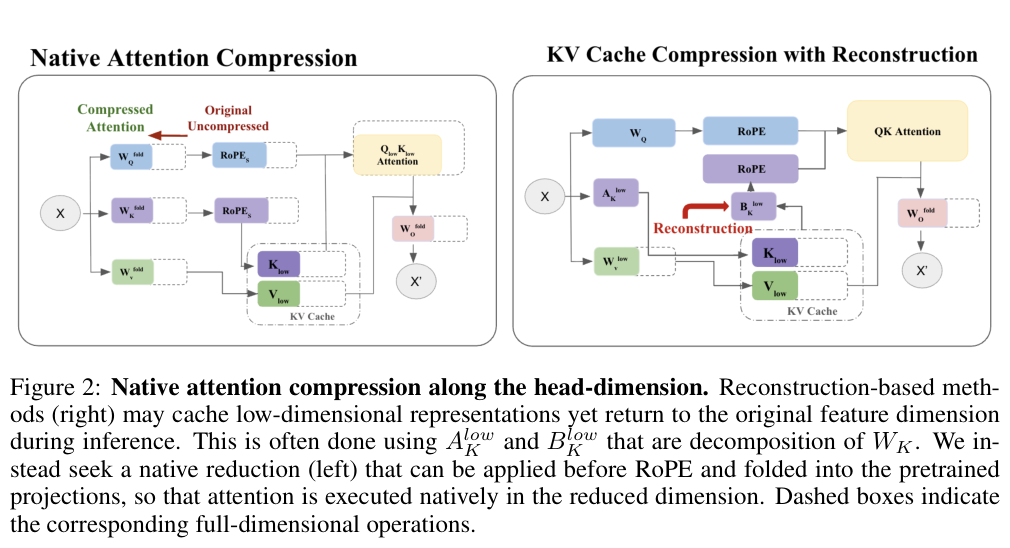
Original figure from the reviewed paper, reused without redrawing. See figure provenance.
Core equations
Rank each rotation pair by \(\|Q_m\|_F^2+\|K_m\|_F^2\) and retain top-\(r_k/2\); V uses top-\(r_v\) right vectors. Use the original head width in the attention denominator, not compressed width. Energy selection optimizes a separable calibration bound, not exact task loss. Calibration/SVD are detached; folded forward differentiates through inputs/weights.
Results reported by the authors
Paper experiments use Llama-3.2-3B, Qwen2.5-7B and Granite-4.1-3B, with about 1M-token KL recovery in all main results. At 256K and 50% retention the system reports ~1.79× throughput. No local recovery/benchmark/speed and no production A/B.
Local reproduction and limits
race_pair_selection supports split-half/interleaved; calibrate_race, fold_race_weights and native_race_attention run a genuinely lower-dimensional causal head without restoring full Q/K/V. Fixture uses 24 width-eight vectors, keeps four Q/K and V coordinates. Checks original noncontiguous frequencies, wrong renumbering, scale, folded vs explicit projections, full rank, orthogonality, detached calibration and nonzero gradients. No GQA, partial-RoPE serving, HF conversion or Evolve.
PYTHONPATH=src python scripts/run_oct21_followup_attention.py \
  --device cpu --seeds 42,43,44 \
  --output runs/oct21-followup-attention-cpu.json
Full experiment: not reproduced
Full setup uses 3B/7B models, 32,768 calibration tokens/model, ~1M-token distillation recovery and multiple benchmarks/64K–256K system runs. No model downloads, trial or automatic retry.