SSA: Correcting stratified sparse attention by inclusion probability
L1 single-head Algorithm 1 reference; diagnostic only. No optimized kernel or full benchmark reproduction.
Paper information
| Field | Details |
|---|---|
| Paper | Stratified Sparse Attention: Reducing the Sparse-to-Dense Gap at Extreme Sparsity |
| Affiliations | First author Sahil Joshi: Rice University; collaborators include UC Berkeley, Stanford and IIT Bombay. |
| First public release | 2026-10-20 16:02:12 UTC |
| Author code | The claimed SSA-Paper-Code returned 404 on 2026-10-21. No verified code or revision. |
| Local key | stratified-sparse-attention; no adapter |
| Local code | src/auto_research/foundation_models/oct21_followup_attention.py |
| Local evidence | Local mechanism metrics; A100 validation receipt |
What the paper changes
Top-k loses tail mass, while uniform sampling wastes budget. Water-fill proxy probabilities to solve \(\sum_i\min(1,\lambda q_i)=k\). Keep \(\lambda q_i\ge1\) exactly; renormalize residual proxy probabilities, draw the remaining budget with replacement and deduplicate. The paper's optimized fixed-heavy-fraction kernel differs from adaptive Algorithm 1.
Original paper figure
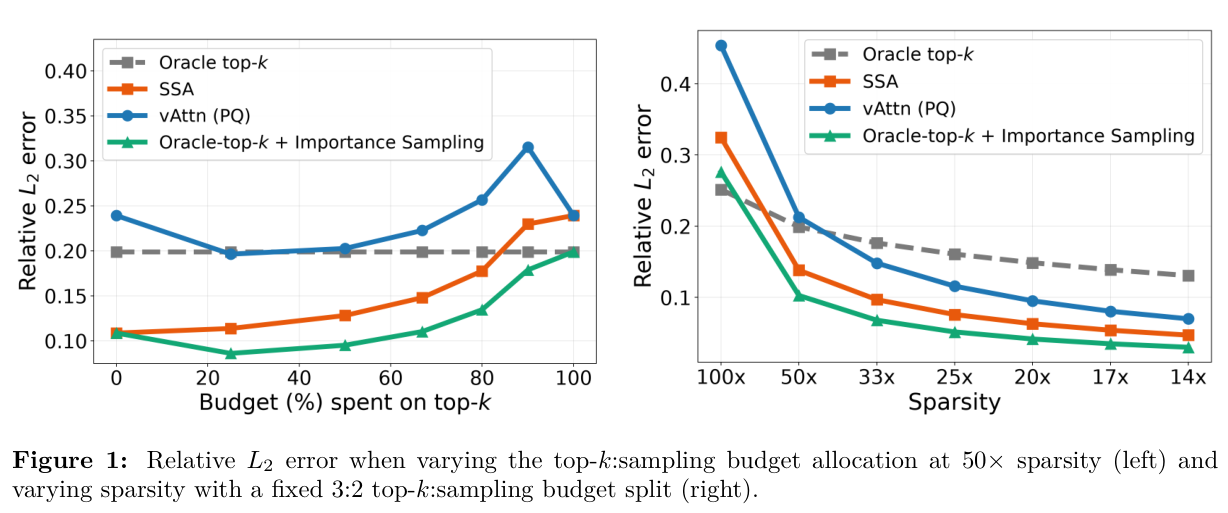
Original figure from the reviewed paper, reused without redrawing. See figure provenance.
Core equations
Use the probability of appearing at least once, not reciprocal per-draw probability, after deduplication. Compute it stably via -expm1(m*log1p(-p)) and normalize corrected logits in log space. The ratio estimator is self-normalized, not strictly unbiased. Full budget returns dense attention; invalid/non-finite or underflowing inputs fail without floors.
Results reported by the authors
Table 1 128K RULER-HARD at 50× sparsity: Ministral-3-8B vAttention 63.78 versus SSA 69.25. Kernel timings use H200 at 1M context. No production A/B or local model/speed result.
Local reproduction and limits
stratified_sparse_attention takes one query, keys, values and external proxy scores. Only exact selected Q/K/V paths differentiate; allocation is detached. Fixture: 64 keys, Q/K width eight, V width six, budget 16. Tests force repeated draws, check inclusion formula, heavy probability one, dense endpoint, Q/K/V gradients, no proxy gradient and invalid input. CPU sync and full-length probability processing preclude the kernel speed claim. No PQCache, layer sampler, paged KV or Evolve.
PYTHONPATH=src python scripts/run_oct21_followup_attention.py \
  --device cpu --seeds 42,43,44 \
  --output runs/oct21-followup-attention-cpu.json
Full experiment: not reproduced
3B–27B models, 32K–128K benchmarks, 32K generation and H200 1M-context kernel testing. No downloads, long run or retry.