Right On Q: Recovering Reasoning under Quantization via Self-Generated Trajectories
Reference entry only. No quantization runtime, distillation, benchmark, metrics or GPU evidence.
Paper information
| Field | Details |
|---|---|
| Paper | Right On Q: Recovering Reasoning under Quantization via Self-Generated Trajectories |
| Affiliations | First author Boyuan Zheng: University of Michigan, Ann Arbor; Jing Xiong and Zhen Zhang: UC Santa Barbara; Zechun Liu: Meta AI. |
| First public release | 2026-10-21 08:03:24 UTC (announced 2026-10-22) |
| Author code | No verifiable author repository in v1 or arXiv. EvalScope is not this implementation. No software license verified; arXiv distribution terms are separate. |
| Local key | right-on-q; no adapter |
| Local code | No executable local implementation. |
| Local evidence | No local experiment, metrics or GPU receipt. |
What the paper changes
Low-bit quantization changes visited prefixes. Calibrate each quantized block against the full-precision output, then have the quantized student generate and let the frozen BF16 teacher score those same prefixes. A token-specific probability ratio adjusts the balance of forward and reverse KL rather than using one coefficient for a whole response.
Original paper figure
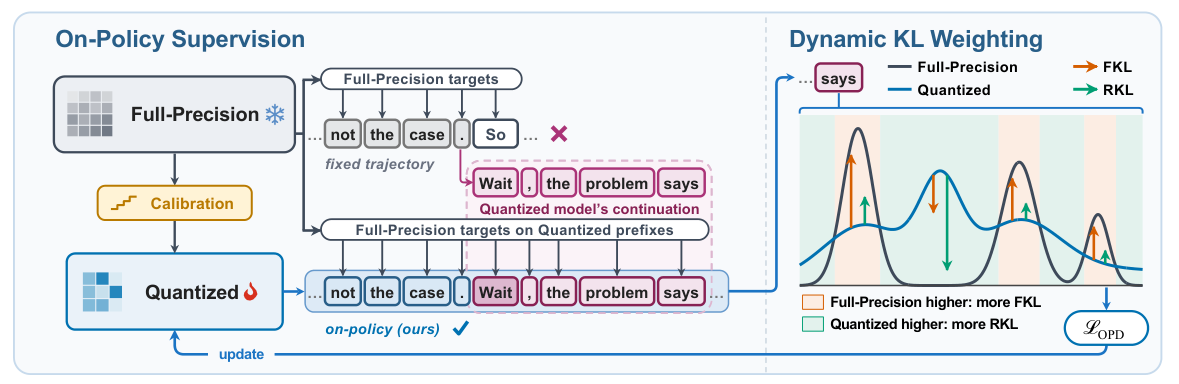
Original figure from the reviewed paper, reused without redrawing. See figure provenance.
Core equations
Use asymmetric uniform group quantization with latent weights, scales and zero points. Freeze rollouts, teacher targets, mixture weights and zero points during OPD; update latent weights/scales. Appendix A.3 uses the union of teacher/student top-20 with an extra residual-mass bucket, preserving student tail gradients and smoothing teacher categories at \(10^{-8}\); this is not truncated renormalization.
Results reported by the authors
Nine math/code/knowledge/instruction task groups for 2/3-bit Qwen3-1.7B/4B/8B; paper reports 10.26 percentage points over the strongest comparator for 2-bit Qwen3-8B and analyzes truncation/repetition. No production A/B or local measurement.
Local reproduction and limits
No QAT/OPD, model loading, toy KL substitute or Evolve. A future faithful run would need calibrated initialization, real quantized rollout, frozen same-prefix teacher, detached candidate weights and residual mass.
Full experiment: not reproduced
Calibration: 4,096 × 2,048-token windows, two epochs/block. OPD: 25,600 prompts; 400 steps for 1.7B, 300 for 4B/8B; 128 one-answer prompts per step at temperature 1. Caps 4,096 for steps 1–50, 8,192 for 51–100 and 16,384 after. H100/H200, verl, vLLM teacher, evaluation up to 32,768 tokens and three main seeds. No total time reported. Full study not reproduced, with no downloads, trials or retries.