ALPS: Visual State Encoders for World Models
L1 Stage 2 geometry and loss interfaces; diagnostic only. No trained ALPS encoder or full experiment.
Paper information
| Field | Details |
|---|---|
| Paper | ALPS: Visual State Encoders for World Models |
| Affiliations | First author Yanqing Liu: UC Santa Cruz; collaborations include UCSB and Google (Jieru Mei and Hongliang Fei). |
| First public release | 2026-10-21 17:57:11 UTC |
| Author code | UCSC-VLAA/ALPS, Apache-2.0, 30ab44b9fcdf3253fc67f5a53e31ea5141eb45c1; training/inference/evaluation source released 2026-10-22 01:45:01 UTC. Public weights were not downloaded. |
| Local key | alps; no adapter |
| Local code | src/auto_research/foundation_models/alps.py |
| Local evidence | Local mechanism metrics; A100 validation receipt |
What the paper changes
A single visual state should support robot-state probes, text alignment and image reconstruction. Stage 1 trains ViT-B/16 with shared pre-final-LayerNorm patch tokens for contrastive, caption, reconstruction and dense crop correspondence. Stage 2 initializes the student and a fixed teacher from Stage 1. A four-layer predictor uses geometry to predict clean crop B teacher tokens from enhanced crop A. Supervise only B centers in A; discard the predictor and retain the student and language interface.
Original paper figure
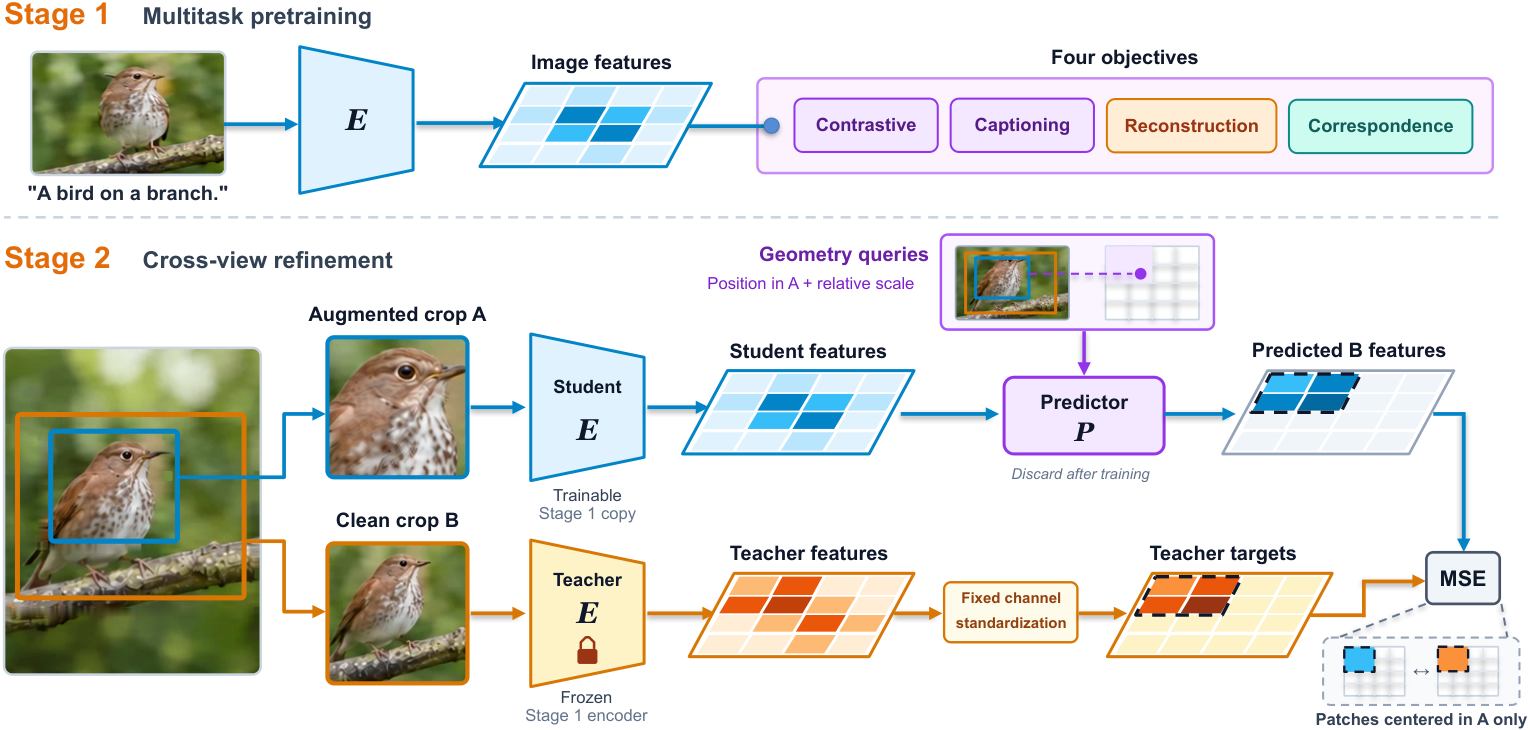
Original figure from the reviewed paper, reused without redrawing. See figure provenance.
Core equations
Crops are normalized (top,left,side); paper grid 14. Geometry queries use mask token, continuous coordinates and affine log-ratio and squared-log-ratio projection with bias. Position channels [sin y, cos y, sin x, cos x] use \(10000^{-k/(W/4)}\), not the encoder's table convention. Teacher normalization uses fixed training-channel statistics and detaches, not EMA. Half-open overlap includes lower but excludes upper edges. Average patches per image, then images. Empty overlap contributes zero; upstream sampler separately requires 16 valid patches with up to ten retries.
Results reported by the authors
Across 15 frozen encoders, the paper reports lowest LIBERO aggregate probe error among ViT-Bs and about 17% further reduction from cross-view training. With its text encoder, mean LIBERO success across four suites is 85.5%; PushT/Wall/Granular study world-model planning and reconstruction. Static image training is not proof of fine temporal understanding. No production A/B or local capability.
Local reproduction and limits
crossview_geometry, sincos_2d, geometry_queries, teacher_targets and crossview_loss_from_pred/stage2_objective validate shape, finite inputs, positive scales/ranges and std. Accept external predictor/teacher tokens and fixed statistics; no sampler, image augmentation, encoders or predictor. Diagnostics use two crop pairs, 4×4 patches, query width eight and random width-six tokens, with a test-only linear readout. Independent scalar references and mask, normalization and geometry/scale controls verify student gradients and zero teacher/out-of-mask gradients. No pretrained calls, benchmark, gold or Evolve; maintain training/validation/test isolation.
PYTHONPATH=src python -m pytest tests/test_alps.py
PYTHONPATH=src python -c 'from auto_research.foundation_models.alps import diagnostic; print(diagnostic(42))'
Full experiment: not reproduced
Stage 1 handles 12.8B images at 128px and 1B at 224px with joint visual/text/caption/reconstruction objectives. Stage 2 uses 5M images, 4,883 steps, global batch 1,024 and stats from 32,768 training images. Add 15 encoders, probes and multi-seed robot policy training. No full training, large resources, probes or retries.