Reverse-KL policy distillation: Bounded prefix comparisons in finite policy classes
CPU finite-MDP implementation of Algorithm 1 and exact probability audit. No LLM experiment; omitted settings are outside scope, not a cost-deferred capability.
Paper information
| Field | Details |
|---|---|
| Paper | Reverse-KL Policy Distillation: Statistical Guarantees and Limits |
| Affiliations | Haolin Liu and Chen-Yu Wei: University of Virginia; Julian Zimmert: Google Research and National Taiwan University. |
| First public release | 2026-10-22 07:19:49 UTC |
| Author code | No public author repository in the paper or arXiv entry; no source license applicable. |
| Local key | rkl-policy-distillation; no adapter |
| Local code | src/auto_research/foundation_models/rkl_policy_distillation.py |
| Local evidence | Local mechanism metrics |
What the paper changes
Reverse-KL risk depends on the candidate's own visit distribution. Refitting on past rollout states can overweight states a candidate rarely reaches. Online full-feedback Algorithm 1 samples one policy for a full episode, queries the teacher's action distribution only at visited states and updates exponential weights using clipped cumulative KL and a truncated prefix importance ratio.
Original algorithm excerpt
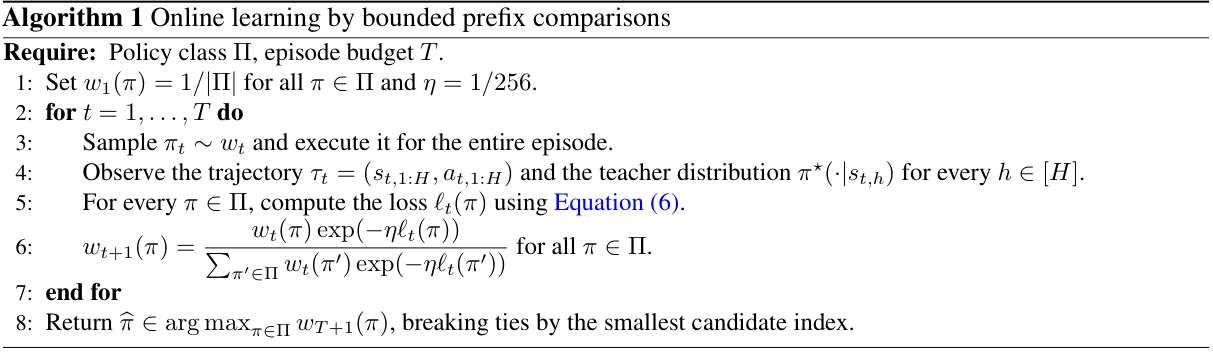
This is an Algorithm 1 excerpt, not an architecture figure. See provenance.
Core equations
The finite reward-free MDP uses shared initial distribution and transition rules. The prefix ratio excludes the current action and multiplies both terms of the difference. Total increments are at most one; the comparison lies in [-1,1]. Initialize uniformly, update at fixed 1/256 and return the largest final weight, breaking ties by smallest index, without querying true risk. A candidate assigning mass outside teacher support fails.
Results reported by the authors
Theorem 3.2 assumes \(\mathbb E_{P^\pi}[K_\pi^2]\le B\mathbb E_{P^\pi}[K_\pi]<\infty\) for all candidates with \(B\ge1\). The high-probability order \(O(B[L^\star+\log(|\Pi|/\delta)/T])\) does not remove constants or \(B\), or establish arbitrary horizon independence. Table 1 compares statistical settings, not experiments. Section 5 leaves practical algorithms and empirical LLM tests for future work. No production A/B.
Local reproduction and limits
bounded_prefix_comparisons, exponential_weights and learn_online implement Algorithm 1; the teacher accepts only visited (step,state) queries, exactly \(H\) per episode. evaluate_exact_moments runs only after training and audits exact moments and minimum fixture \(B\). The CPU fixture has two states/actions, three steps/candidates, a teacher outside the class and 256 complete episodes. Exhaustive trajectory checks compare exact recurrence, chain rule, moments, shared-prefix antisymmetry, Eq.2/6, prefix zero, shared ratio, cumulative clipping, teacher queries and update/ties. Three seeds verify L1, not minimax sample complexity.
PYTHONPATH=src python scripts/run_oct23_priority_components.py \
  --device cpu --seeds 42,43,44 --source-commit COMMIT \
  --frozen-proof oct23-frozen-proof.json --output runs/oct23-cpu-new.json
Scope limits
Limits: up to 64 policies, 16 states/actions/steps and 4,096 episodes. Enumeration costs \(O(T|\Pi|H|\mathcal A|)\) excluding environment sampling. Offline estimation, Hellinger extension, action-feedback lower-bound construction and all LLM training are out of scope. No GPU, data download, capability claim or Evolve promotion.