OpenAttention: Query geometry and count-aware residual tail proxies
L1 single-head attention mechanism; diagnostic only. Full model and custom-kernel performance not reproduced.
Paper information
| Field | Details |
|---|---|
| Paper | OpenAttention: One Percent Is Enough with Tail Proxies |
| Affiliations | First author Hyunwoo Yu; Sogang University, Samsung Electronics and Pusan National University. |
| First public release | 2026-10-22 09:03:08 UTC |
| Author code | hyunwoo137/OpenAttention, Apache-2.0 at 6e43d4fc8c0e95b26d17d198a4545c627b2d6931. |
| Local key | openattention; no adapter |
| Local code | src/auto_research/foundation_models/openattention.py |
| Local evidence | Local mechanism metrics; A100 validation receipt |
What the paper changes
Sparse reads must handle unread KV rows as well as select exact ones. QGC mixes static and conditioning query second moments equally, projects keys as \(KU_r\Lambda_r^{1/2}\) and runs Lloyd clustering. QGS quantizes \(U_r^\top k_i\) coordinatewise to int8 and ranks with the current projected query. Geometry uses prefill-visible queries, not future answers. ErrorGate estimates proxy error per cluster and allocates exact reads by capped water filling.
Original paper figure
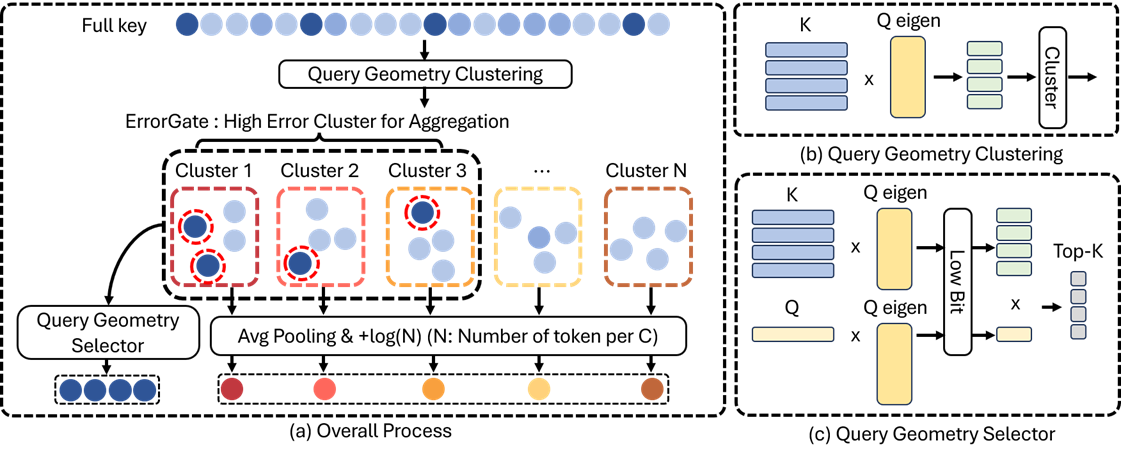
Original figure from the reviewed paper, reused without redrawing. See figure provenance.
Core equations
Round quotas down and spend the remainder on high-scoring clusters with spare capacity. After removing exact rows, recompute residual mean key/value and count \(n_b\); the joint softmax gives the mean value logit \(q^\top\bar k_b/\sqrt d+\log n_b\). The Gaussian/diagonal assumptions are estimates, not exact finite-cluster bounds or optimality guarantees.
Results reported by the authors
Llama-3.1-8B RULER-32K HARD is 86.30 at 1% read versus 87.04 dense. Reported 5–10× decode-attention kernel gains omit some index-scan/setup costs and are not end-to-end service speed. No production A/B or local model result.
Local reproduction and limits
fit_cache, qgs_scores, errorgate, waterfill, residual_proxy_attention and attend execute the single-head chain, directly recomputing residual statistics rather than porting Triton. All-zero error uses equal weights; ties use original position; empty clusters have no proxy. Seeds generate 128 width-16 keys, width-8 values, 24 static/eight conditioning queries, and decode query only after index fit; eight clusters, QGC rank eight, QGS rank 12, 16 exact rows plus 12 detector rows give 28 reads, not 1%. Dense expansion of each proxy checks the log count, all-read/equal-key accuracy, budgets, int8 bound, geometry and signed mean logit. No checkpoint, multi-head serving, dynamic index append, speed or Evolve claims.
PYTHONPATH=src python scripts/run_oct23_priority_components.py \
  --device cpu --seeds 42,43,44 --source-commit COMMIT \
  --frozen-proof oct23-frozen-proof.json --output runs/oct23-cpu-new.json
Full experiment: not reproduced
Full experiments use 7B/8B models, 16K–96K contexts and several budgets/benchmarks; RULER alone uses seven tasks × 200 examples plus kernel comparisons. This exceeds single-device memory/time budget. No weight download, capability probe or automatic retry.