EditJev: System One Routing for Image Editing Models
L1 preference head, pairwise loss and router; diagnostic only. Full image-editing experiments were not reproduced due to cost.
Paper information
| Field | Details |
|---|---|
| Paper | EditJev: System One Routing for Image Editing Models; reviewed full text |
| Affiliations | First author Zhile Guan: Peking University |
| First public release | 2026-10-23 13:46:53 UTC (announced 2026-10-26) |
| Author code | No author EditJev method repository or source license verified. Candidate-editor repositories are not the router source; the paper has an arXiv non-exclusive license. |
| Local key | editjev; no adapter |
| Local code | src/auto_research/system_one/editjev.py |
| Local evidence | Local mechanism metrics; A100 validation receipt |
What the paper changes
Image editors have complementary strengths. Offline, run and judge all candidates and turn reliable quality gaps into pairwise supervision. The router takes the last non-padding hidden state of one image/instruction forward pass and predicts a utility vector in fixed candidate order. At serving time, add a fixed normalized speed prior weighted by beta and select once; candidate editors are not evaluated before choosing.
Original paper figure
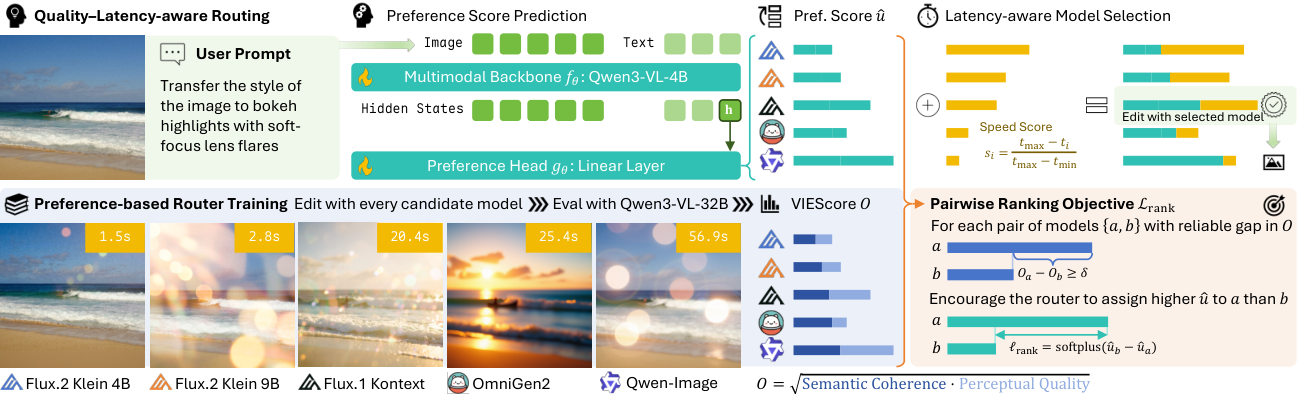
Original figure from the reviewed paper, reused without redrawing. See figure provenance.
Core equations
Reduce pairwise softplus per request before the batch mean, not across all pairs globally. A request with no pair contributes differentiable zero. When all mean latencies coincide the speed formula is undefined; the local interface rejects rather than inventing a policy. Higher beta favors faster models for equal utility.
Results reported by the authors
The authors report ImgEdit 4.592 versus the best fixed editor at 4.540 and GEdit-En 8.255 versus 8.194, with estimated end-to-end latency reductions of 60.8% and 31.7%. These depend on the real backbone, offline judge and candidate pool. No production A/B, local quality score or measured speedup.
Local reproduction and limits
PreferenceHead gathers the last non-padding token for left or right padding and projects it linearly. Qwen3-VL hidden states come from the caller. offline_quality and pairwise_ranking_loss use detached labels only in training; route receives utilities, mean latencies and beta, not judge scores, editor outputs or test gold. Ties follow fixed candidate order. CPU and A100 seeds 42/43/44 check formulas, gradients, interfaces and negative controls with small tensors and no CUDA fallback. No backbone load, editor, LoRA data, judge or Evolve integration.
PYTHONPATH=src python -c 'from auto_research.system_one.editjev import diagnostic; print(diagnostic(42))'
python -m pytest tests/test_oct26_foundation_components.py
Full experiment: not reproduced
The full matrix includes a Qwen3-VL-4B LoRA router, FLUX.2 Klein 4B/9B, Kontext, OmniGen2 and Qwen-Image-Edit (20B), all-candidate offline outputs, Qwen3-VL-32B/GPT judging, 737 ImgEdit plus 606 GEdit-En requests, and ablations. RTX PRO 6000 timings are not local A100 measurements. No model downloads, batch API calls or automatic retries.
