ResCom: Low-rank output compensation from activation rounding residuals
Local status: L1 standalone closed-form calibration; diagnostic only. This is not a full quantized model or a native low-bit kernel. The complete experiment is not reproduced due to cost (review complete), without automatic retries or Evolve promotion.
Paper information
| Field | Details |
|---|---|
| Paper | ResCom: Activation Residual Compensation for Large Language Model Quantization; reviewed v1 full text |
| Affiliations | First author Ning Yang: Institute of Automation, Chinese Academy of Sciences; collaboration with Fudan University, CUHK and UCAS |
| First public release | 2026-10-25 03:02:21 UTC, arXiv v1 |
| Author code | No method repository was found in the reviewed v1 text, appendix or arXiv page. Baseline repositories such as SERQ are not ResCom source. |
| Local key | rescom; standalone component, no adapter or Evolve integration |
| Local code | src/auto_research/foundation_models/rescom.py |
| Entry points | ResidualMoments, fit_residual_correction, diagnostic(seed, device) |
| Local evidence | Three-seed mechanism metrics; A100 validation receipt |
What the paper changes
Low-bit quantization maps distinct activations to the same lattice point. A correction that sees only the quantized value cannot recover differences within that cell. ResCom retains the activation rounding residual \(d=x-Q(x)\) from the current forward pass and compensates for its effect on the output with a low-rank branch. The quantized model, main weights and quantizer stay frozen.
Ranking channels by residual magnitude is not equivalent: even a small residual can be amplified by the main projection. ResCom uses cross-statistics of residuals and output errors to allocate its rank budget for output reconstruction. It solves a regularized reduced-rank regression with an intercept in closed form.
Original paper figure
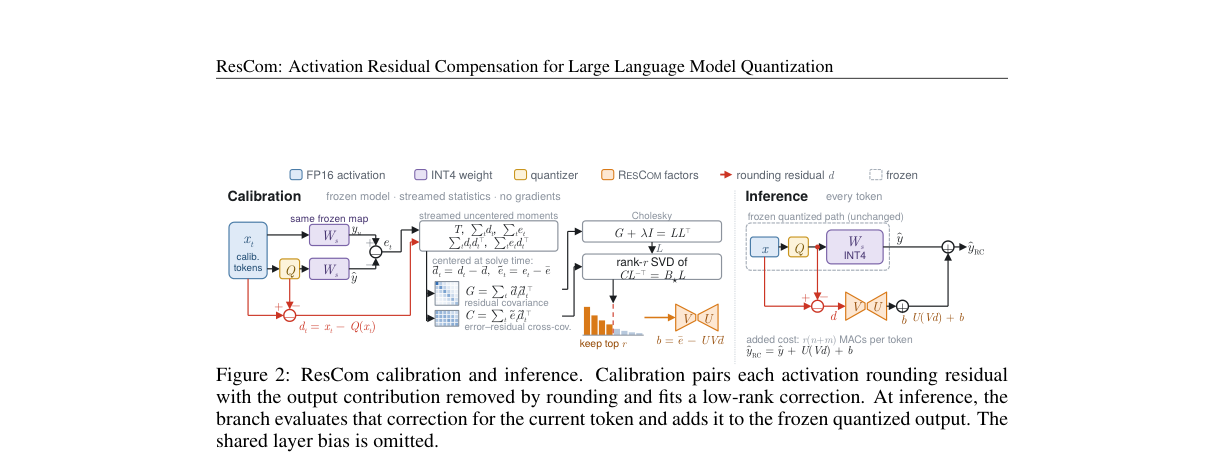
Unredrawn figure from the reviewed v1 paper; see figure provenance for the source, checksum and caption. The quantized model and GPU kernels in the figure are not local integrations.
flowchart TD
    X[Pre-quantization activation] --> Q[Fixed quantizer]
    X --> D[Rounding residual]
    Q --> D
    Q --> Y[Frozen original linear path]
    D --> UV[Fixed low-rank correction]
    UV --> ADD[Add correction and intercept]
    Y --> ADD
    MOM[Collect all layer residual and output statistics first] --> FIT[Cholesky whitening and truncated SVD]
    FIT --> UV
Core equations
Equations 1–3 compare unrounded and rounded inputs passed through the same frozen mapping \(W_s\); the target is not arbitrary whole-layer quantization error:
Center the data and use the unnormalized sums \(G=\sum_t\tilde d_t\tilde d_t^\top\) and \(C=\sum_t\tilde e_t\tilde d_t^\top\). With \(G+\lambda I=LL^\top\) and \(CL^{-\top}=\Phi\Sigma\Psi^\top\), Equation 6 gives
Algorithm 1 collects statistics for every target layer on the same frozen model before any corrections are installed, then installs the branches together. Applying corrections immediately after collecting each layer would alter the targets for later layers.
Results reported by the authors
For Llama-3-8B W4A4 the paper reports WikiText-2 perplexity falling from 7.708 to 7.147 and MMLU increasing by 2.89 percentage points. It also compares models and quantization pipelines. These are author results; the local component does not load those models or claim B200 low-bit speed or memory gains. No production A/B test was reported.
Local reproduction and limits
The component computes stable, mergeable, centered streaming statistics, solves the Cholesky/truncated-SVD system, and applies a fixed \(UVd+b\) branch. The small-scale check preserves output-aware calibration, the rank constraint, the unnormalized statistics and the unpenalized intercept. Plain SVD of \(W\) or ranking by residual magnitude is not a substitute.
The caller supplies residuals and errors from the same frozen quantized coordinate system. There is no SERQ/FlatQuant pipeline, checkpoint conversion, MXFP4, fused kernel or whole-LLM instrumentation. Calibration does not backpropagate into external inputs. Held-out synthetic residuals test the linear mechanism, not LLM generalization.
PYTHONPATH=src python -c 'from auto_research.foundation_models.rescom import diagnostic; print(diagnostic(42))'
export PYTHONPATH=src
python -m pytest tests/test_oct29_foundation_components.py -q
Tests compare the full-rank result with independent ridge regression, merged batch statistics with one-pass statistics, the rank-zero case with the mean, and the intercept with the calibration mean. Two inputs with the same quantized value but different residuals must be distinguishable. Fixed-rank results also retain a separate held-out error check on a linear host. The three seeds measure mechanism repeatability, not formal model performance.
Full experiment: not reproduced
The complete matrix covers 1B–70B models, 128×2,048 calibration tokens, multiple quantization pipelines and downstream tasks, long-context generation, and measurements with B200/native MXFP4. The reported 1B/3B B200 calibration times do not establish the cost of the complete matrix on one A100/A30. Model downloads and the full benchmark and hardware comparison exceed the local short-run budget. No costly trial or automatic retry was scheduled.