ProLand: product-space spectral updates with independent Landing for LoRA
Paper information
| Field | Details |
|---|---|
| Paper | arXiv 2611.00236; fixed v1 full text |
| Original title | ProLand: A New Infeasible Manifold Optimization Method for LoRA Fine-Tuning |
| Company / institution | First author Chenyu Zhou: Shanghai Jiao Tong University; collaborators at SIMIS and Stanford University |
| First publication | 2026-10-30 18:18:00 UTC; found in the official 2026-11-03 announcement, which does not replace the v1 date |
| Author code | No verifiable method implementation found in fixed v1, the abstract page, or method/author searches; not found/not yet released. Muon or other LoRA repositories are not this method's code |
| Local adapter / stable key | proland; adapter: null, no executable Evolve mapping |
| Local code | src/auto_research/foundation_models/proland.py |
| Implementation status | component_only, L1 mechanism diagnostic; CUDA verification is recorded separately in this batch's GPU receipt |
| Full experiment | Too costly, not reproduced (review DONE); not_reproduced_high_cost |
Original paper summary
Background and main changes
LoRA's factors \(\Delta W=BA\) can develop redundant basis directions. ProLand constrains \(B^\top B=I\) without retracting onto the manifold every step. It first forms coordinated spectral directions in the product space of \(BA\), then independently restores feasibility with Landing. Running Muon separately on A and B is not an equivalent algorithm.
flowchart LR
  G[A/B gradients from the same loss] --> M[Reprojected thin-factor momentum]
  M --> C[Polar decomposition of at most 2r core]
  C --> D[Coordinated DA and horizontal DB]
  D --> U[Simultaneous update using old A/B]
  L[Independent Landing: B times Gram error] --> U
Key original-paper figure
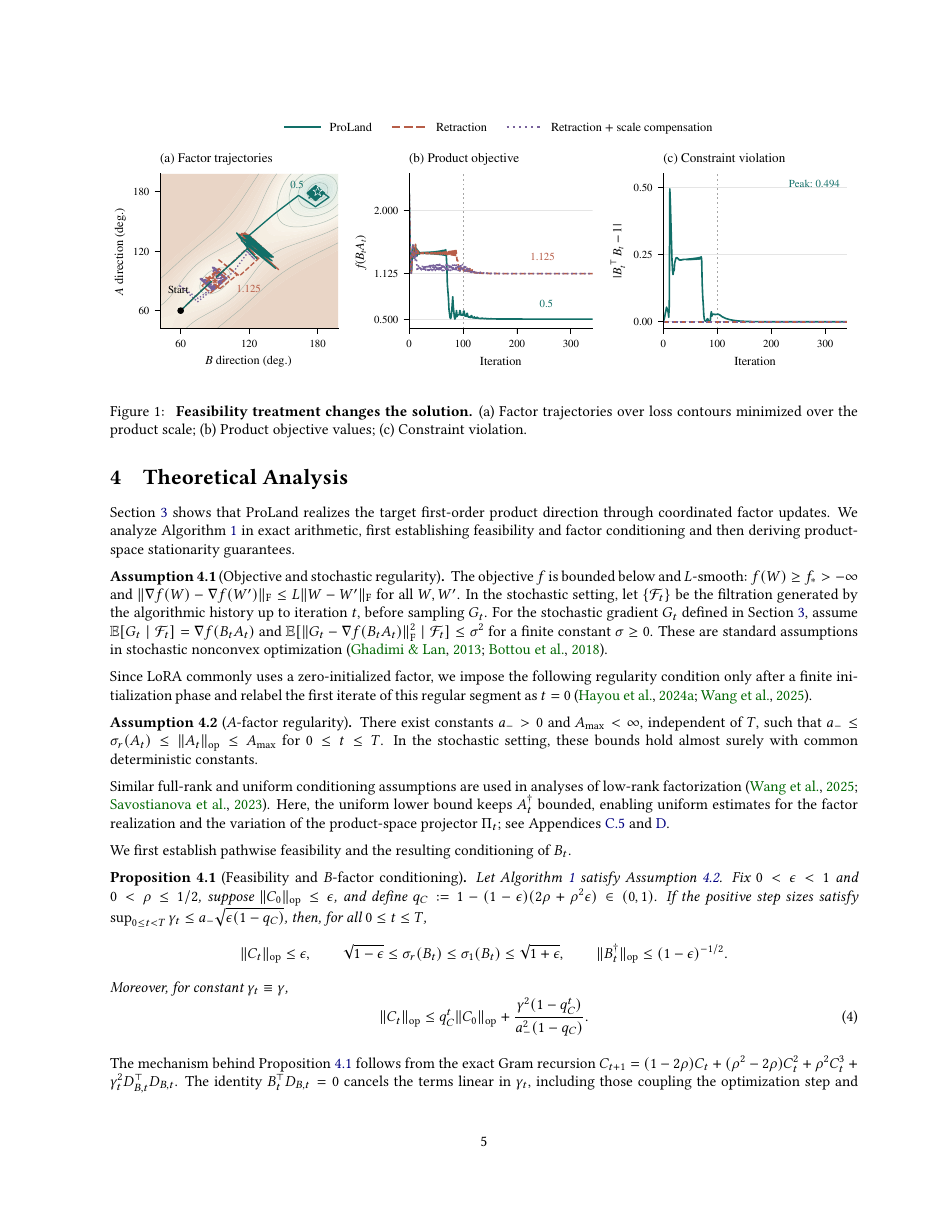
Original-page screenshot from fixed-v1 PDF page 5, preserving Figure 1 and its caption in full without redrawing. It compares Landing and per-step retractions in trajectories, objective values, and constraint violation—not local results. Copyright belongs to the authors. The paper uses the arXiv perpetual non-exclusive license; this does not establish an open image license.
Core equations
With \(P_B=BB^\dagger\), \(P_A=A^\dagger A\), and \(\Pi(Z)=P_BZ+(I-P_B)ZP_A\), momentum and spectral direction are
Both right-hand sides use the old factors; \(\rho\) is not multiplied by \(\gamma\) again. Since \(B^\top D_B=0\), the objective direction does not perturb the Gram constraint to first order. From gradients of the same loss, \(g_A=B^\top G\) and \(g_B=GA^\top\), Algorithm 2 reconstructs momentum of width at most \(2r\). QR and an SVD core no larger than \(2r\times2r\) produce the exact compact polar factor; zero singular directions stay zero.
Reported offline and online evidence
The authors evaluate four GLUE validation tasks on DeBERTa-v3-base and seven language benchmarks on Qwen2.5-3B, Llama-3.2-3B, and Moonlight-16B-A3B, reporting the best average for each tested model/rank configuration. This does not mean every individual task wins. Production online A/B: not reported.
Local reproduction
Implementation and commands
step executes Algorithm 2 using real factor gradients, returning simultaneously updated factors and thin momentum. The caller copies the returned factors into parameters. FP32/FP64 are supported; mismatched shapes, devices, dtypes, nonfinite inputs, and invalid configurations are rejected. No weight decay or pseudoinverse regularization is silently added.
PYTHONPATH=src python -c 'from auto_research.foundation_models.proland import diagnostic; print(diagnostic(42, "cpu"))'
PYTHONPATH=src python -m pytest tests/test_nov04_foundation_components.py -q
Checks and negative controls
The synthetic small-matrix recipe uses \(8\times2\) and \(2\times7\) factors with genuine MSE gradients. Four consecutive steps are checked against dense Algorithm 1. The independent reference uses an eigendecomposition for the polar factor instead of reusing the QR/SVD core. Checks cover momentum reprojection, \(B^\top D_B\), Gram feasibility recovery, objective descent, zero-gradient/zero-Landing identity, and zero cores. A separate test covers one exact rank-deficient step.
This is not public language-capability evaluation. Pseudoinverses may be ill-conditioned near a rank change. Arbitrary-rank equivalence in exact arithmetic does not guarantee floating-point stability at every condition number; tests do not pretend multistep cancellation near rank transitions is exactly zero.
Cost assessment and scope
The paper spans 11 tasks, multiple backbones, ranks, and ablations. Appendix L discloses H100 80GB settings with rank 16, sequence length 512, effective batch 640, 290 updates, and nine primary runs. Available resources are one A100/A30 or a Mac: the full matrix is too costly, not reproduced (review DONE). No checkpoint was downloaded, full training hours measured, or language score/throughput verified.
Local coverage is the optimizer core only: no LoRA-layer installation, production mixed-precision kernel, GLUE data, or model training. There is no automatic Evolve integration or full-paper reproduction claim. CPU checks do not replace a real CUDA receipt.
This batch's unified GPU evidence belongs in the per-seed component metrics and A100 receipt. Their actual completion status is authoritative; this page does not assert success in advance.