HVMap: Mapping and two-space reranking across heterogeneous vector databases
L1 mechanism component: the mapping network, fuzzy contrastive loss, SCORE2 and hub/spoke paths. Small-tensor diagnostics are not semantic retrieval evidence or Evolve promotion.
Paper information
| Field | Content |
|---|---|
| Paper | Federated Vector Retrieval across Heterogeneous VectorDBs; fixed v2 |
| Institution | First author Mintaek Lim: Seoul National University |
| First publication | 2026-11-01 03:47:55 UTC, arXiv v1; reviewed v2: 2026-11-13 05:59:39 UTC |
| Original source code | yoon123seul/HVMap, commit 1fe819a0369b5a2a00bfb535c5755daa15a5d035. Public source has no declared license; local code independently implements formulas rather than copying it |
| Local adapter / key | hvmap; adapter is null; no Evolve integration |
| Local code | src/auto_research/foundation_models/hvmap.py; tests: tests/test_nov18_root_components.py |
Paper summary
Motivation and changes
Different encoders produce incompatible vector spaces. HVMap encodes a query once in a hub, maps it to other spaces, retrieves K candidates independently per database, and reranks their union using mapped candidates. All final K results may come from one database; equal quotas are not required. Sections 3.3–3.5
Original figure
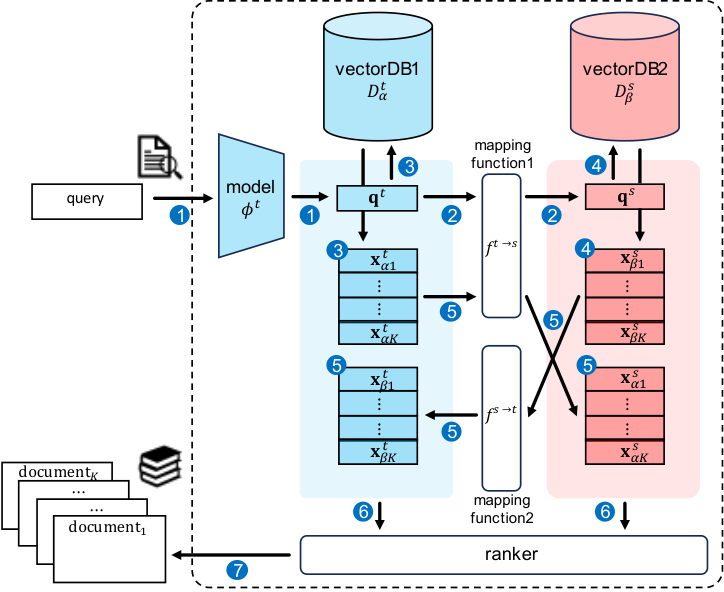
Original Figure 2, copyright belongs to its authors; not a local complete-system result. Source and SHA256.
Image from the original paper; copyright belongs to the original authors.
Core formulas
Four affine layers, three SELUs, hidden width five times the target dimension, and L2-normalized output implement the map. Paired embeddings, not relevance gold, supervise:
The observed matrix is mapped-to-original-target, not mapped-to-mapped RKD. Its diagonal anchors absolute alignment; InfoNCE or hinge is not equivalent. Cosine/L2 are explicit choices; sum matches the formula, while mean is an explicit scaling option.
Retain each candidate's native embedding:
The 0.7 coefficient always weights the candidate database's native space, not always the hub. Multiple databases use spoke→hub→spoke with at most two maps. Local code neither builds ANN indexes nor trains complete multi-database mappings.
Author results
The paper compares retrieval quality, construction time and QPS across heterogeneous encoders, modalities and large databases. These are author measurements, not local small-tensor loss results. Production A/B was not verified; this is admitted as a foundation/retrieval mechanism, not as having passed the industrial A/B gate.
Local implementation
Data and code mapping
HVMap, fuzzy_contrastive_loss, score2, map_via_hub and federated_topk implement the map, loss, two-space score, star path and final merge. Inputs are seeded small tensors and explicit ranking examples. The author dataset and semantic encoders are not downloaded or trained.
PYTHONPATH=src python -c 'from auto_research.foundation_models.hvmap import diagnostic; print(diagnostic(42, device="cpu"))'
Controls and limits
Seeds 42/43/44 check actual forward/backward, unit norms, zero loss at exact alignment, unchanged RKD but increased fuzzy loss after a global sign flip, native weights and no final database quota. Zero/nonfinite vectors and mismatched shapes/pairs are rejected. CUDA checks the same mechanism, not throughput; actual artifacts are stored separately under metrics/.
High-cost full experiments
The original includes roughly 2.5 million pairs, 40 epochs, batch 1792, multiple datasets/encoders and large indexes. Not reproduced due to cost; review DONE. No full download, single-card campaign or automatic retry. An L1 component does not constitute full reproduction.