Multi-layer Indexer: overlapping selection and attention
Paper information
| Field | Details |
|---|---|
| Paper | arXiv 2611.03768; fixed v1 |
| Original title | Multi-layer Indexer: Overlapping Selection and Attention in DeepSeek Sparse Attention |
| Institution | First author Serdarcan Dilbaz: Writer AI Research, Writer Inc. |
| First publication | 2026-11-02 15:46:01 UTC; November 4 is the observed announcement date |
| Author code | Official implementation, found |
| Local key / adapter | multi-layer-indexer; adapter: null, local_operator: null |
| Local code | None; this is review_only, not an executable adapter |
| Status | deferred_high_cost; no local metrics or GPU receipt |
| Full experiment | Too costly, not reproduced (review DONE); not_reproduced_high_cost; no automatic retry |
Original paper summary
Background and main changes
DSA normally scans the index cache, selects top-k and then attends. MLI consumes an earlier full layer's selection while computing a new selection on another CUDA stream. It composes with IndexCache but does not reuse stale selections across generated tokens. See Sections 3/4 and Appendix A.
flowchart LR
 H[Current layer hidden state] --> I[Side stream: current-token new selection]
 H --> A[Main stream: earlier full-layer selection]
 A --> F[Output projection and FFN]
 I --> J[Join at first consumer; hold tensor references]
 F --> J
Key original-paper figure
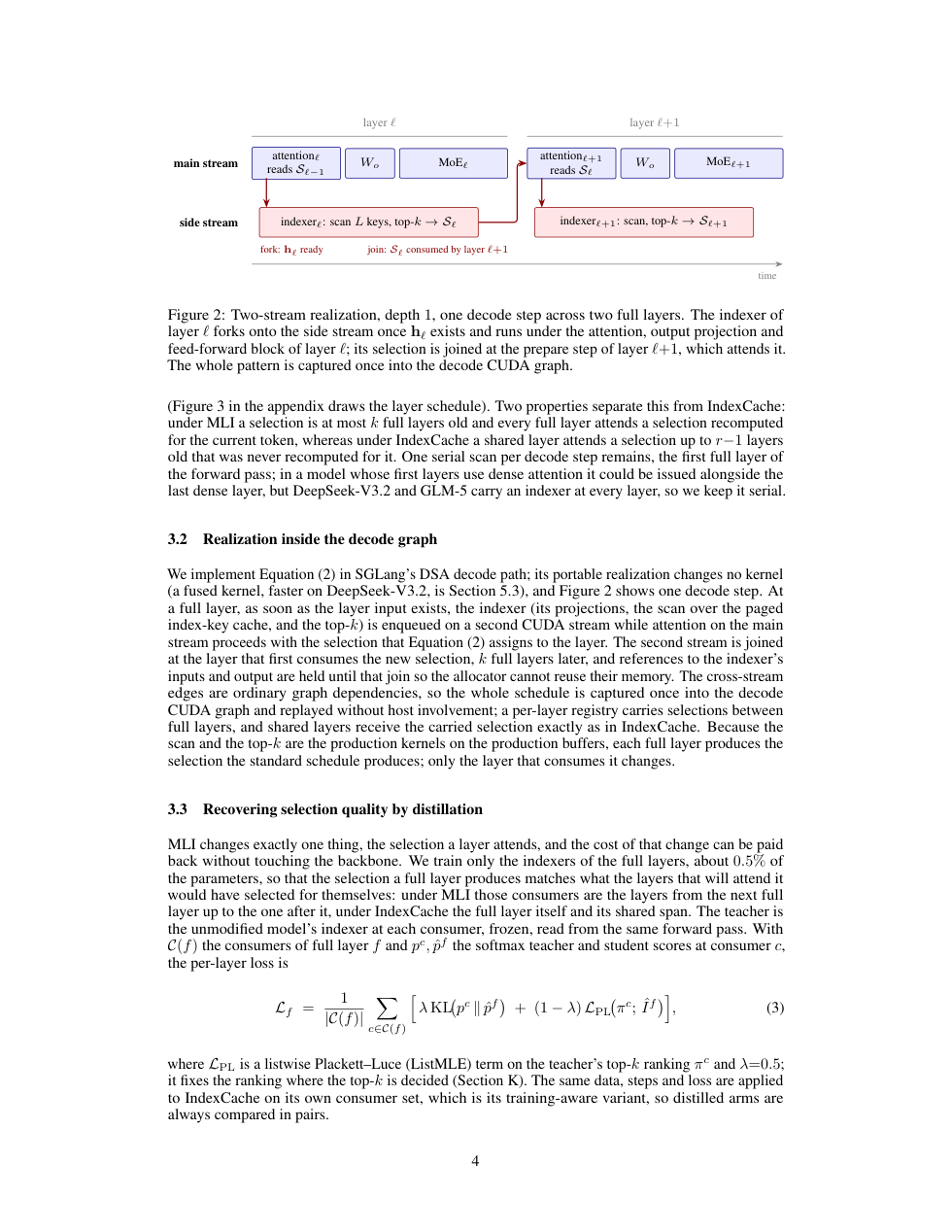
Visually checked screenshot of fixed-v1 PDF page 4, preserving Figure 2's fork/join/consumer order and complete caption. Copyright belongs to the authors; CC BY 4.0. This is not a local execution trace.
Core equation
For retained-indexer layers F, nearest preceding full layer p and k-full-layer predecessor π:
The first k full layers lack a predecessor and follow the standard schedule. The first consumer joins the producer event, keeping input/output references alive against allocator reuse. A dependency diagram alone is not executed CUDA-graph overlap.
Paper results
The paper compares paired serving configurations on fixed nodes and reports decode/quality results. Gains can vanish at high concurrency. These are systems experiments, not business A/B, and not local measurements.
Local disposition
Reviewed and unimplemented
Selection routing, stream lifetimes, IndexCache composition, resources and author code were reviewed. There is no local scheduler, sparse kernel, SGLang installation, synthetic timing proxy or fabricated metric. A constant-latency simulator would not establish production-path behavior.
Cost decision
The experiments use FP8 DeepSeek-V3.2/GLM-5 checkpoints, SGLang v0.5.16, eight H200 GPUs with TP8, 10K-195K contexts and full quality sweeps. A single A100/A30 or Mac cannot reproduce that setup affordably: not reproduced due to cost (review DONE). No model download, probe or automatic retry is launched. Local runtime, metrics, GPU receipts and executable Evolve mappings remain absent.