Anchor: shared KV-state read maps and gates
Paper information
| Field | Details |
|---|---|
| Paper | arXiv 2611.04327; fixed v1 |
| Original title | Anchor: Augmented Cross-Layer Recurrent State for Long-Context Retrieval in Test-Time Training |
| Institution | First author Vimal William: University of Arizona |
| First publication | 2026-11-03 05:07:50 UTC; observed in the November 4 announcement |
| Author code | No verifiable Anchor-author implementation found in fixed v1 or abstract; not found/not released. Referenced Liger/LoLCATs/LaCT projects are not this paper's code |
| Local key / adapter | anchor-kv; adapter: null; no executable Evolve mapping |
| Local code | src/auto_research/foundation_models/anchor_kv.py |
| Status | component_only; external-state writing/read-map/gate L1 component, not complete TTT |
| Full experiment | Too costly, not reproduced (review DONE); not_reproduced_high_cost |
Original paper summary
Background and main changes
Layers may encode related information in different bases. Anchor shares a recurrent state, learns a read map for each reader and gates memory into local SWA output. Interior TTT branches remain during training and are removed only at deployment. See Sections 3.2/4.1 and Appendix C.
flowchart LR
 W[External TTT writer] --> S[One shared state]
 S --> R1[Reader 1 linear map]
 S --> R2[Reader 2 linear map]
 R1 --> G[Input-dependent sigmoid gate]
 L[Local SWA output] --> O[Added output]
 G --> O
Key original-paper figure
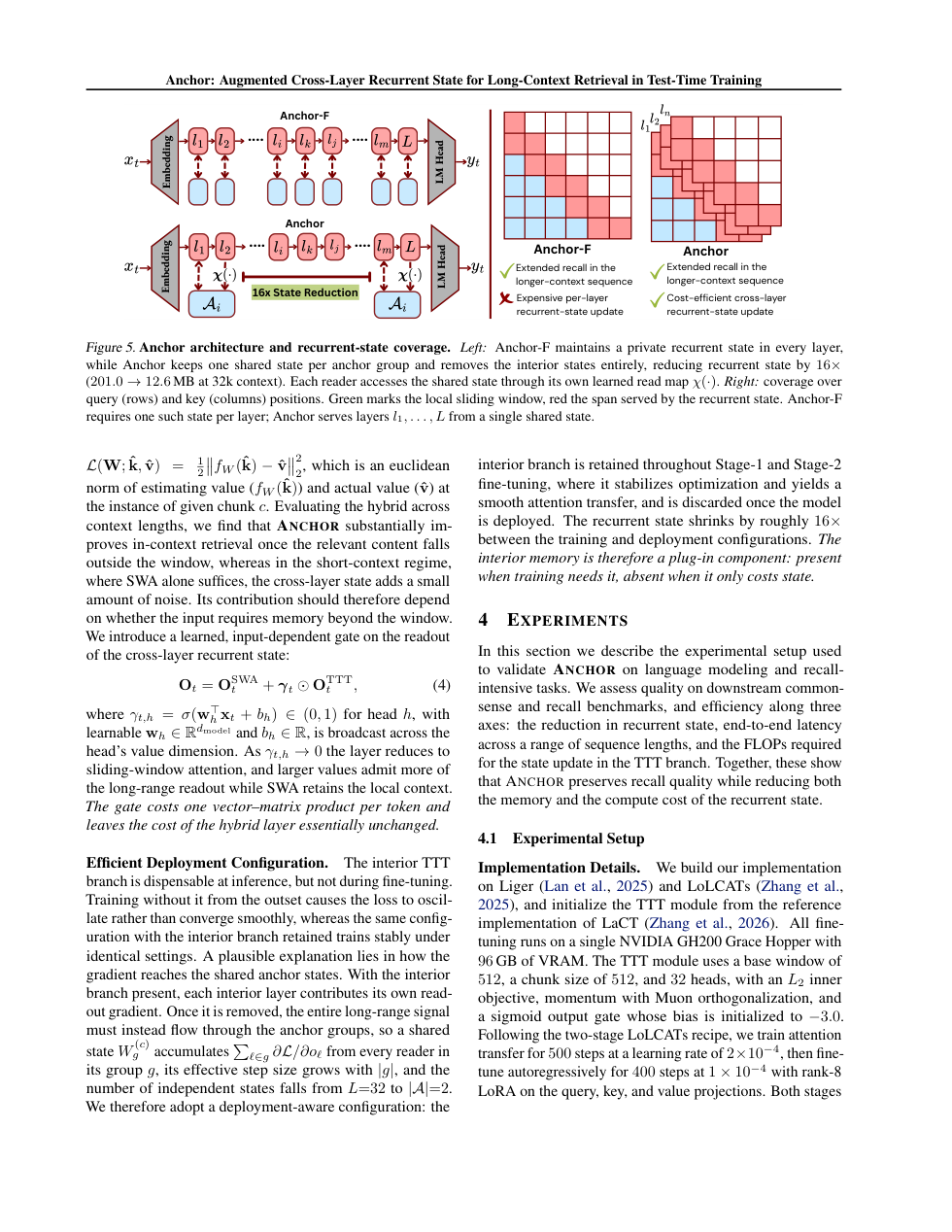
Visually checked original-page screenshot with complete Figure 5 caption. Copyright belongs to the authors. The arXiv perpetual non-exclusive license does not establish an open image license. The illustrated 16-fold change belongs to the paper's configuration, not local measurements.
Core equations
Bias-free reader maps start at identity; the writer retains its own basis. The actual state optimizer uses LaCT-style momentum/Muon. An arbitrary SGD step, mean cache or fixed answer is not a substitute for complete Anchor.
Paper results
The paper reports retrieval/state-efficiency gains on 7B/8B models and notes that memory can add short-context noise, motivating a learned gate. Production business A/B is not reported. No language-model accuracy or speed is remeasured here.
Local component
Implementation and commands
SharedKVReadout accepts externally updated KVState. Only the designated writer may advance its revision. Input buffers are cloned to prevent later caller mutation; outer-loop gradient links are not silently detached. Readers share the state while learning separate identity-initialized linear maps and sigmoid gates.
PYTHONPATH=src python -c 'from auto_research.foundation_models.anchor_kv import diagnostic; print(diagnostic(42, "cpu"))'
PYTHONPATH=src python -m pytest tests/test_nov04b_foundation_components.py -q
Checks and boundaries
The diagnostic uses an explicitly supplied synthetic KV matrix, not LaCT training. It checks equal initial writer/reader outputs, real read-map/gate gradients and preserved old state. Tests reject reader writes and stale revisions, verify a nonidentity basis change and recover local output when the gate is closed. No answer is read or memory capability measured.
Cost decision
The original GH200-96GB study uses Llama-3.1-8B/Mistral-7B, 500 attention-transfer steps, 400 LoRA steps and multiple evaluations: too costly, not reproduced (review DONE). No checkpoints/data are downloaded. LaCT/Muon writing, SWA kernels, inner-loop TTT training and model installation are outside this component. An external writer interface does not certify those algorithms. Actual A100/A30 receipts remain required for the CUDA path; no Evolve or capability claim is made.