Tokenization Premium: matched-content cost and abstention-safe evaluation
L1 CPU arithmetic component. It implements matched-content token ratios, UNK exclusion, and calibration/selective-risk readouts. It does not train the proprietary model or claim to rerun all 31 languages × 7 tokenizers.
Paper information
| Field | Value |
|---|---|
| Paper | arXiv:2611.13441v1; original Zenodo release |
| Institution/company | First author Paulo Câmara: LUA Vision Tecnologia, São Paulo, Brazil |
| Original release | September 22, 2026, Zenodo v1.0. Official API created timestamp: 15:08:28.012501 UTC; publication_date has date precision. ArXiv v1: November 10, 2026, 01:32:16 UTC. The PDF says Version 1.2; arXiv upload is not the first public release |
| Authors' code | Released: Zenodo data.zip, containing measure_udhr_31_languages.py and results.json, CC BY 4.0. Reviewed archive MD5 e624311cbfc5df3138003b9b44499f24. The proprietary architecture is not open and must not be confused with the measurement scripts |
| Local adapter/key | tokenization-premium; adapter null; no Evolve integration |
| Local code | src/auto_research/foundation_models/tokenization_premium.py; tests/test_nov18_data_protocols.py |
Original paper
Motivation and changes
Fine-tuning inherits a base model's tokenizer, knowledge, license and biases. The authors measure the token cost of identical meaning using parallel UDHR text: 31 languages, 7 tokenizers, and 27 common articles. A low count caused by collapsing a script into unknown tokens is not a cost advantage. Section 3
The paper also proposes eight black-box sovereignty audits. An abstaining system should report coverage, selective risk, full-sample calibration and correct answers per joule, not only accuracy on a small retained subset.
Key original table
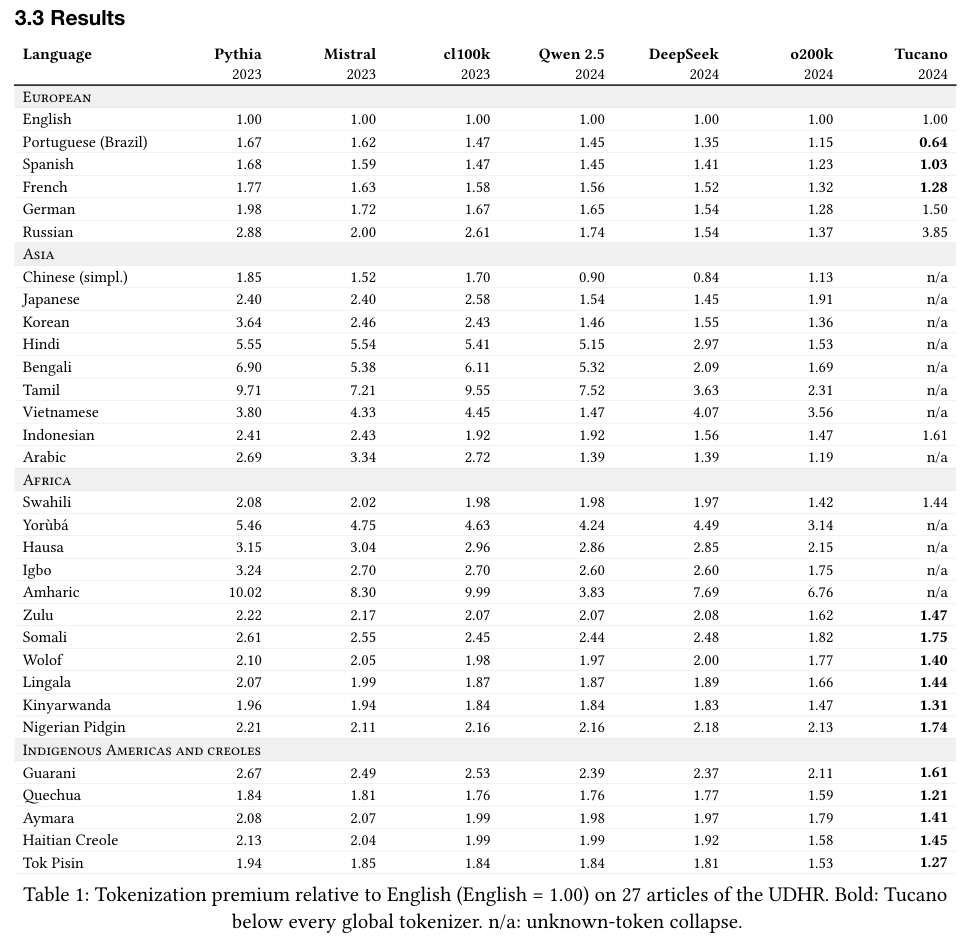
Table 1 and caption, fixed arXiv-v1 PDF page 3, CC BY 4.0. These are the authors' measurements, not local reruns. Provenance and SHA256.
Image from the original paper; copyright belongs to the original authors.
Equations
The same 27 articles are sorted by number, joined with spaces, then encoded once, following the authors' public script. This is neither the mean of per-article ratios nor necessarily the sum of separately encoded article counts. Default articles are 1, 2, 4, 5, 7, 8, and 10–30.
ECE uses all items, not only high-confidence answers. Correct answers per joule requires energy measured over the full evaluation, including abstained items. At zero coverage, risk is unavailable, not fictitiously zero.
Paper results
Table 1 reports an Amharic premium up to 10.02 for an older tokenizer and 6.76 for o200k. Tucano's non-Latin-script UNK-collapse cells are n/a. Small internal calibration results for a proprietary architecture are not a full public benchmark or general evidence of multilingual gains. No production A/B is reported.
Local component
Inputs and code
measure_aligned_texts receives caller-provided parallel articles and a tokenizer callable, joining and encoding once; it downloads no weights. tokenization_premium only reads supplied totals and cannot establish boundary consistency itself. Any UNK conservatively makes a cell unavailable: the paper specifies no universal threshold, and local code invents none. selective_audit consumes external confidences, independently evaluated correctness, and full-run energy. It is a scorer, not a selection policy that reads gold.
PYTHONPATH=src python -c 'from auto_research.foundation_models.tokenization_premium import diagnostic; print(diagnostic(42, device="cpu"))'
Controls and limits
Checks cover total-ratio versus mean-ratio, cross-article merges, misleading UNK costs, unchanged all-item ECE under abstention, and coverage/energy denominators. Constructed arithmetic is not a 31-language experiment. No hardware energy is measured; the eight audit data-collection procedures and AURC curves are not fully implemented.
Full experiment status
The 31×7 tokenizer/corpus campaign is out of this component's scope; it is not arbitrarily labeled high-cost. The proprietary architecture and internal tasks are unavailable, so the full model experiment is not reproduced, review DONE. Public scripts/data and proprietary-model reproducibility are recorded separately, with no automatic retry.