REAL Loss: train a speculative drafter on actual accepted branches
L1 differentiable loss component, not a model or serving reproduction. The reference checks path estimation, Rao–Blackwellization, gradients, and masking. The expensive full study is not reproduced (review DONE).
Paper information
| Field | Value |
|---|---|
| Paper | arXiv:2611.14399v1; fixed text |
| Institution | First author Yu Tian: The University of Hong Kong |
| Original publication | November 10, 2026, 17:45:12 UTC; November 11 announcement. This is a same-announcement discovery gap, not a November 12 first release |
| Authors' source code | Reference branch, with EAL implementation and counterexample tests checked at commit 3dff4579c5f93f692108df8b5178c9e9200b8536 |
| Local adapter/key | real-loss; adapter=null; no Evolve integration |
| Local code | src/auto_research/foundation_models/real_loss.py |
Original paper
Motivation and changes
An accepted token determines the prefix verified next. Multiplying marginal acceptance rates, as in the WTV surrogate, uses target-distributed branch proportions for later acceptance. It can omit the covariance between accepted-branch weight and subsequent difficulty, even reversing the gradient.
REAL preserves propose-and-accept mass along trajectories sampled from a frozen target and analytically marginalizes the final step in each prefix term. It replaces the loss, not the drafter architecture or verifier. Target sampling is an estimator assumption; arbitrary draft trajectories cannot be substituted unchanged.
Key original figure
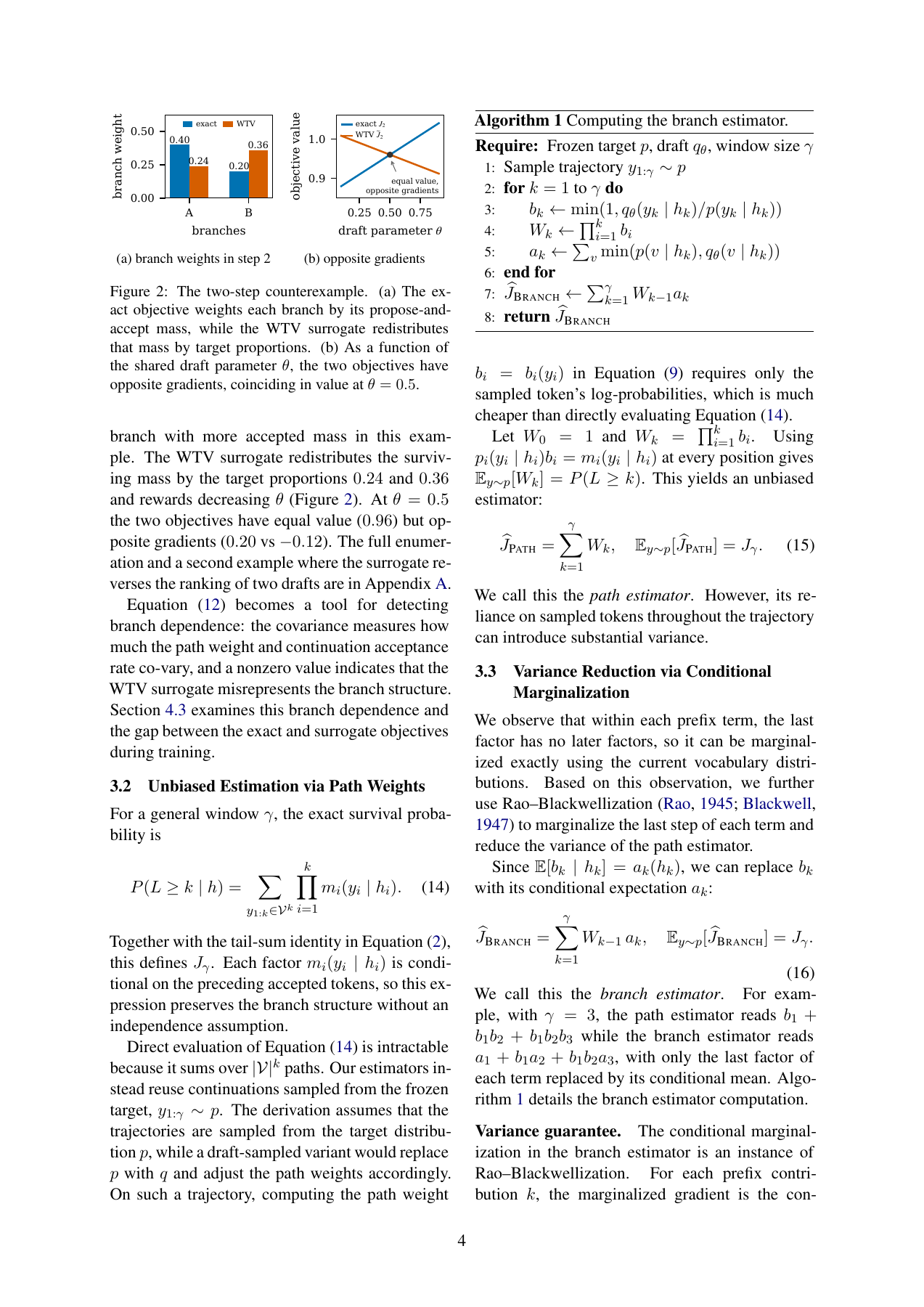
The complete PDF page 4 is rendered without content changes. Copyright remains with the authors. Its derivation and experiments are not local model-training results.
Equations and flow
For target p, draft q, and a target-sampled trajectory, define:
The training ratio is q/p, opposite to serving acceptance p/q on draft proposals.
Both prefix weights and overlap retain draft gradients; target probabilities are detached. EOS itself is acceptable, later positions are masked, and masks must be prefix-contiguous. The divisor stays at fixed gamma, not the random valid length. EAL here excludes the serving acceptance-length bonus token.
flowchart LR
  A[Frozen target trajectories] --> B[Clipped q over p weights]
  A --> C[Full-vocabulary overlap]
  B --> D[Prefix weights]
  C --> E[Branch EAL with last-step marginalization]
  D --> E
  E --> F[Fixed-window normalization plus CE]
  F --> G[Update drafter only]
Paper results
The study compares losses with a Qwen3.6-35B-A3B target and Domino drafter across nine task subsets, five sampling seeds, and three repetitions per seed under probabilistic and greedy serving. Its main claim concerns probabilistic acceptance length, not a universal gain under greedy proposals. No production-traffic A/B is reported.
At theta=0.5, the paper's two-token counterexample gives both objectives value 0.96, but gradients +0.20 for the exact objective and −0.12 for WTV. Equal values need not imply equal optimization directions; this independently enumerable example is the local negative control.
Local component
Data contract and code
eal_terms consumes external [blocks, gamma, vocabulary] logits, target-sampled tokens, and prefix masks, returning path, branch, WTV, and CE terms. real_loss implements Eq.19. The code neither calls a target nor creates genuine training trajectories. A token tensor cannot prove its sampling provenance; that remains the caller's responsibility with real data receipts.
PYTHONPATH=src python -c 'from auto_research.foundation_models.real_loss import diagnostic; print(diagnostic(42, device="cpu"))'
PYTHONPATH=src python -m pytest tests/test_nov12_foundation_components.py -q
Evidence and limitations
CPU diagnostics at seeds 42/43/44 check exact tree enumeration, path/branch expectations, the gradient reversal, non-detached prefix gradients, frozen targets, post-EOS masks, and fixed gamma. Independent finite-difference gradcheck covers random small tensors. These are not acceptance-length, throughput, or task-quality measurements.
CUDA diagnostics at seeds 42/43/44 passed on a real NVIDIA A100; see the GPU receipt and three-seed metrics. The receipt binds frozen execution sources and the actual device. This remains L1 verification of small-tensor losses and gradients, not large-model training or serving capability, and cannot promote an Evolve candidate.
Full experiment not reproduced
The original study trains Domino from scratch for about 140K steps using continuations regenerated by a 35B-A3B target, multiple losses, nine subsets, and repeated serving evaluations. Appendix E records approximately 845 ms per REAL step. Extrapolating 140K steps gives roughly 33 hours for one recipe in the authors' environment, not a measured local A100 runtime, excluding the other recipes and full evaluation. This exceeds the short single-A100/A30-or-Mac budget: too costly; not reproduced (review DONE). No model/data download or cost probe was attempted; automatic retry and implementation queues are disabled.