Smart Model Routing: accounting for overhead, traffic skew and conditional quality
CPU L1 cost/policy arithmetic; diagnostic only. This is not a trained router and makes no model requests. “10×” is conditional analysis, not a local or production gain. Full model/API and cross-task campaigns are not run; the high-cost full matrix is explicitly not reproduced.
Paper information
| Field | Value |
|---|---|
| Paper | arXiv:2611.15911v1; fixed PDF |
| Original title | Smart Model Routing for Order-of-Magnitude LLM Cost Reduction |
| Institution/company | First author Hesham Elbakoury: Independent Researcher, as stated in the paper |
| Original publication | November 11, 2026, 19:13:21 UTC, arXiv v1. The cover separately says September 2026; that is not substituted for the verifiable arXiv release timestamp |
| Authors' code | Public: coauthor Deep Shah's llm-routing-formula-validation, linked in fixed v1 Section 5.1/reference [10], with GSM8K traces, accounting and follow-up. Referenced RouteLLM/FrugalGPT are not substituted for this author release |
| Fixed upstream version | 26e0ebd288a7e48fe8cf5ec97fe7f2d8a143d7ac; only public metadata/README inspected, no external code executed |
| License | GitHub reports no declared code license, so no source is copied; local formulas are independently implemented. Original figure copyright remains with its authors under the arXiv perpetual non-exclusive license, not an asserted open redistribution license |
| Local adapter/key | smart-model-routing; adapter=null, promotion_eligible=false, evolve_integrated=false |
| Local code | src/auto_research/foundation_models/smart_model_routing.py: shadow_price_tier, cost_reduction, cascade_cost, two_stage_breakeven, cascade_quality |
Original paper
Motivation and changes
This paper studies application-level selection among complete models/endpoints, not token-to-expert MoE routing or load balancing between replicas. Costs include the router, checker, discarded cheap-model calls and the additional tokens in difficult requests.
Calibration is not discrimination: predicting 90% cheap-model correctness for every identical-looking request can be perfectly calibrated without identifying failures. With 99% frontier quality and a 98% target, at least 8/9 of requests must still use the frontier tier. An aggregate quality floor can also hide harm to particular languages or difficult subgroups.
Architecture and protocol
flowchart LR
  X[Request and observable features] --> Q[Validation-calibrated quality estimates]
  Q --> R[Cost minus shadow-price times quality]
  R --> A[Select complete-model endpoint]
  X --> C[Alternative: cheap model answers first]
  C --> V[Checker and overhead]
  V -->|reject| F[Stronger model handles residual requests]
  V -->|accept| Y[Return answer]
  A --> Y
  F --> Y
Core equations
Equation 7 chooses, for a fixed shadow price,
\(\lambda\) has cost/quality units and must be selected on validation data to satisfy the constraint. A supplied value does not automatically guarantee quality. Inputs are predicted qualities, not a request's held-out gold answer.
With equal per-request costs, Equation 4 gives \(R=\rho/[1+(\rho-1)\phi]\). If frontier-routed requests use \(\tau\) times the tokens, Equation 5, extended here with router overhead \(r\) in cheap-call units, gives
A two-stage cascade requires the complete path cost:
Equality only breaks even. For K stages, reach probabilities \(P_i=\prod_{j<i}(1-a_j)\) weight each stage's cost. Quality uses conditional accepted/residual subsets: \(Q=a q_A^{acc}+(1-a)q_B^{rej}\). Unconditional model accuracy cannot replace quality on rejected hard requests.
Reported results and limits
The headline magnitude depends on stated pricing and traffic assumptions, not current product quotes. Section 5.1 evaluates a Luna-to-Sol cascade on 200 GSM8K development and 1,319 held-out questions: 2.19× lower cost including the checker, with 97.95% versus 97.88% accuracy. The +0.08pp difference interval [-0.15,+0.38] does not establish improvement. Omitting the checker inflates savings to 2.70×; substituting overall for residual fallback quality overstates accuracy by 0.97pp. Costs are reconstructed from traces, not reconciled invoices. There is no production A/B.
The same repository's learned-router follow-up is negative: 96.28% versus 96.32% for cost-matched blind mixing on 2,500 fresh questions, with difference interval [-0.38,+0.22]pp. In Section 5.2's independent CPU test, no learned candidate passes calibration, so the frozen policy falls back to a fixed 3B model: 67.19% quality at 1.00× cost, below the 90% target. Fail-safe fallback is not a routing gain. At 2% frontier traffic and a 25× price ratio, long hard requests invalidate a naive 16.9× claim: the \(\tau=100\) counterexample gives only about 1.46× before router overhead.
Key original figure
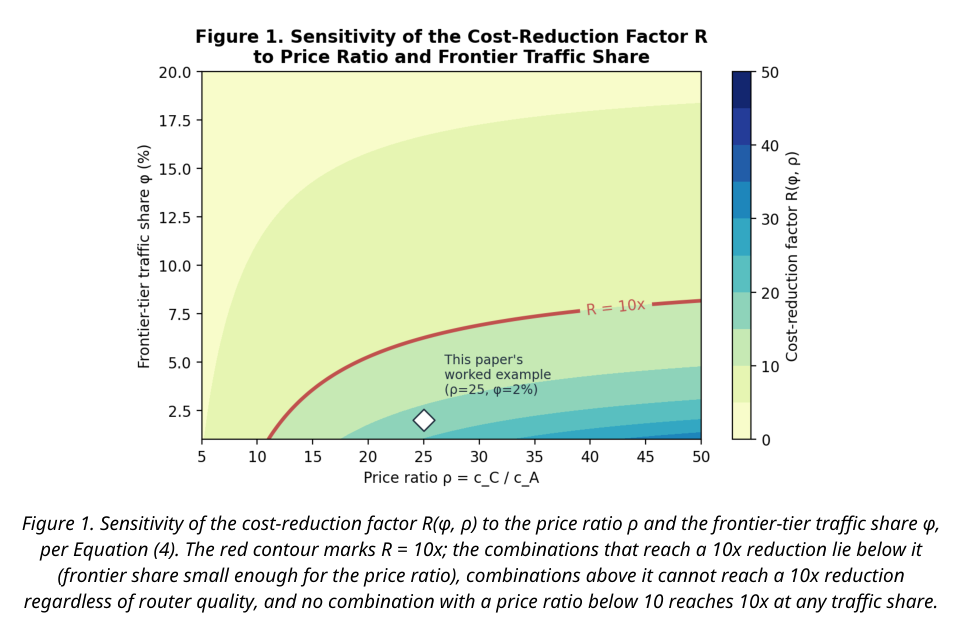
Fixed v1, page 13, Figure 1 with its original caption, not redrawn. The plotted equal-cost Equation 4 must not erase Equation 5's token-skew caveat. Copyright remains with the authors under the arXiv non-exclusive publication license. Source and SHA256.
Image from the original paper; copyright belongs to the original authors.
Local implementation
Data contract and mapping
The module implements the shadow-price argmin, input/output token prices, minimum frontier share, token-skew correction, K-stage cascade cost, strict two-stage breakeven and conditional quality sums. Terminal acceptance must be one; negative costs, non-finite values and invalid probabilities are rejected. Shadow prices are not selected on test data, and no gold-answer input exists. It does not estimate quality, train difficulty classifiers, call providers or fabricate checkers.
PYTHONPATH=src python -c 'from auto_research.foundation_models.smart_model_routing import diagnostic; print(diagnostic(42, device="cpu"))'
PYTHONPATH=src python -m pytest tests/test_nov18_eval_protocols.py -q
Checks and evidence boundary
Checks cover overhead increasing costs, token skew reducing apparent gains, equality not constituting savings, residual-conditional rather than unconditional quality, and a calibrated-but-nondiscriminating counterexample. Fixed teaching arithmetic is not model training or a capability ranking; actual three-seed records are component diagnostic artifacts. REQUIRES_GPU_VALIDATION=False; there is no CUDA path.
High-cost full experiment
The analytic formulas are implemented and are not themselves labeled expensive. Offline analysis of the authors' public traces is also inexpensive, but is outside this round's independent-formula execution scope and is not claimed complete. Recollecting pilot/follow-up answers, checks and retries requires thousands of paid calls; Section 5.2 additionally runs 0.5B/1.5B/3B CPU models. The complete collection/inference and wider task matrix exceeds this short-run budget and is not reproduced due to cost (review DONE). The complete GSM8K pipeline was not attempted; arithmetic examples are not a benchmark pass receipt.