DuoJEPA: translate within target spaces instead of forcing coincidence
L1 mechanism component. Two target-space CLS InfoNCE terms and one single-head skipless image translator with its initialization. No full LeJEPA, text translator, patch term or distributed pretraining.
Paper information
| Field | Value |
|---|---|
| Paper | arXiv:2611.15968v1; fixed text |
| Institution/company | Mahmut S. Gokmen: Kentucky Center for Digital Innovation, University of Louisville |
| Original release | November 11, 2026, 20:10:52 UTC; announced November 13. An announcement backfill, not a November 15 first release |
| Authors' code | No released original DuoJEPA repository found in fixed v1, arXiv resources or author links |
| Local adapter/key | duojepa; adapter null; no Evolve integration |
| Local code | src/auto_research/foundation_models/duojepa.py; tests/test_nov15_foundation.py |
Original paper
Motivation and changes
Each encoder retains its LeJEPA space. A single translator layer maps into the other modality's own space. The objective is computed there, without directly comparing own embeddings across modalities. Both encoders nevertheless train jointly; no direct alignment term does not mean independent optimization. Residual translators permit an identity shortcut, so only the translator loses both residual additions. Section 5
Key original figure
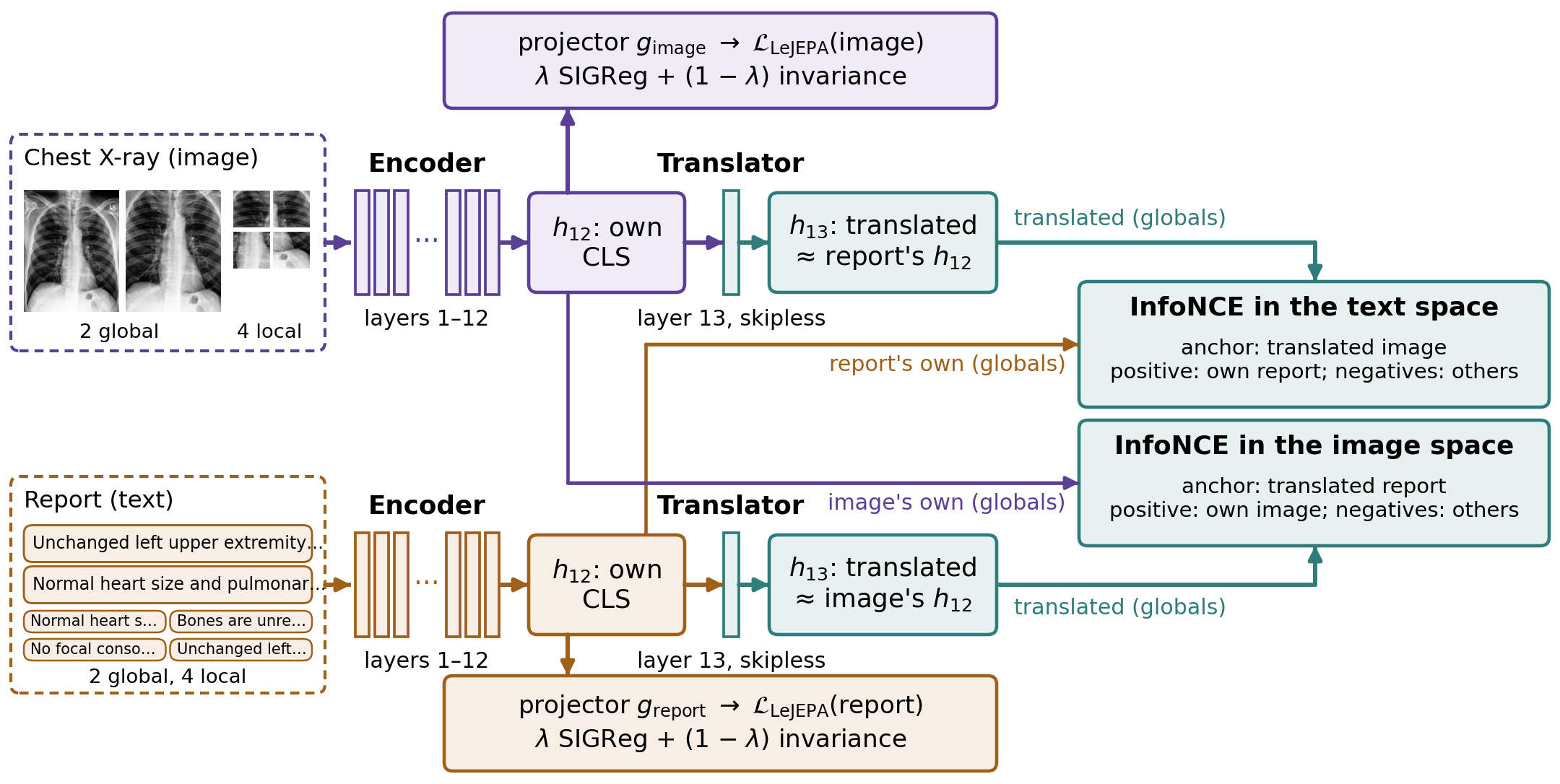
Original fixed-v1 Figure 3 PNG, not redrawn; authors retain copyright under the arXiv perpetual non-exclusive license. The full dual-tower training was not run locally. Provenance.
Equations
Let \(u(x)=LN(x)/\|LN(x)\|\), with nonlearned LN. In target space \(m\), translated anchors come from the other modality. The positive is the normalized sum of the same sample's normalized global views:
Losses from both spaces are added. Target centroids also receive gradients; replacing them with EMA/stopped targets changes the method.
The image layer is \(y=\gamma_1\odot Attn(LN_1(x))\), followed by \(x'=\gamma_2\odot MLP(LN_2(y))\), with neither \(x+\) nor \(y+\). Initialization uses \(W_QW_K^T=2Z+0.6I\), gain-three orthogonal V/O, orthogonal MLP matrices and zero biases. Local code explicitly adopts row-vector matrix conventions and one head. Section 5.2–5.3 and Appendix A
Paper results
The authors compare classification/retrieval, residual versus skipless layers, and target detachment on radiograph/report and optical/radar data. Unaligned own spaces can support cross-modal tasks; arbitrary shallow mappings are not guaranteed to do so. The planted-rotation illustration is not evidence about trained medical-model geometry. There is no production A/B, nor local AUC/retrieval measurement.
Local component
Inputs and code
target_space_loss accepts external [batch,global_views,width] own/translated CLS tensors with within-batch negatives, correct positive identities and gradients on both sides. SkiplessTranslator implements only a pre-norm single-head image path. There are no ViT/BERT backbones, LeJEPA projectors, cross-device gather, patch-neighborhood term, datasets or augmentations.
PYTHONPATH=src python -c 'from auto_research.foundation_models.duojepa import diagnostic; print(diagnostic(42, device="cpu"))'
Controls and limits
One backward pass checks both target gradients and translator gradients. QK matches its initialized product. Zeroing the last layer makes output exactly zero, excluding a hidden identity route. A paired permutation preserves loss; shuffling targets alone does not. See the GPU receipt and three-seed artifact. These controls do not train complete spaces or demonstrate retrieval from unaligned representations.
Full experiment not reproduced
Table 8 reports satellite training for 100k steps/batch256 on two H200s in 28h49m; radiograph/report training uses 20k steps/batch128 on two H200s in 2h34m, plus ablations. Too costly; not reproduced (review DONE). No images, reports or weights are downloaded, no complete matrix is attempted, and no automatic retry is queued.