UniGraph: A Unified Graph-based Index for Dynamic Hybrid Dense-Sparse Vector Retrieval
L1 bounded mechanism component, not a capability benchmark or Evolve promotion.
Paper information
| Field | Content |
|---|---|
| Paper | UniGraph: A Unified Graph-based Index for Dynamic Hybrid Dense-Sparse Vector Retrieval; fixed v1 |
| Institution | First author Keyu Chen: Tongji University; fixed-v1 byline checked |
| First publication | 2026-11-16 09:06:58 UTC, arXiv v1 |
| Original source code | No publicly verifiable paper-specific author implementation found in the fixed paper and linked sources. Cited dependencies or integration claims are not verified paper-specific code. |
| Local adapter / key | unigraph; adapter is null, not a complete model |
| Local implementation | src/auto_research/foundation_models/unigraph.py |
Paper summary
Motivation and changes
Separate dense/sparse retrieval can prematurely discard vectors that are strong only under their combined distance. UniGraph takes neighbors under multiple sampled alpha values and frequency-merges them into one bounded-degree graph. Queries traverse it with their own alpha without rebuilding. Sparse or dense guides supply entry points to reduce hybrid-distance work near the target region.
Original figure
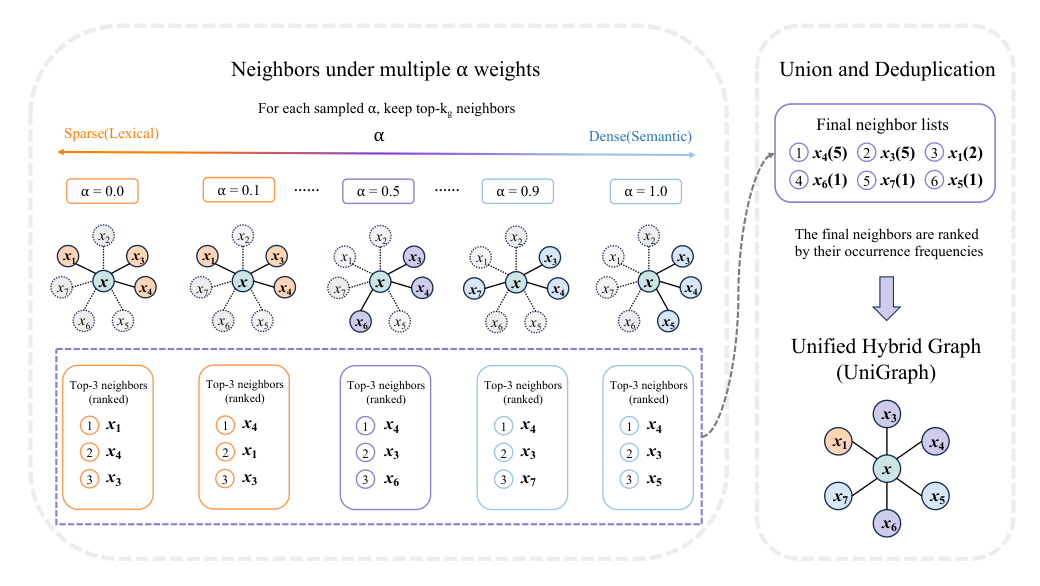
Image from the original paper; copyright belongs to the original authors. Original asset/PDF crop, not local results. Provenance and SHA256.
Core formulas
Algorithm1 takes top-kg neighbors peralpha and retainsM by occurrence frequency. Algorithm2 maintains candidate and ef-sized result sets under query-specific hybrid distance. Dense-first pruning uses a Cauchy–Schwarz norm bound to avoid some sparse inner products: gamma=1 is a safe lower bound, while gamma<1 is a more aggressive estimate without that guarantee. Main experiments usegamma=0.3; local controls usegamma=1 against unpruned beam results. The guide is dense abovealpha0.5 and sparse otherwise;0.5 is the paper’s comparable-scale convention.
Author results
On five datasets with2.68M–8.84M vectors, mixedalpha in[0.3,0.7] and Recall@100≥0.95, SectionV reports27.6%–52.3% higher QPS than the fastest baseline. These measurements depend on large-memory CPU indexes and construction/query settings, not the local24-vertex graph. No production A/B is reported.
Local implementation and boundaries
Data protocol and code mapping
Exact all-pairs construction and exact guide lookup are finite diagnostic backends, not the scalable C++ candidate builders. BGE-M3 encoding, SINDI, million-vector indexes and QPS comparisons are absent. Safe pruning is relative to the same beam insertion rule and does not imply globally complete ANN recall; gamma<1 retains explicit risk. The full campaign is not reproduced due to cost.
PYTHONPATH=src python -c 'from auto_research.foundation_models.unigraph import diagnostic; print(diagnostic(42, device="cpu"))'
Results, controls and limits
L1 bounded mechanism component, not a capability benchmark or Evolve promotion. Seeds42/43/44 check explicit fixtures/small-tensor arithmetic and gradients, not three independent model-capability trials. CPU and actual GPU evidence remain separate. Author scores must not populate local dashboards.
High-cost full experiments
2.68M–8.84Mvector indexes,1024dense dimensions and full Recall/QPS matrix exceed short diagnostic budget; no empirical speedup claimed Not reproduced due to high cost; review DONE. No automatic training/retry queue and no blocking of declared review closure.
Same-topic comparison
HVMap learns representation mappings across heterogeneous databases. UniGraph does not learn a new mapping; it retains dense/sparse components and changes neighborhoods across weights. SCORE2 native/mapped weights and UniGraph semantic/lexical alpha have different meanings and are not interchangeable.