SIMQ: A Single Graph-based Index for Multi-Vector Query
L1 bounded mechanism component, not a capability benchmark or Evolve promotion.
Paper information
| Field | Content |
|---|---|
| Paper | SIMQ: A Single Graph-based Index for Multi-Vector Query; fixed v1 |
| Institution | First author Yifan Lu: Tongji University; fixed-v1 byline checked |
| First publication | 2026-11-17 02:01:39 UTC, arXiv v1 |
| Original source code | No publicly verifiable paper-specific author implementation found in the fixed paper and linked sources. Cited dependencies or integration claims are not verified paper-specific code. |
| Local adapter / key | simq; adapter is null, not a complete model |
| Local implementation | src/auto_research/foundation_models/simq.py |
Paper summary
Motivation and changes
ColBERT-style MaxSim matches every query token to document tokens. SIMQ samples initial aggregation points, assigns residual tokens through a temporary graph, recursively splits oversized clusters, normalizes their means and builds one centroid graph. Queries navigate to a few centroids, collect documents through membership maps and access original tokens only for exact candidate reranking, avoiding a full query-by-centroid matrix.
Original figure
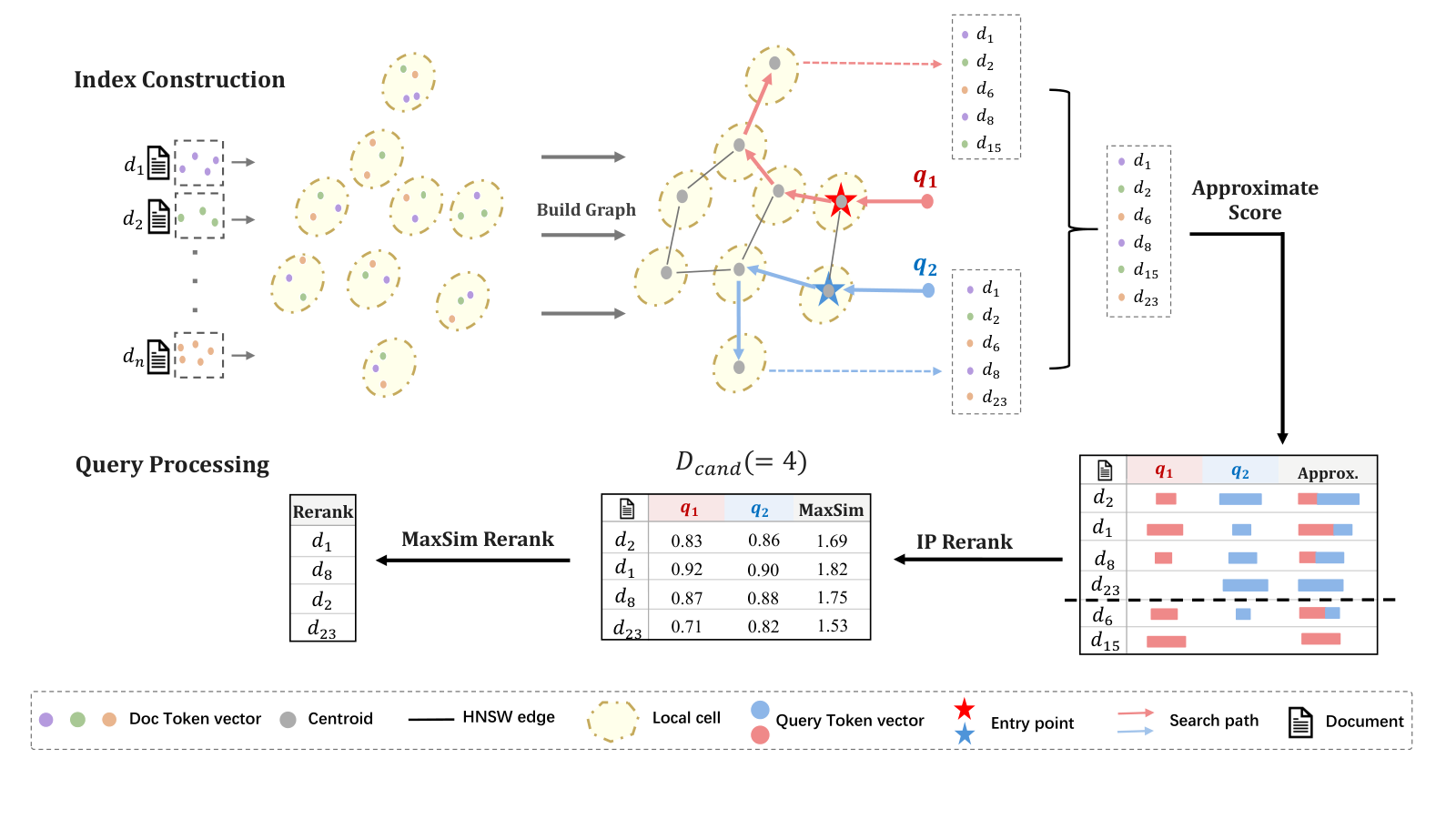
Image from the original paper; copyright belongs to the original authors. Original asset/PDF crop, not local results. Provenance and SHA256.
Core formulas
SectionIII/Algorithms1–2 retain sampling, graph-guided assignment, deferred splitting, normalized centroids, token-wise candidates and exact MaxSim reranking. SIMQ+ in SectionV/Algorithm3 counts distinct document membership in each raw token pool without TopDocs truncation. All boundary-count ties are retained, so the pool may exceedNmin. The local Index uses exact finite kNN graph construction and bounded Lloyd splitting instead of scalable HNSW/VSAG backends; this is an explicit small-data deviation, not an industrial build/QPS reproduction.
Author results
SectionVI compares recall–QPS and construction cost against PLAID, MUVERA, IGP and GEM across five public retrieval datasets. There is no parameter- and recall-independent universal speedup. Alternative graph backends produce different quality/throughput trade-offs. No production A/B is reported. Twelve random local documents test assignment, counting and reranking invariants only.
Local implementation and boundaries
Data protocol and code mapping
No ColBERT encoder, million-token index, residual compression, full HNSW or fair throughput experiment is supplied. Repeated seeds do not turn random vectors into semantic evaluation. SIMQ+ preserves the complete boundary tie group, so the rerank argument is not its hard candidate cap. The full five-dataset campaign is not reproduced due to cost(reviewDONE).
PYTHONPATH=src python -c 'from auto_research.foundation_models.simq import diagnostic; print(diagnostic(42, device="cpu"))'
Results, controls and limits
L1 bounded mechanism component, not a capability benchmark or Evolve promotion. Seeds42/43/44 check explicit fixtures/small-tensor arithmetic and gradients, not three independent model-capability trials. CPU and actual GPU evidence remain separate. Author scores must not populate local dashboards.
High-cost full experiments
Five large-index CPU throughput/build campaigns; full PLAID baseline requires separateGPU clustering. The small exact construction backend is an explicit diagnostic deviation, not scalable HNSW performance Not reproduced due to high cost; review DONE. No automatic training/retry queue and no blocking of declared review closure.
Same-topic comparison
HVMap handles incompatible encoder spaces through hub mappings and native/mapped SCORE2 reranking. SIMQ assumes one normalized token space and changes graph organization and late-interaction computation. SIMQ hit counts do not validate mapping quality, and HVMap tensor losses do not establish graph efficiency.