RISA: recoverable storage and reusable sparse addresses
L1 mechanism component, not a complete model. Full experiments are too costly; not reproduced (review DONE). No capability improvement or Evolve promotion is claimed.
Paper information
| Field | Value |
|---|---|
| Paper | arXiv:2611.22191v1; fixed text |
| Institution/company | First author Xinrui Zhong: Rice University |
| Original publication | 2026-11-17T04:27:48Z (arXiv v1); separately observed announcement: 2026-11-18 |
| Authors' code | No released method-specific author source was found in fixed v1 and its author links. Dependency libraries are not counted as the paper code. |
| Local adapter/key | risa; adapter null; no Evolve integration |
| Local source | src/auto_research/foundation_models/risa.py |
Original paper
Motivation and changes
RISA separates persistent HOT/COLD storage priority from a temporary denoising-block read plan. Unread pages remain stored and can be recovered later. Seed queries score page extrema while protecting initial/recent HOT pages and mandatory recent/current rows. Reviewed method: 4.1–4.3, 5.
Key original figure
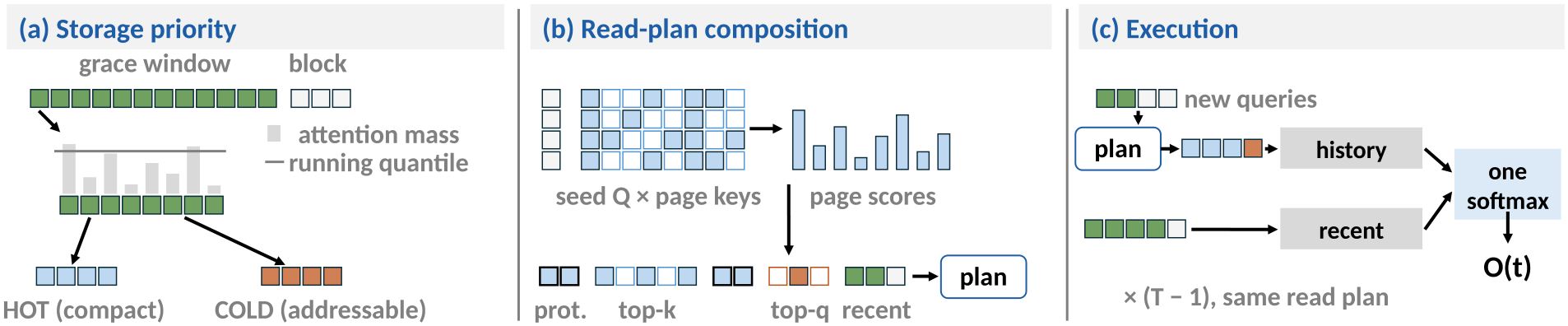
The fixed-version author figure/table is not a local result. Scientific content was not redrawn. Copyright remains with the original authors; no open-image license is inferred. Source, crop and SHA256.
Equations
The maximum is taken after two complete dot products, not the coordinate-wise QUEST bound. Later steps reuse addresses, not attention outputs, and recompute one softmax with current queries/KV. Exact storage does not imply dense-equivalent decoding.
flowchart LR
 S[Exact HOT and COLD storage] --> P[Seed page-extrema scores]
 P --> B[Protected bounded address plan]
 B --> A[Fresh queries with one joint softmax]
Reported results and evidence
The reported quality/efficiency relies on the full paper configuration, which was not reproduced locally. No production randomized-traffic A/B is reported for this method. Benchmarks, single-device serving measurements, or using Meta/Google models are not production A/B evidence.
Local implementation
Protocol and code mapping
Executes mass-only grace priorities, HOT/COLD/mandatory address selection and gathered attention on caller-owned exact storage. It omits native block-diffusion decoding, learned admission correction, seed commitment/finalization and CUDA-graph serving.
PYTHONPATH=src python -c 'from auto_research.foundation_models.risa import diagnostic; print(diagnostic(42, device="cpu"))'
PYTHONPATH=src python -m pytest tests/test_nov18_latest_foundation.py -q
CPU seeds42/43/44passed the mechanism checks on synthetic tensors, not capability benchmarks. CUDA acceptance requires the real-device receipt; this text does not preclaim a GPU pass.
Same-topic comparison and boundaries
DropKV evicts KV to reduce storage. RISA limits recurring reads while retaining COLD for recovery. Read and storage budgets cannot be exchanged as memory/latency conclusions. Multiple seeds do not upgrade these mechanism checks into L2/L3 capability evidence.
High-cost full experiments
DreamReasoner8B/SDAR8B/LLaDA2.2-mini,BF16H200,16K–128Kcontexts,512output-tokentrajectories andmultiplebenchmarks; full campaign high cost.
This is a configuration-based cost assessment, not measured local duration. The budget is one A100 or A30, or the local Mac. No multi-GPU capacity, costly probing run, large-resource download or automatic retry is assumed. Full experiments are too costly; not reproduced (review DONE) and do not block review closure.