LARA++: deterministic clustered proposals for kernel attention
L1 mechanism component, not a complete model. Full experiments are too costly; not reproduced (review DONE). No capability improvement or Evolve promotion is claimed.
Paper information
| Field | Value |
|---|---|
| Paper | arXiv:2611.22947v1; fixed text |
| Institution/company | First author Fırat Öncel: Concordia University / Mila |
| Original publication | 2026-11-17T15:38:48Z (arXiv v1); separately observed announcement: 2026-11-18 |
| Authors' code | Author repository, verified HEAD 20a9f67a252059ce04383e1365700416de9d9447. No upstream source was copied; its license was not separately verified. |
| Local adapter/key | lara-plus-plus; adapter null; no Evolve integration |
| Local source | src/auto_research/foundation_models/lara_plus_plus.py |
Original paper
Motivation and changes
The paper audits practical kernel-attention efficiency. Deterministic proposal means replace sampling, and similarity clusters replace contiguous chunks. When the number of clusters grows with sequence length, k-center costs are quadratic; near-softmax quality does not imply a FlashAttention speedup. Reviewed method: 7, Appendix E.1.
Key original figure
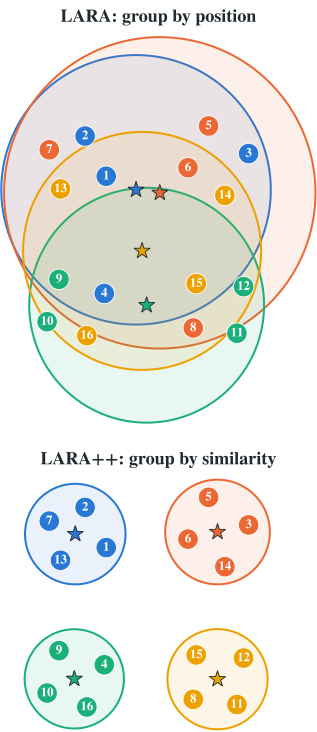
The fixed-version author figure/table is not a local result. Scientific content was not redrawn. Copyright remains with the original authors; no open-image license is inferred. Source, crop and SHA256.
Equations
The local operator follows the pinned author mis-opt path. Section7 describes query-only clustering and a random initial center, whereas released code uses normalized joint Q+K features, deterministic initialization and a separate CLS proposal. This difference is explicit. Proposal construction is detached; Q/K features and value aggregation remain differentiable.
flowchart LR
 Q[Q and K] --> C[Detached joint-feature clustering]
 C --> M[Deterministic proposal means]
 M --> I[Feature and proposal-density scores]
 I --> S[Self-normalized importance weights]
 S --> V[Value aggregation]
Reported results and evidence
The reported quality/efficiency relies on the full paper configuration, which was not reproduced locally. No production randomized-traffic A/B is reported for this method. Benchmarks, single-device serving measurements, or using Meta/Google models are not production A/B evidence.
Local implementation
Protocol and code mapping
Executes the pinned deterministic clustering, proposal means, mis-opt self-normalized importance weights and value aggregation. No layerwise distillation, ImageNet/YFCC15M training or efficient FLA kernel is included.
PYTHONPATH=src python -c 'from auto_research.foundation_models.lara_plus_plus import diagnostic; print(diagnostic(42, device="cpu"))'
PYTHONPATH=src python -m pytest tests/test_nov18_latest_foundation.py -q
CPU seeds42/43/44passed the mechanism checks on synthetic tensors, not capability benchmarks. CUDA acceptance requires the real-device receipt; this text does not preclaim a GPU pass.
Same-topic comparison and boundaries
LazyFlash keeps dense forward attention and sparsifies backward work. LARA++ approximates forward softmax and requires distillation. Their computation and error targets differ. Multiple seeds do not upgrade these mechanism checks into L2/L3 capability evidence.
High-cost full experiments
DeiT/DINOv2 through1.1B40layers,layerwise distillation plus jointfinetuning,ImageNet/YFCC15M andsegmentationmatrix; full campaign high cost.
This is a configuration-based cost assessment, not measured local duration. The budget is one A100 or A30, or the local Mac. No multi-GPU capacity, costly probing run, large-resource download or automatic retry is assumed. Full experiments are too costly; not reproduced (review DONE) and do not block review closure.