Spool: affine summaries for sliding recurrent windows
L1 mechanism component, not a complete model. Full experiments are too costly; not reproduced (review DONE). No capability improvement or Evolve promotion is claimed.
Paper information
| Field | Value |
|---|---|
| Paper | arXiv:2611.23228v1; fixed text |
| Institution/company | First author Rui Ning: MIT CSAIL |
| Original publication | 2026-11-17T18:59:27Z (arXiv v1); separately observed announcement: 2026-11-18 |
| Authors' code | No released method-specific author source was found in fixed v1 and its author links. Dependency libraries are not counted as the paper code. |
| Local adapter/key | spool; adapter null; no Evolve integration |
| Local source | src/auto_research/foundation_models/spool.py |
Original paper
Motivation and changes
With recorded layer inputs fixed, GDN keys, values and gates make each update affine in prior state. Per-frame transitions compose chronologically in a segment tree. Expiry rebuilds state from the prefix anchor without replaying retained tokens through the backbone. Reviewed method: 3.2–3.4, 4, 5.1, Appendix A.
Key original figure
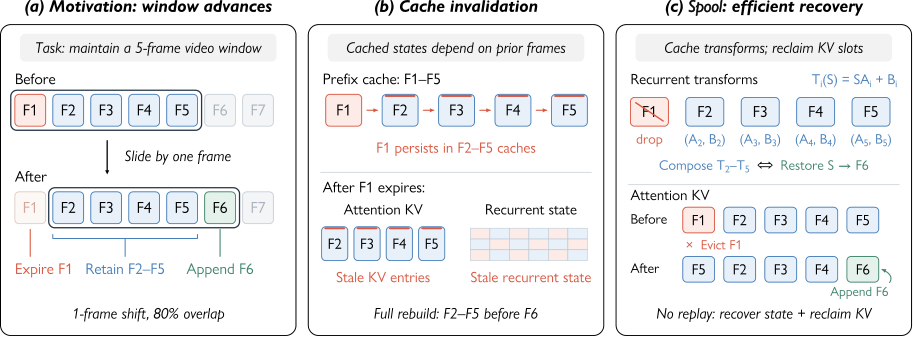
The fixed-version author figure/table is not a local result. Scientific content was not redrawn. Copyright remains with the original authors; no open-image license is inferred. Source, crop and SHA256.
Equations
Storing D=A-I protects small deviations from identity in low precision. Composition is noncommutative. Exactness holds for recorded inputs within a layer, not whole-network recomputation: higher-layer cached features can retain expired-frame influence.
flowchart LR
 X[Recorded GDN keys values gates] --> A[Per-block affine summary]
 A --> T[Ordered residual segment tree]
 T --> S[Replay retained interval from anchor]
Reported results and evidence
The reported quality/efficiency relies on the full paper configuration, which was not reproduced locally. No production randomized-traffic A/B is reported for this method. Benchmarks, single-device serving measurements, or using Meta/Google models are not production A/B evidence.
Local implementation
Protocol and code mapping
Implements token-to-block GDN summaries and a cyclic residual segment tree with append, expiry and queries. No VLM, Triton/FLA engine integration, KV-tail-filling or RoPE-rebasing kernel is included.
PYTHONPATH=src python -c 'from auto_research.foundation_models.spool import diagnostic; print(diagnostic(42, device="cpu"))'
PYTHONPATH=src python -m pytest tests/test_nov18_latest_foundation.py -q
CPU seeds42/43/44passed the mechanism checks on synthetic tensors, not capability benchmarks. CUDA acceptance requires the real-device receipt; this text does not preclaim a GPU pass.
Same-topic comparison and boundaries
DropKV selects attention KV entries for eviction. Spool reconstructs shared recurrent state after expiry. Layerwise recorded-input exactness does not establish full-network equivalence. Multiple seeds do not upgrade these mechanism checks into L2/L3 capability evidence.
High-cost full experiments
0.8B–122B hybrid VLM matrix, video streaming benchmarks up to5hours, A100/GH200/B200/B300; no full serving campaign on available single-device budget.
This is a configuration-based cost assessment, not measured local duration. The budget is one A100 or A30, or the local Mac. No multi-GPU capacity, costly probing run, large-resource download or automatic retry is assumed. Full experiments are too costly; not reproduced (review DONE) and do not block review closure.