Kernel Ridge Attention: Nonlinear Memory with Selective Forgetting
l1_mechanism component; not a complete model. Full experiments: high cost, not reproduced (review DONE).
Paper information
| Field | Value |
|---|---|
| Paper link | arXiv:2611.23896v1; fixed PDF |
| Company / institution / school | Haowei Chen: Independent Researcher (verified fixed-v1 PDF byline) |
| Original publication date | 2026-11-18T05:49:34Z (arXiv v1); announcement2026-11-19 |
| Original source code | No author KRA implementation was found in fixed v1. Cited FLA is a dependency, not this method release. |
| Local adapter / key | kernel-ridge-attention; adapter: null; not Evolve-integrated |
| Local reproduction code directory | src/auto_research/foundation_models/kernel_ridge_attention.py |
Original paper summary
Background and main changes
KRA stores associations in fixed-size regression coefficients and posterior covariance. Shared learned Fourier features supply a nonlinear kernel. A content-dependent OU clock decays coefficients while restoring uncertainty toward the prior, reopening forgotten directions for writing. Reads include the current write. Fixed-v1 source.
flowchart LR
 X[Projected causal Q K V] --> F[Shared learned Fourier features]
 C[Content clock] --> P[OU coefficient decay and covariance recovery]
 F --> R[Covariance guided residual write]
 P --> R
 R --> O[Inclusive query read]
Original paper figure
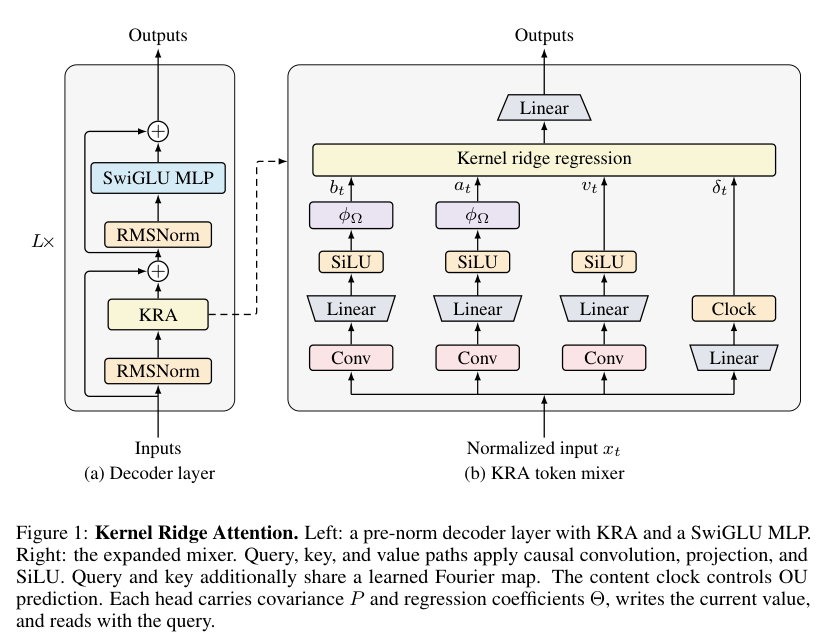
Original PDF crop; author method/result, not local evidence. Page, crop and SHA256. Copyright remains with the original authors.
Core equations
Keys and queries share unit-norm sine/cosine features. P rotates and rescales a write; it is not a scalar gate. An independent dual reference solves each causal prefix with the product of content and OU-time Gram matrices.
Paper offline and online results
At the paper’s matched100M-token budget, validation perplexity is88.00 versus97.21 for Transformer++. Rare-repeat top1 is25.41%, below Transformer++32.00%; memory is not uniformly better. Training uses one seed. No production A/B is reported.
Local reproduction
Data protocol and code mapping
Implements shared Fourier features, OU prediction, covariance-guided RLS, inclusive reads and streaming continuation. It excludes the width4 convolution frontend, decoder, parallel adjoints and fused kernels. The expensive dual solve is only a small independent reference.
PYTHONPATH=src python -c 'from auto_research.foundation_models.kernel_ridge_attention import diagnostic; print(diagnostic(42))'
PYTHONPATH=src python -m pytest tests/test_nov19_latest_foundation.py -q
Local generated tensors/contract cases are diagnostics only, not public capability benchmarks. Seeds42/43/44 do not elevate the evidence tier.
CUDA acceptance is recorded separately in thesanitized GPU receipt; CPU success cannot substitute for it.
Same-topic comparison and boundaries
Mamba controls an SSM with input-dependent steps and read/write vectors. KRA additionally maintains covariance to handle correlated-key interference, costing D-squared state per head. Bounded context-independent state does not make their costs identical.
High-cost full experiment
The paper trains30.92M parameters on100,007,936tokens for3,052updates using eight RTX5090 GPUs, plus baseline/ablation runs. The full pretraining matrix is outside this single-device short-run budget.
This is a configuration-based cost estimate, not a measured full-run duration. High cost, not reproduced (review DONE); no large downloads, full experiments, automatic retries or implementation queue. No capability improvement or Evolve promotion is claimed.