LoopCache: Accelerating Long-Context Self-Speculative Decoding for Looped Transformers
l0_interface component; not a complete model. Full experiments: high cost, not reproduced (review DONE).
Paper information
| Field | Value |
|---|---|
| Paper link | arXiv:2611.24301v1; fixed PDF |
| Company / institution / school | Zizhuo Fu: Peking University (verified fixed-v1 PDF byline) |
| Original publication date | 2026-11-18T12:11:43Z (arXiv v1); announcement2026-11-19 |
| Original source code | Yes:author repository, MIT, inspected HEAD0ebecb21cc1bfb4a26696496694e25ba9e819e68. Upstream serving code was not copied or executed. |
| Local adapter / key | loopcache-interface; adapter: null; not Evolve-integrated |
| Local reproduction code directory | src/auto_research/foundation_models/loopcache_interface.py |
Original paper summary
Background and main changes
A fixed-depth draft can remain on a stale trajectory. LoopCache replaces it only when the new-versus-old logit margin is large enough and prunes dependent descendants. Speculation shares a cyclic cache while a separate exact KV branch recomputes with correct loop caches. Selected shallow layers may decouple when loop mismatch is large. Fixed-v1 source.
flowchart LR
 G[Global step] --> C[Cyclic KV loop]
 D[Current draft logits] --> M[New old margin threshold]
 M --> P[Replace and prune descendants]
 C --> S[Approximate spec branch external]
 S --> E[Exact full KV branch external]
 E --> T[Verified token commit external]
Original paper figure
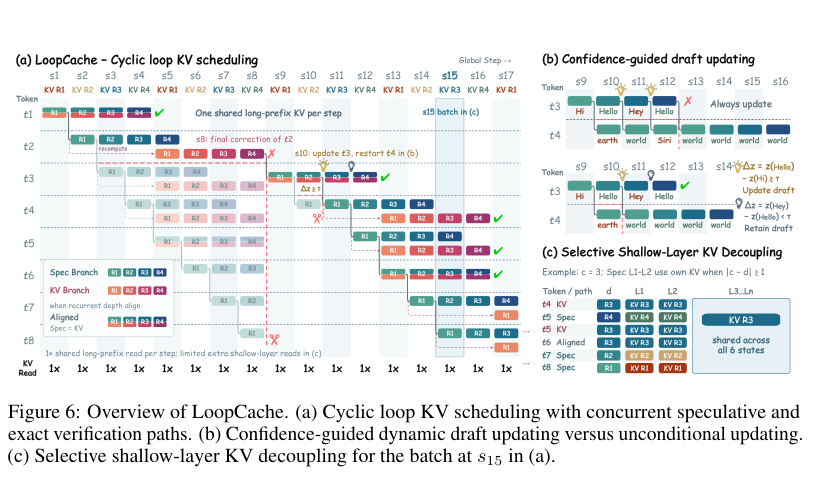
Original PDF crop; author method/result, not local evidence. Page, crop and SHA256. Copyright remains with the original authors.
Core equations
Equality at the margin threshold triggers replacement. Future-loop harmful-switch labels are analysis only, never runtime oracles. Approximate speculative-cache computation cannot commit a token; the exact branch is mandatory.
Paper offline and online results
Across six looped models and4K–128K contexts, reported average speedups are10.25x/14.56x over WFD/LoopSpec. The full campaign uses eight A100 GPUs and long-context parallelism. Local code reports neither speed nor acceptance. No production A/B is reported.
Local reproduction
Data protocol and code mapping
L0 implements margin updates, cyclic loop IDs, shallow-cache selection and the next full verification-cycle interface. It includes no model, real KV buffers, exact verifier, rejection sampler or token commit. A zero committed-token counter describes scope, not model performance.
PYTHONPATH=src python -c 'from auto_research.foundation_models.loopcache_interface import diagnostic; print(diagnostic(42))'
PYTHONPATH=src python -m pytest tests/test_nov19_latest_foundation.py -q
Local generated tensors/contract cases are diagnostics only, not public capability benchmarks. Seeds42/43/44 do not elevate the evidence tier.
Same-topic comparison and boundaries
Spool reconstructs recurrent state for fixed recorded layer inputs. LoopCache schedules loop-specific KV reads and corrects approximate speculation through an exact branch. Their exactness claims concern different objects.
High-cost full experiment
Six0.84B–3.5B models, contexts up to128K, eight A100 GPUs, context parallelism and an additionally trained DFlash baseline exceed this single-device short-run budget.
This is a configuration-based cost estimate, not a measured full-run duration. High cost, not reproduced (review DONE); no large downloads, full experiments, automatic retries or implementation queue. No capability improvement or Evolve promotion is claimed.