Counterfactual World Models: JEPAs That Reason About "What If"
l1_mechanism component; not a complete model. Full experiments: high cost, not reproduced (review DONE).
Paper information
| Field | Value |
|---|---|
| Paper link | arXiv:2611.24778v1; fixed PDF |
| Company / institution / school | Randall Balestriero: Brown University / AMI Labs (verified fixed-v1 PDF byline) |
| Original publication date | 2026-11-18T17:24:00Z (arXiv v1); announcement2026-11-19 |
| Original source code | The fixed PDF linksthe method repository, but this review received404. Accessible code, revision and license could not be verified; the link is not presented as successfully retrieved source. |
| Local adapter / key | counterfactual-wm; adapter: null; not Evolve-integrated |
| Local reproduction code directory | src/auto_research/foundation_models/counterfactual_wm.py |
Original paper summary
Background and main changes
A factual world model estimates average outcomes, not the same-event coupling between actions. This method combines an observed outcome with the factual predictor’s action contrast. It is exact under additive disturbances, with interaction bounds for smooth short transitions; contacts, gain faults and curved coordinates can break it. Fixed-v1 source.
flowchart LR
 O[Observed factual outcome] --> R[Observed residual]
 F[Factual action prediction] --> R
 A[Alternative action prediction] --> C[Residual reuse]
 R --> C
 C --> L[Same event alternative estimate]
Original paper figure
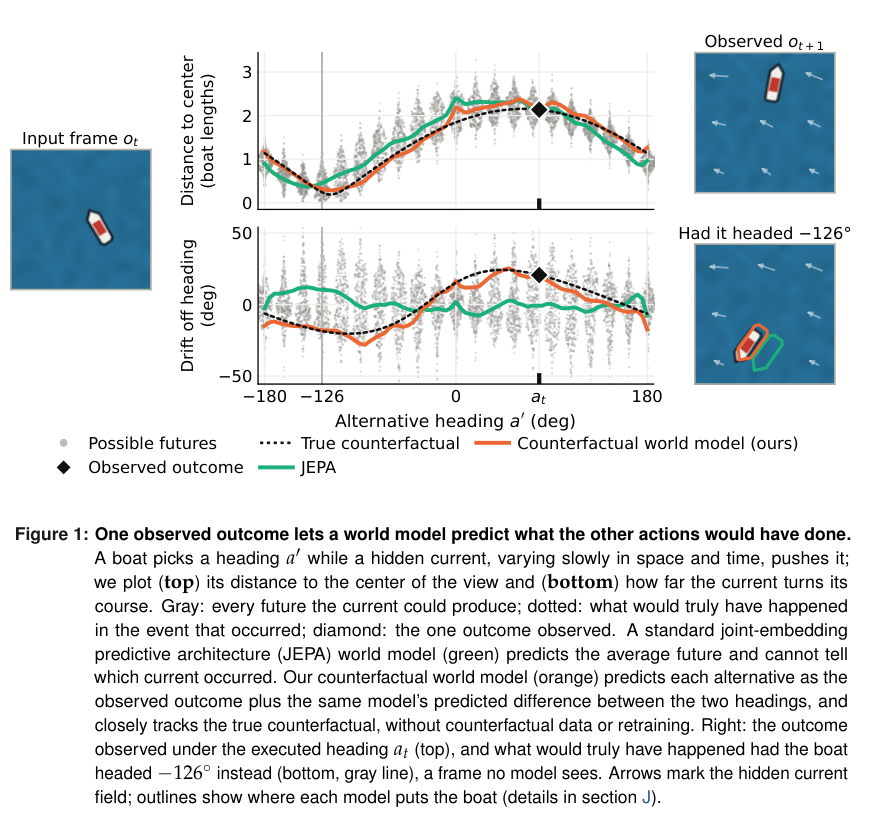
Original PDF crop; author method/result, not local evidence. Page, crop and SHA256. Copyright remains with the original authors.
Core equations
The observed input follows the factual action; the true alternative outcome is never an algorithm input. Transport-then-decode differs from decoding each term before transport. Coordinate guarantees need readout assumptions. Error is individual-minus-average action effect, not simply factual-model prediction error.
Paper offline and online results
In four pixel-based simulators, reported counterfactual R-squared rises from38–46% to86–96%. A fifth underwater task uses16times more factual data and reaches90–94%. These require frozen encoders, fitted predictors and simulator replay, not this local operator. No production A/B is reported.
Local reproduction
Data protocol and code mapping
Implements equation6 residual reuse and equation7 readout-space transport, rejecting implicit broadcasting. Tests establish additive exactness and preserve expected failures under gain faults/nonlinear readouts. No JEPA training, encoder, simulator collection or planning runs. Analytic diagnostics are not trained world models.
PYTHONPATH=src python -c 'from auto_research.foundation_models.counterfactual_wm import diagnostic; print(diagnostic(42))'
PYTHONPATH=src python -m pytest tests/test_nov19_latest_foundation.py -q
Local generated tensors/contract cases are diagnostics only, not public capability benchmarks. Seeds42/43/44 do not elevate the evidence tier.
CUDA acceptance is recorded separately in thesanitized GPU receipt; CPU success cannot substitute for it.
Same-topic comparison and boundaries
DT-JEPA predicts future latent distributions from history for decision making; true futures appear only in training. CWM answers alternative actions after a factual outcome is observed. It cannot access an unobserved future, and a DT-JEPA mean is not automatically an individual counterfactual.
High-cost full experiment
Full evaluation combines several frozen visual encoders, five pixel simulators, width1024 two-block predictors,20,000updates per fit at batch256/three seeds, and history/readout/planning sweeps. Total GPU hours are not stated; configuration-based cost exceeds this short-run budget, without a costly probe.
This is a configuration-based cost estimate, not a measured full-run duration. High cost, not reproduced (review DONE); no large downloads, full experiments, automatic retries or implementation queue. No capability improvement or Evolve promotion is claimed.