Physics of Language Models: Part 4.2, Canon Layers at Scale where Synthetic Pretraining Resonates in Reality
Review only; no executable reproduction. Full experiment: high cost, not reproduced (review DONE).
Paper information
| Field | Value |
|---|---|
| Paper link | arXiv:2611.24963v1; fixed PDF |
| Company / institution / school | Zeyuan Allen-Zhu: Allen-Zhu Research (fixed-v1 byline) |
| Original publication date | 2026-11-12T18:51:19Z (arXiv v1); announced2026-11-20 |
| Original source code | https://github.com/facebookresearch/PhysicsLM4; Apache-2.0; revision 75806965208c55e9f7f2e2363d3793d2da75d2e4 |
| Local adapter / key | canon-layers-scale; adapter: null; not Evolve-integrated |
| Local reproduction code directory | None (review-only; no reproduction code) |
Current author affiliation is Allen-Zhu Research. The fixed paper states experiments were conducted at FAIR at Meta; this research relationship does not change the byline grouping.
Original paper summary
Background and principal changes
Canon adds residual short convolutions along the token axis at several within-layer locations. This paper tests architecture lessons from smaller synthetic training in64 real-corpus pretraining runs at1.3B–8B parameters, including GLA5/GDN2 with low-rank output gates. Budget alignment, baseline tuning and measurable skills are central to the study.
flowchart LR
 H[Token hidden sequence] --> A[Canon A before attention]
 A --> B[Canon B on projected Q K V]
 B --> C[Canon C before MLP]
 C --> D[Canon D on gated MLP branches]
 D --> E[Matched scale and tuned baselines]
 E --> F[Knowledge scores plus retrieval and two hop probes]
Original paper figure
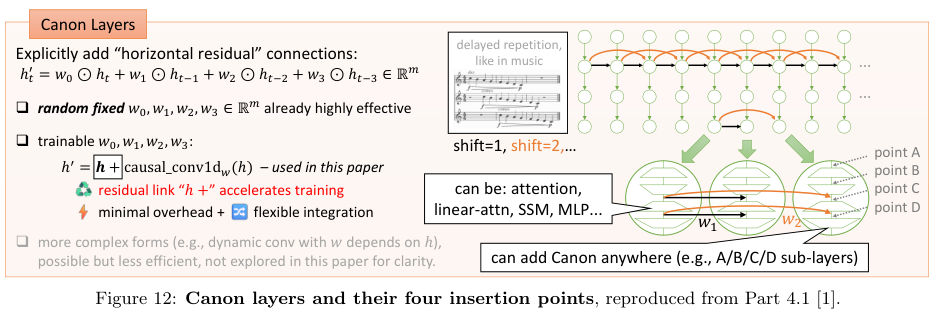
Original PDF crop, no semantic editing; author evidence, not a local result. Provenance. Copyright remains with the authors.
Core equations
Canon is a per-channel causal width4 convolution with left zero padding and a hidden-state residual. A/C follow normalization, B follows QKV projections, and D covers both gated-MLP branches. The rank constraint applies before SiLU; the activated gate need not be low-rank. Released LlamaCanon also uses quarter RoPE, so its differences are not solely convolution.
Paper offline and online results
At8B/1T, Canon needs roughly30% fewer tokens to reach vanilla Llama's final MMLU. Yet linear models with stronger standard scores still struggle with simple retrieval in roughly500-token contexts and unreliable two-hop reasoning. This is not universal evidence against linear models. No online A/B is reported. ArXiv v1 is November12; the manuscript's2025-12-09 date and earlier code releases are separate from today's announcement.
Local reproduction
Data protocol and code mapping
Review-only fixed-source documentation, figures, affiliation, code revision, cost and limitations. No Canon/GLA5/GDN2 implementation, metrics, GPU receipt or executable Evolve operator is added. A small convolution demo would not reproduce64 pretraining runs. The current byline is Allen-Zhu Research; experiments were conducted at FAIR at Meta and code is in facebookresearch, not proof of current Meta authorship.
Same-topic comparison and boundaries
Canon's causal width4 residual supplies local token mixing, not a long-history state or independent access to arbitrary distant positions; it can augment attention, linear attention or SSMs. Mamba also maintains input-selective recurrent state beyond its local convolution. These roles differ. Align parameters/state and tuning, then separately test retrieval: stronger knowledge scores do not establish attention-like remote reads from fixed-size state.
High-cost full experiment
The study contains64 from-scratch1.3B/3B/8B runs on1–2T Nemotron-CC tokens, multiple learning rates and evaluations. The paper estimates about100kUSD per8B run. This exceeds one A100/A30 or Mac budget; no checkpoint download or training probe is attempted.
Configuration-based cost judgment, not measured full-run time. High cost, not reproduced (review DONE); no automatic retry or implementation queue, no capability improvement or Evolve promotion claim.