AVMeme Exam: multilingual, multicultural audiovisual meme evaluation
L0 evaluation-protocol interface, not a reproduction of multimodal capability. The local code implements option shuffling, text-shortcut exclusion, visual-shortcut masking and grouped scoring. It neither downloads access-controlled media nor calls an evaluated model.
Paper information
| Field | Value |
|---|---|
| Paper | arXiv:2601.17645v1, fixed text |
| Institution / company / university | First author Xilin Jiang: Columbia University. Coauthors Cong Han and Yinghao Aaron Li are affiliated with Google and Meta respectively; these are not substituted for the first author's affiliation |
| Original publication | 2026-01-25 01:40:15 UTC; a historical backfill, not a new release |
| Authors' code | The official project and data/loading instructions are public. A complete model-evaluation framework was not confirmed released. The dataset requires acceptance of access conditions |
| Local adapter / key | avmeme-exam; adapter=null; not integrated with Evolve |
| Local code | src/auto_research/multimodal/avmeme_exam.py |
Paper summary
Background and main changes
Speech benchmarks often emphasize transcription and acoustic events rather than culturally situated humor, connotations or uses. AVMeme Exam uses multiple-choice questions over multilingual, multicultural short clips to examine audio, language, context, emotion, popularity, application and world knowledge. meme-full contains 1,032 examples; the text-shortcut-filtered meme-main contains 846.
Three text-only LLMs identify text_cheat examples answerable without hearing the clip; the main split excludes them. If video reveals the answer, visual_cheat requires removing video even from audiovisual evaluation. Options are shuffled. Audio uses 16 kHz mono; video uses 1 fps and 360p with preserved aspect ratio; clips are at most 30 seconds.
Architecture and flow
flowchart LR
  D[Externally authorized questions and media] --> F[Exclude text_cheat from main split]
  F --> S[Shuffle choices and retain private answer mapping]
  S --> V[Mask video for visual_cheat]
  V --> A[Question choices anonymous media request]
  A --> M[External evaluated model]
  M --> P[Explicit local letter parser]
  K[Evaluator answers and analysis labels] --> E[Micro and three-axis grouped scoring]
  P --> E
Only the protocol and scoring are local. Transcoding, upload, inference and shortcut annotation remain external.
Key original figure
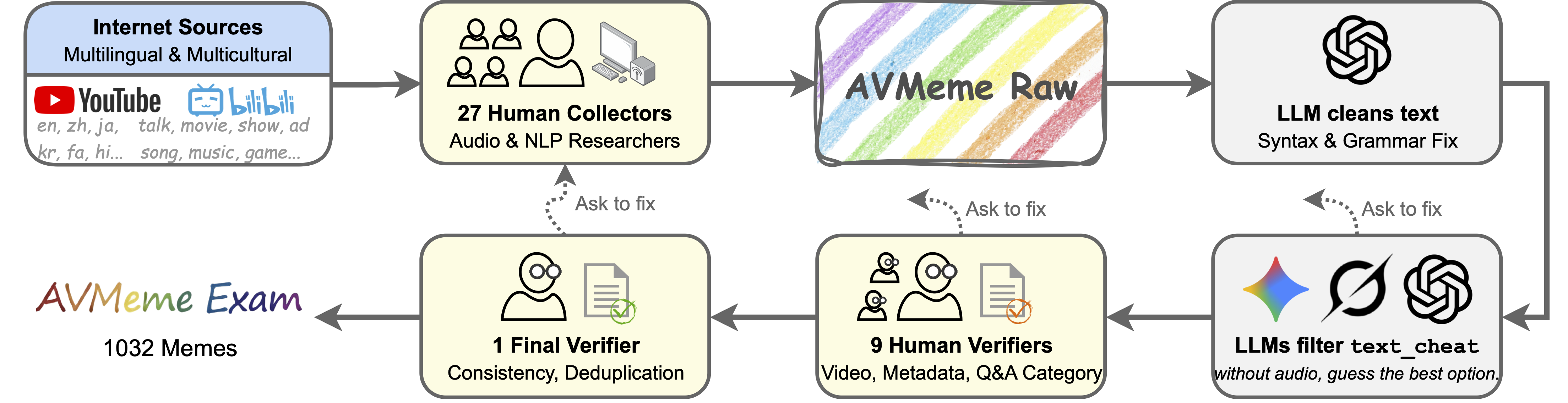
Original Figure 3 shows 27 collectors, text cleaning, LLM shortcut detection and human verification. This is the unchanged original HTML PNG, not a redrawing or crop. Source: fixed paper; copyright remains with the authors. Local fixtures do not reproduce collection or human annotation.
Core equations
For option permutation π, the private correct letter must change accordingly:
The interface reports micro accuracy, counts and scores by question type, sound category and language. The fixed-v1 overall AVG is not reproduced by simply averaging seven displayed question-type percentages, so no guessed seven-type macro AVG is claimed. The strict local parser accepts only A or (A); free text, multiple letters and out-of-range responses count incorrect. This explicit convention is not claimed to match every upstream backend.
Reported results
The paper reports main-split Gemini 3 Pro accuracy of 76.6% for audio and 80.0% for audiovisual input; Qwen3-Omni obtains 55.4% and 57.4%. These are paper-reported offline scores, not local measurements or online A/B results. Cultural coverage, annotator demographics and temporal drift limit the conclusions; correct multiple-choice answers do not establish reliable real-world cultural judgment.
Local implementation
Data protocol and code mapping
Item holds evaluator answers and shortcut labels. prepare separates ActorRequest from ScoringKey. The evaluated callback receives questions, shuffled choices and an anonymous-media format contract, not identities, original titles, source URLs, summaries, transcriptions, analysis labels or answers. This typed boundary is not a security sandbox; callers must still isolate permissions and inspect question text for leakage.
evaluate makes one fixed pass, retains invalid responses and group denominators, and performs neither retries nor result-based model selection. Media fields are contracts, not evidence of media processing or inference.
PYTHONPATH=src python -c 'from auto_research.multimodal.avmeme_exam import diagnostic; print(diagnostic(42))'
PYTHONPATH=src python -m pytest tests/test_avmeme_exam.py -q
Checks and negative controls
Tests cover shuffled-answer mapping, split differences, video masking, invalid-response handling, group denominators and empty-set rejection. The fixture callback always returns A and never reads answers. Diagnostics publish protocol counts, not fixture “model accuracy.” See the three-seed CPU protocol receipt. There is no CUDA model path and no fabricated GPU receipt.
Boundaries and full experiment
The dataset requires access-condition acceptance. Annotations use CC BY 4.0, while source-media licenses differ. This round neither bypasses access controls nor downloads approximately 774 MB of media. The full 19-model matrix, human verification and multi-backend inference exceed the bounded single-card scope: high cost; not reproduced (review DONE). No unsupported total single-GPU runtime is invented. This L0 interface is not a complete benchmark integration, capability comparison or Evolve promotion signal.