AW-0: Jointly generating programs, video and continuous actions
Reference entry only. No local robot model, proxy or metrics; full experiment not reproduced due to cost.
Paper information
| Field | Details |
|---|---|
| Paper | Agentic World Action Models |
| Affiliations | Co-first authors Zhuoyang Liu (UC Berkeley), Dantong Niu (UC Berkeley/NVIDIA), Botong Zhang (University of Pennsylvania) and Boning Shao (UC Berkeley). Gemini annotation does not establish Google authorship. |
| First public release | 2026-10-21 17:59:56 UTC |
| Author code | Official agentic-wam repository, 7ad228bebb897bf01705cc10171e1d88cf5e9b22, BSD-2-Clause at root; dependencies separate. Project and checkpoint, not the pretraining corpus. |
| Local key | aw0; no adapter |
| Local code | No executable local implementation. |
| Local evidence | No local experiment, metrics or GPU receipt. |
What the paper changes
A mixture of code, video and action Transformers combines reusable programs, future dynamics and controls. Experts have separate projections, normalization and FFNs with per-layer joint attention: bidirectional within each expert and block-causal code→video→action across them. An annotation agent derives programs and a coordinator extracts reusable skills; freeze the library, relabel selected examples and cache programs. Previous fragments become learned memory. Code normally conditions control without execution; optional hybrid executes skills only after validity, precondition and progress checks, otherwise falls back to direct actions.
Original paper figure
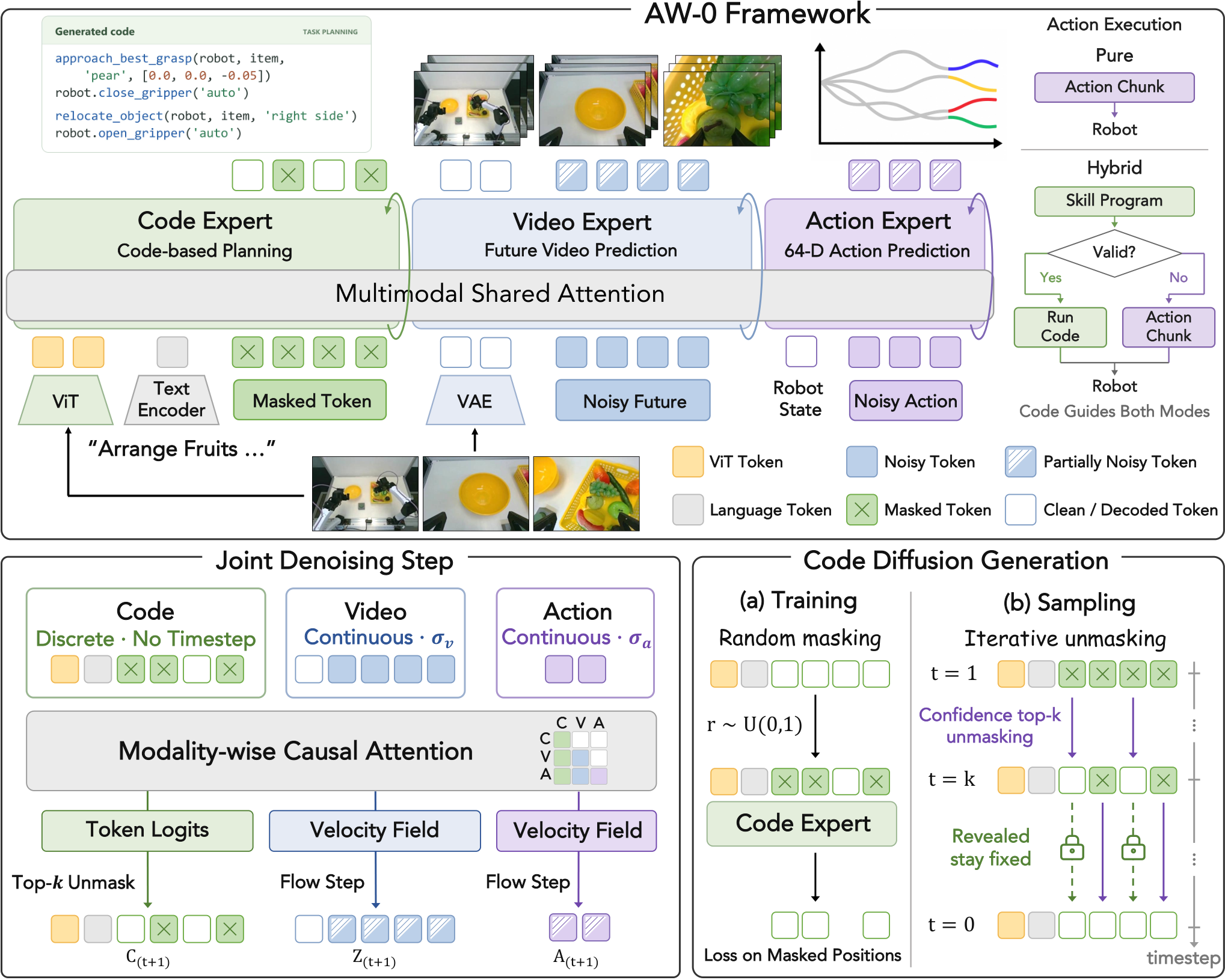
Original figure from the reviewed paper, reused without redrawing. See figure provenance.
Core equations
\(C_0,Z_0,A_0\) represent programs, future video VAE latents and action chunks. Train continuous modalities by flow-matching velocity \(\epsilon_m-X_0^m\); code uses independent Bernoulli masks and only masked targets. For video, \(u_v=0.999b\), \(b\sim\mathrm{Beta}(7,1)\); mix pretraining noise and uniform to expose more informative low-noise video to action. Video and action/code have separate importance weights, capped at four then normalized to mean one. Loss weights \((v,c,a)=(1,0.5,1)\); action noise and code masks are independent.
Results reported by the authors
RoboTwin 2.0: 50 tasks × 50 rollouts per setting. Default clean/random/mean 80.8%/20.6%/50.7%, random below \(\pi_{0.5}\) at 27.7%. Hybrid 63.1%/29.2%/46.2%. Two real robot platforms, eight tasks, three seeds × 16 rollouts each give mean rubric 71.1%, not universal strict success. Real towel hybrid 90.6% versus 84.4% default is task-specific. Future vision, grasp/contact and executable preconditions remain limits. No production A/B or local result.
Local reproduction and limits
No executable adapter, metrics, receipt, generated programs, upstream script or skill execution. Code availability is not reproduction and this entry is not Evolve-integrated.
Full experiment: not reproduced
Three 28-layer experts (SDAR-1.7B, Cosmos-Predict2.5-2B and action DiT), plus frozen Qwen3-VL, Wan2.2 VAE and Cosmos-Reason1. Pretraining uses six nodes/48 H100s, BF16, ZeRO-1, effective batch 2,592 and one epoch; 248,642 episodes over 606 tasks, ~2,913.2 hours. RoboTwin adaptation takes two nodes/16 GPUs and 100,000 steps; real platforms need 100 demos/task and 20 epochs. No large resources, paid calls, training or automatic retry. Any later reduced study would need its own scope.
