GSLM2: cross-stream deduplication and speech-unit transition scoring
L1 mechanism diagnostic. The local component consumes externally supplied discrete units and target log probabilities; it does not run a speech model. The full experiment is too costly and not reproduced (review DONE).
Paper information
| Field | Details |
|---|---|
| Paper | GSLM2: Multi-Stream Speech Representation Learning and Generative Spoken Language Modeling; fixed v1 full text |
| Company / author institutions | First author Yosuke Higuchi, Meta Superintelligence Labs. Other affiliations include AMI Labs, Université Paris Dauphine–PSL, Doctolib, and EHESS. |
| First public date | 2026-10-31 17:31:45 UTC (arXiv v1); the official Meta research directory dates it November 4, 2026. This is an earlier omission added in the November 7 review, not a new first publication. |
| Author code | facebookresearch/gslm2 releases training/evaluation code and checkpoint links under the authors' stated CC BY-NC 4.0. The local implementation follows the paper independently; no code was copied or weights downloaded. |
| Local adapter / key | gslm2; adapter: null, not integrated into Evolve. |
| Local code | src/auto_research/multimodal/gslm2.py |
Original paper summary
Motivation and method
A single-stream spoken language model usually quantizes one encoder layer, potentially missing phonetic and semantic information in other layers. GSLM2's SpidR 2.0 trains units at multiple speech-encoder layers using differentiable prediction heads. On the language side, it aligns units across layers at each audio frame and retains positions where any stream changes. Averaged stream embeddings feed a shared temporal Transformer. Each stream-specific head scores the next unit of its stream using the previous multi-stream history. A separate generation head predicts the streams within a time step in order, so later streams can depend on earlier ones at the current step. Training combines a single-stream loss, transition-level self-distillation, and multi-stream generative loss; none is in the local slice.
Key original-paper figure
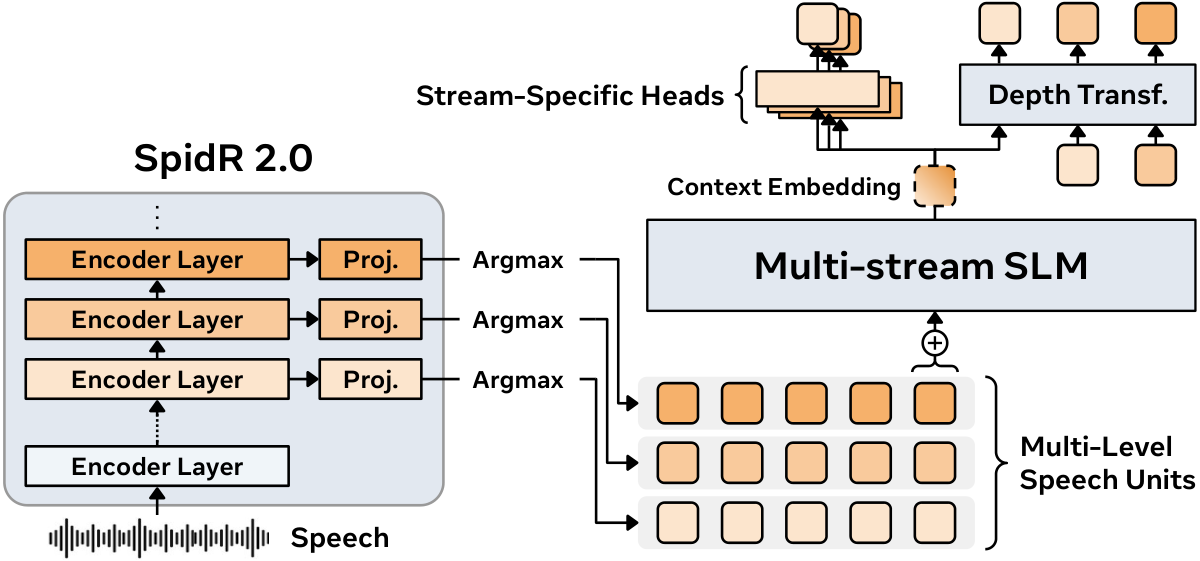
The left architecture panel of Figure 1 from the fixed v1 paper is the original author PNG, not a redrawing. Copyright belongs to the original authors; the code license is distinct from the figure's publication provenance. Asset source and SHA256.
Core equations
In Section 2.2, let \(z_{l,t}\) denote the unit of stream \(l\) at the aligned audio frame \(t\). The kept frames are (one-based, as in the paper):
Let \(\mathbf q_u\) be a retained tuple. In Appendix C.1.6, paired discrimination uses each stream's own transition positions \(C_l\), including its first unit. Average the stream-specific head's target log probabilities over those positions first, then give every stream equal weight:
When another stream changes, an unchanged unit remains in the tuple context but does not count in its own transition average. Independently deduplicating then concatenating streams breaks alignment; pooling event counts before averaging changes the weighting. This score is not the depth head's joint generation likelihood.
Reported offline and online results
In Appendix C.1.6, Table 12, the 6,000-hour, 300M model's default transition scoring gives 76.3% / 67.2% / 78.9% on sWuggy / sBLIMP / tSC, versus 66.7% / 56.3% / 61.7% using the same model's generative head at all retained positions. These are the paper's paired discrimination results, not local data, speech generation quality, or a production A/B test. No production A/B test is reported.
Local reproduction
Data protocol and code mapping
cross_stream_deduplicate takes time-by-stream discrete IDs and returns zero-based retained indices and tuples. transition_log_score takes aligned retained tuples and each stream head's finite, nonpositive target log probabilities. It returns per-stream means and counts plus the equally weighted total. The input probabilities must be computed elsewhere from shared history. The routine computes no model logits, receives no correct-candidate label, and does not run speech encoding, decoding, or a benchmark.
PYTHONPATH=src python -c 'from auto_research.multimodal.gslm2 import diagnostic; print(diagnostic(42))'
PYTHONPATH=src python -m pytest tests/test_nov07_gslm2.py -q
Results, negative controls, and limits
Small synthetic sequences test union-of-change alignment, an independent per-stream reference, first-unit inclusion, exclusion of repeated scores, and column permutation. A two-stream example has valid counts 1 and 4 and means −4 and −2.5, giving −3.25; averaging all five events would instead give −2.8. Changing only excluded repetition scores must not change the result. These checks measure no real speech, training, task accuracy, or performance. The CPU reference needs no GPU acceptance.
Cost of the full experiment
In Appendix B.3, Table 9, even the smallest GSLM2 used 32 H200s (90M, 600 audio hours). The largest used 112 H200s (6.5B, 6 million hours, 750,000 steps). Training one SpidR 2.0 encoder used 16 H200s for about 18 hours, while generative evaluation additionally used duration prediction, a vocoder, and transcription. A single A100/A30 or Mac is not a practical match. Too costly, not reproduced (review DONE). No weights or audio were downloaded, no model or API calls were made, and no automatic retry is scheduled.