C²-Routing: joint-correctness risk gating for cropping and compression
L1 CPU policy kernel, not a trained visual router. Only joint-correctness risk and validation-cost utility are implemented. No SmolVLM, Grounding DINO, risk classifier, or real VQA result is supplied.
Paper information
| Field | Value |
|---|---|
| Paper | arXiv:2611.14469v1; fixed text |
| Institution | First author Guorui Lu: Leiden University |
| Original publication | November 10, 2026, 18:32:28 UTC; November 11 announcement, recovered in this same-announcement gap review |
| Authors' source code | No method repository found in fixed v1 or author links. The open VLM dependencies are not a release of this method |
| Local adapter/key | c2-routing; adapter=null; no Evolve integration |
| Local code | src/auto_research/multimodal/c2_routing.py |
Original paper
Motivation and changes
Cropping magnifies local text or small objects; whole-image compression better preserves global relationships and distributed evidence. C²-Routing extracts shared image-question features with frozen SmolVLM-500M and learns the choice. Grounding DINO-tiny locates the crop; the compression branch selects a 256/512 visual-token budget.
The safety gate predicts joint correctness for original and reduced inputs, not just whether reduction fails. Fallback cannot fix shared failure, and can lose a reduction-induced benefit. The risk model must distinguish those cases.
Key original figure
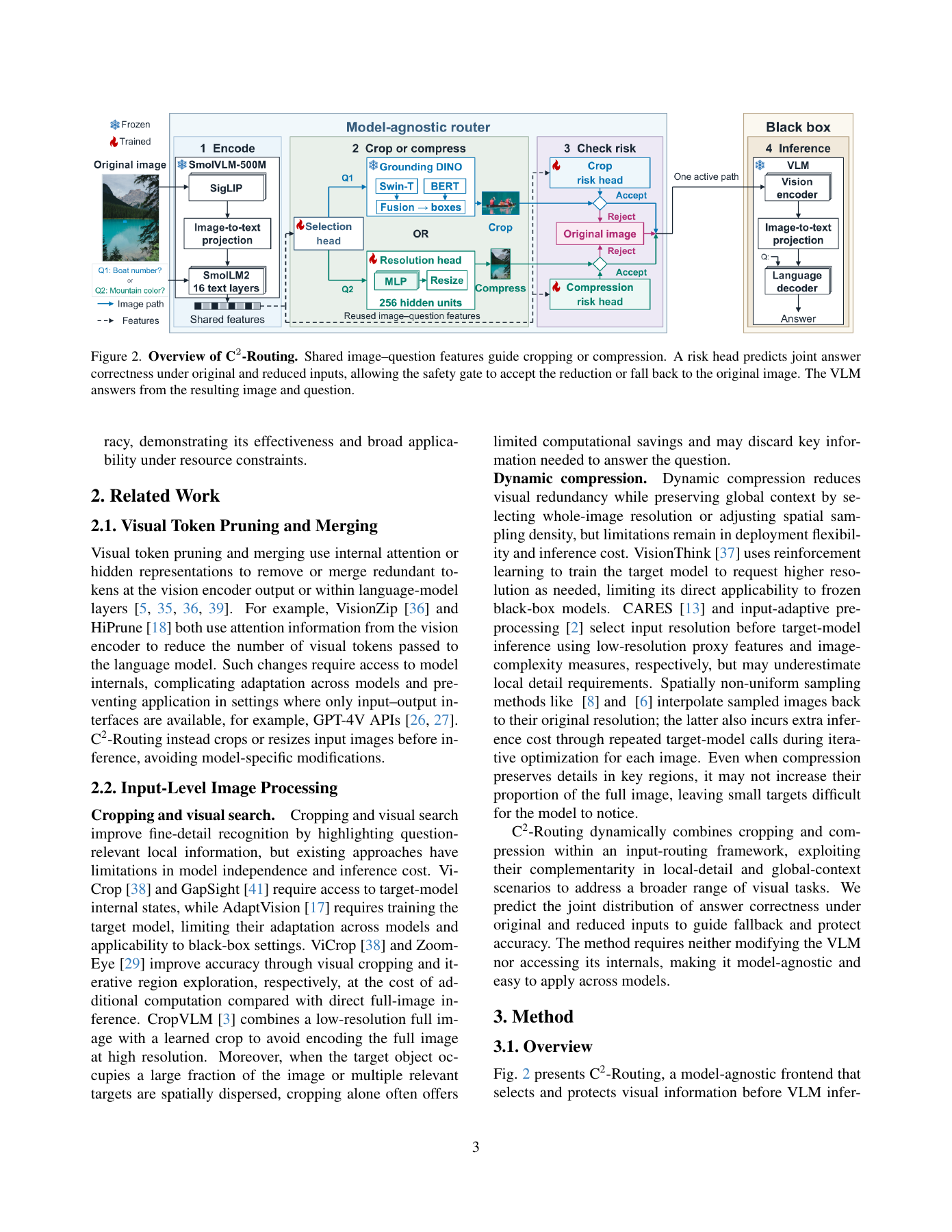
The full PDF page 3 includes Figure 2 and its caption without content changes. Copyright remains with the authors. The learned heads and VLM in the figure are not local implementations.
Equations and flow
Joint states follow the order of original/reduced correctness: 11=(1,1), H=(1,0), B=(0,1), and 00=(0,0). Expected reduction-induced accuracy loss is:
This is not the reduced-input error rate p_H+p_00. Validation costs use an equal-dataset mean of within-dataset FLOP-sum ratios:
With original cost normalized to one, accept an externally proposed R, C256, or C512 only if:
Calibration, cost ratios, and thresholds are frozen on validation. Test answers are not consulted when selecting an action.
flowchart LR
  A[Image and question] --> B[Frozen shared features]
  B --> C[Trained head proposes crop or compression]
  C --> D[Calibrated joint-correctness distribution]
  V[Fixed validation cost ratio] --> E[Risk-utility gate]
  D --> E
  E -->|Accept| F[Reduced input]
  E -->|Reject| G[Original input]
Paper results
Three VLMs and 18 datasets are split approximately 4:2:4 with image/document and cross-source grouping. Router training and validation configuration selection use four seeds. Relative to an already capped 1,024-token original-image baseline, the authors report mean FLOPs reduction of 36.53%, visual-token reduction of 42.36%, and a 0.77% relative task-score decrease. This is an accuracy-efficiency tradeoff, not an accuracy gain. No production A/B is reported, and none of those results is locally reproduced.
Local component
Data contract and code
reduction_risk computes four-state risk. validation_cost_ratio accepts explicitly labeled validation FLOPs and dataset IDs. Immutable SafetyPolicy uses frozen ratios and externally calibrated probabilities to accept a proposal or fall back to F. The CPU-only module rejects CUDA instead of presenting policy arithmetic as a GPU visual model.
PYTHONPATH=src python -c 'from auto_research.multimodal.c2_routing import diagnostic; print(diagnostic(42))'
PYTHONPATH=src python -m pytest tests/test_nov12_foundation_components.py -q
Evidence and limitations
Seeds 42/43/44 use synthetic probabilities to verify H−B against expected correctness loss, benefit credit, shared-failure handling, inclusive thresholds, and dataset-macro costs. Tests distinguish per-example ratio means and pooled-sum ratios, and reject test-data fitting.
Three-seed CPU metrics are L1 evidence only. Callers must supply genuinely calibrated predictions and validation costs; a split label is no substitute for provenance. Selection, resolution, and risk heads are not trained. No localization, model inference, or real-image VQA runs; no black-box routing benefit or Evolve promotion is claimed.
Full experiment not reproduced
The full pool contains 206,996 questions. Three frozen 3B/7B/8B VLMs generate offline answers for original, cropped, and compressed inputs before training/calibrating heads and evaluating the 18-dataset, multi-seed/configuration/baseline matrix. Although the authors use RTX 3090 GPUs, fitting one model does not make this entire matrix cheap. It exceeds the short single-device scope: too costly; not reproduced (review DONE). No weights/images were downloaded or cost probes launched; no automatic retry is scheduled.