RS-JEPA: Scan Views, Adversarial Partitions and Cross-Sensor Consensus
简体中文 · English
Local coverage is three independent tensor components, not a stand-in Vim backbone, complete model or image-retrieval score. The CUDA path requires a committed A100/A30 validation receipt.
Paper information
| Field | Details |
|---|---|
| Paper | RS-JEPA; reviewed v1 |
| Affiliation | First author Tanishq Rachamalla: Prince Mohammad Bin Fahd University, verified from PDF page 1 superscripts |
| First public release | 2026-11-10, 18:51:05 UTC |
| Authors' code | RSJEPA; no code copied, weights or remote-sensing data downloaded |
| Local adapter | None (adapter: null); component key rs-jepa |
| Local code | src/auto_research/multimodal/rs_jepa.py |
Original paper summary
Background and main changes
Order-sensitive Vision Mamba features let different traversals of identical patches define views without pixel editing. An adversarial hard half-split makes hidden-feature prediction harder. Neighbourhood consensus aligns relationships with other scenes, not just registered twins. Targets use stop-gradient features from the shared trunk, not a momentum encoder.
flowchart LR
    A[Registered sensor pairs] --> B[Shared Vim and four scan views]
    B --> C[Stop-gradient hidden-patch targets]
    B --> D[Adversarial hard half-split]
    D --> E[CVA and path-conditioned predictor]
    C --> E
    B --> F[Uni and cross embeddings]
    F --> G[Twin-excluded neighbourhood KL]
Key figure from the paper
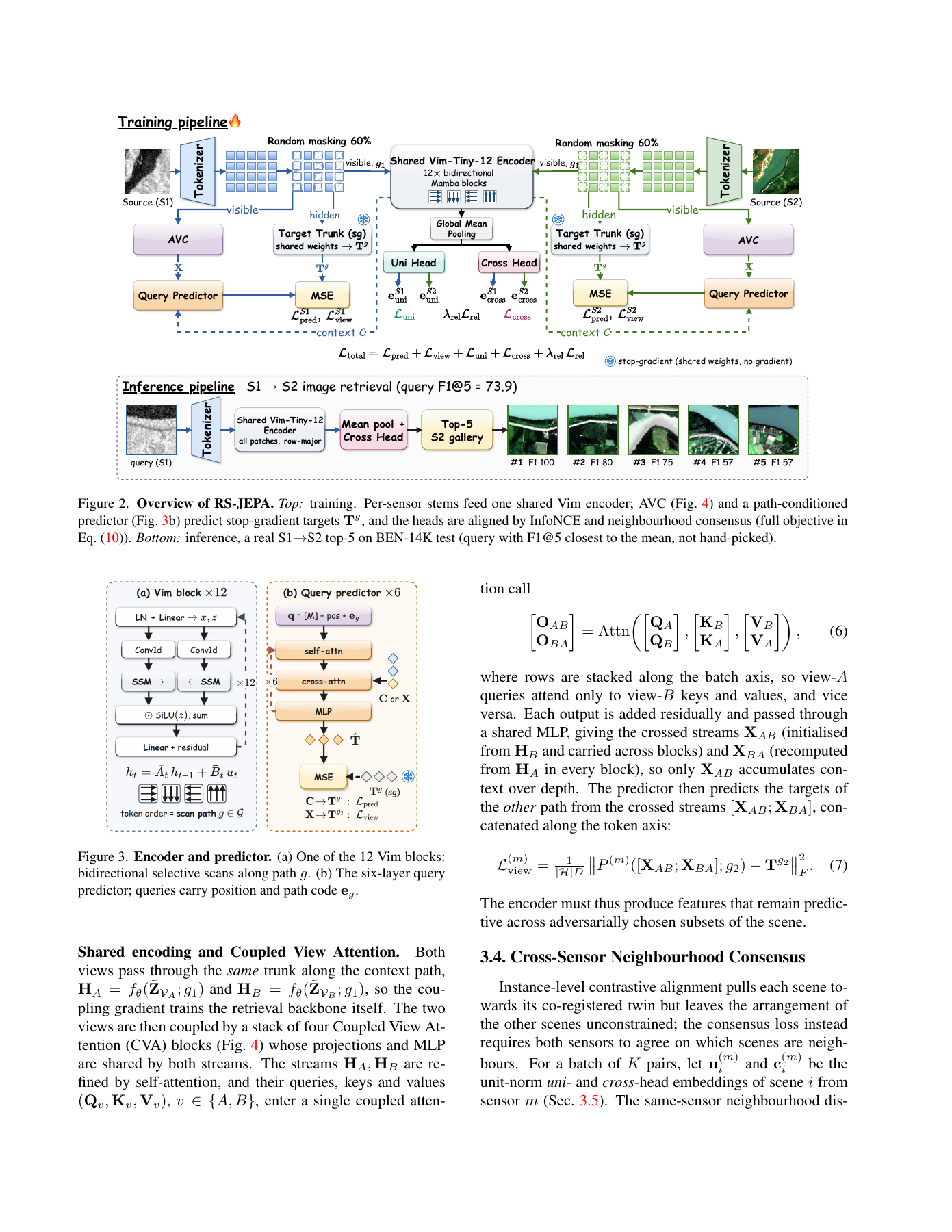
Figures 2 and 3, PDF page 4, from the original paper, © the original authors. The complete networks shown are outside local coverage. Image from the original paper; copyright belongs to its authors. Full-system or experimental results shown are not local component results.
Core equations
The traversals are row-major, column-major, horizontal row mirror and vertical column mirror, not complete sequence reversal. Equation 5 uses hard membership and \(\widetilde z_j=z_j(1+\omega_j-\operatorname{sg}\omega_j)\): the forward value is unchanged, while the scorer receives reversed gradients. Plain top-k slicing cannot replace it.
For \(j\ne i\), \(Q_m(j|i)\propto\exp(u_i^{m\top}u_j^m/\tau_r)\) and \(\bar Q_i=\operatorname{sg}[(Q_1+Q_2)/2]\). \(L_{rel}\) sums four KL terms, two within-sensor and two cross-sensor, divided by \(4K\). Every distribution excludes the twin; the target is detached.
Paper results
The authors report F1@5 72.92, 80.35 and 94.43 on BEN-14K, CBRSIR-VS and DSRSID, with about 3.88M retrieval and 14.57M training parameters. Their shared-budget baseline results are not each baseline's best published result. No production A/B test or local image-retrieval replication is reported.
Local implementation
Data contract and code mapping
scan_path() returns exact permutations. adversarial_partition() performs hard grouping, straight-through weighting and gradient reversal. neighbourhood_consensus() implements equations 8-9 and rejects singleton batches, zero vectors, non-finite values and mixed devices. Small synthetic tensors replace neither images nor a backbone; no complete JEPA training is claimed.
PYTHONPATH=src python -c 'from auto_research.multimodal.rs_jepa import diagnostic; print(diagnostic(42, device="cuda"))'
Results, controls and limits
CPU diagnostics 42/43/44 show scorer-gradient reference error below \(2\times10^{-15}\), equal disjoint partitions, unchanged token values, near-zero agreeing-distribution loss and sensor-swap invariance. An independent loop checks loss values and detached-target gradients. Unavailable CUDA fails explicitly, never silently falling back. Actual GPU validation is recorded separately at docs/gpu-validations/rs-jepa-a100-20261111.json; CPU tests cannot substitute for it. No Vim, full CVA/predictor or retrieval-capability result is included, and no Evolve operator is registered.
On 2026-11-11, seeds 42/43/44 completed real cuda:0 forward and backward execution on one NVIDIA A100. All eight mechanism checks passed for each seed, with maximum scorer-gradient reference error below \(8.89\times10^{-16}\). See the per-seed mechanism artifact and sanitized GPU receipt. CPU and CUDA random-number streams differ, so synthetic loss values need not match bit-for-bit. This remains a component validation, not an image-retrieval benchmark.
High-cost full experiment
The original campaign uses a 12-block Vim, six-layer predictor, four CVA blocks, batch 290 and 100 epochs across three paired datasets, independent repetitions and retrained baselines; DSRSID alone has 56,000 training pairs. The reported setup uses four V100s. The full comparison is too costly and is not reproduced (review DONE). Cheap tensor components still receive separate real-CUDA validation rather than being dismissed solely because the paper uses multiple GPUs.