FEND: accumulate evidence to a deadline instead of letting the first detector win
component_only / L0 voice-detection protocol interface. Only external detector events and separate labels are processed. Audio, ASR, LLM and AI-cadence classifiers are not implemented. The full private-call campaign is not reproduced due to cost (review DONE).
Paper information
| Field | Content |
|---|---|
| Paper | FEND: Far-End Detection in Outbound Voice AI Calls, fixed v1 |
| First-author affiliation | Abhishek Kumar, Observe.AI, India |
| Original publication | 2026-11-13 11:25:42 UTC, arXiv v1 |
| Author code | No verifiable paper-specific author code found in fixed v1. Cited nexmo-community repositories are not this paper's release |
| Local adapter / key | fend-protocol; adapter=null, not integrated into Evolve |
| Local code | src/auto_research/multimodal/fend_protocol.py |
Original paper
Background and main changes
Outbound voice systems distinguish people, voicemail, IVR and another AI. Mistaking a person for automation can terminate a useful call, so AI-detection AUC alone is insufficient. FEND concurrently reads audio, streaming ASR and existing dialogue-model tool events: an STFT beep detector, multilingual keywords, LLM voicemail/IVR tools, and an AI-cadence classifier using first-turn word timings. Reusing an already-running dialogue model does not mean this local interface implements free LLM detection.
Events accumulate through window \(W\), default 20 seconds. The final order is voicemail > IVR > AI > human, with human only when no detector fires. Later higher-priority evidence can supersede early AI evidence; this is not first-firing termination. The paper sweeps window and ordering on training data, not on public/private test results.
Architecture and workflow
flowchart LR
  A[External audio/transcript detectors] --> E[Timestamped events]
  E --> W[Accumulate to fixed deadline]
  W --> P[VM above IVR above AI]
  P --> O[Human default if no firing]
  O --> S[Independent outer scorer and human FPR]
Original paper figure
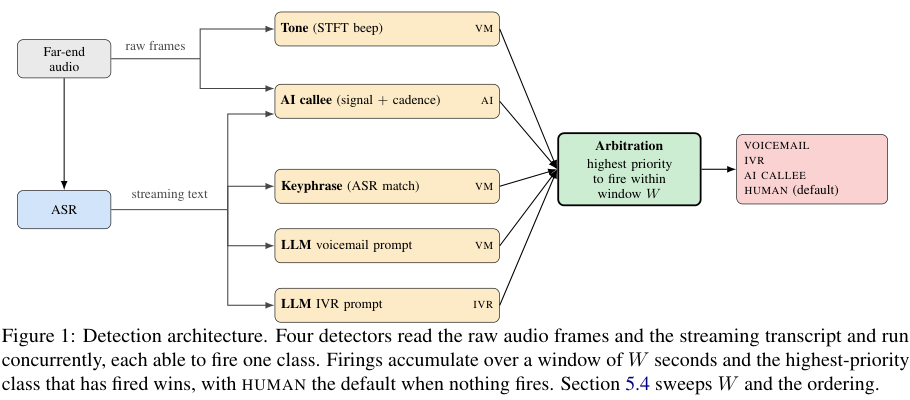
Fixed-v1 PDF p.3, Figure 1, including its caption. Left-side detectors and ASR are not local implementations. Original figure, copyright belongs to the authors. Crop and hashes.
Image from the original paper; copyright belongs to the original authors.
Core equations
For events \(e_j=(t_j,c_j)\) and automated-class priority \(\pi\):
The risk denominator contains only true humans:
HFPR is undefined without human examples; it must not be filled with zero. Acoustic candidates first face a cross-human-corpus calibration screen: \(g=(median(S)-median(R))/IQR(R)\), admitting only \(|g|\le1\). Passing does not imply positive-class discrimination. Local sample quantiles explicitly use linear interpolation and do not reproduce the complete acoustic front end.
Author results
Public Telephony-AMD has 400 clips, split 119 tuning/281 evaluation. Private 1,000-call data are divided roughly equally, with 501 calls in the held-out table. The private timing subset contains only 67 AI and 62 human calls with at least four timed words, yielding reported AUC 0.952. Human-versus-rest binary F1 is 0.979 with HFPR 2.9%; this is not four-class weighted F1. Default-order four-class accuracy is 0.938 and AI-class F1 only 0.571. IVR counts are tiny and should not be overgeneralized. Offline evaluation of production data is not randomized online A/B. No calls or models were evaluated locally.
Local implementation
Data protocol and code mapping
DetectorEvent requires finite nonnegative time, a named detector and an automated class. arbitrate sees only events, not gold, audio or answers. Events at \(t=W\) are included; later events are counted as ignored. No wall-clock sleep is needed. Detectors require trusted external implementations; hand-supplied events are not automatic detection accuracy.
The outer evaluate scores exactly matching call IDs. acoustic_null_gate compares external human-only scores, rejecting zero IQR and invalid values. Missing components include keyword matching, STFT, streaming ASR, GPT-4o tool prompts, seven-feature timing logistic regression, sample grouping, and the full train/tune/test pipeline.
PYTHONPATH=src python -c 'from auto_research.multimodal.fend_protocol import diagnostic; print(diagnostic(42))'
PYTHONPATH=src python -m pytest tests/test_nov18_agent_protocols.py -q
Diagnostics and limits
CPU protocol metrics test event-order invariance, late voicemail superseding early AI, the 20-second boundary, human default and shifted-human null rejection. These are synthetic interface diagnostics, not capability accuracy. Unlike GSLM2, FEND targets low-latency call classes and human rejection risk, not multi-stream speech representation learning. Both local slices depend on external model outputs and must not be presented as reproduced speech models.
High-cost full experiment
The complete pipeline needs private production calls, commercial ASR, existing dialogue-LLM tools and trained timing/acoustic detectors. A single A100/A30 or Mac cannot cheaply recreate these resources. Full experiment not reproduced due to cost (review DONE). No audio/weights, calls, ASR API or automatic retry. This CPU interface has no CUDA gate and remains promotion_eligible=false, evolve_integrated=false.