JEPA Dots: Dual-Latent World Model for Language-Guided Robot Control
Review only; no implementation. Full experiments: high cost, not reproduced (review DONE).
Paper information
| Field | Value |
|---|---|
| Paper link | arXiv:2611.24062v1; fixed PDF |
| Company / institution / school | Xianhao Pan: Z Robotics (fixed-v1 PDF byline) |
| Original publication date | 2026-11-18T08:55:54Z (arXiv v1); announcement2026-11-19 |
| Original source code | No author method source or license verified in fixed v1; dependencies are not a method release. |
| Local adapter / key | jepa-dots; adapter: null; not Evolve-integrated |
| Local reproduction code directory | None (not reproduced) |
Original paper summary
Background and main changes
A shared visual backbone feeds separate dynamics and task latents; language FiLM enters only the task path. World queries read dynamics history and supplied clean actions; the policy reads history, goals and noisy actions. Multi-layer masks also block indirect leakage. Fixed observations/actions/parameters yield instruction-invariant world predictions while policy actions may change.
flowchart LR
 O[Observations] --> B[Shared visual backbone]
 B --> D[Dynamics latent]
 B --> T[Task latent with language FiLM]
 L[Instruction] --> T
 D --> W[World branch with clean supplied actions]
 D --> P[Flow policy]
 T --> P
 P --> A[Execute first two of eight actions]
 W --> S[Training supervision only]
Original paper figure
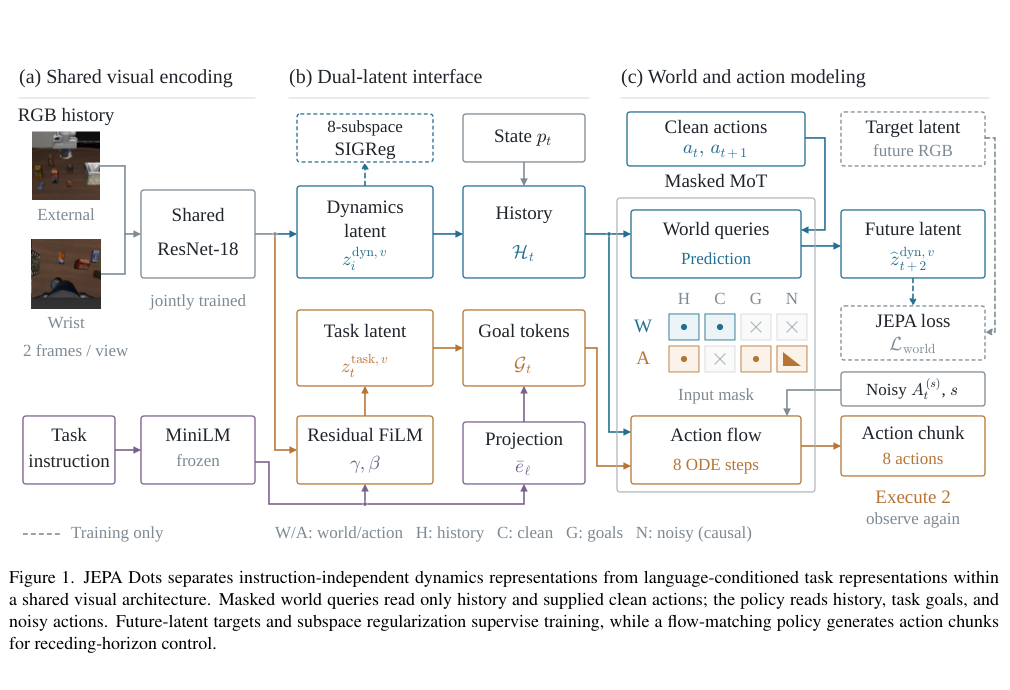
Original PDF crop, no semantic edits; author method, not local evidence. Page, crop and SHA256. Copyright retained by the original authors.
Core equations
The invariance is a forward-conditioning property, not statistical independence after joint backbone training. The world branch supplies training supervision; deployment generates eight actions by action flow and executes the first two before replanning, rather than searching actions through the world model.
Paper offline and online results
The reference experiment reports84.9% over40 trained LIBERO tasks versus76.0% for its task-ID adaptation baseline. Published NanoVLA-S comparisons use different protocols, not a controlled matched-budget win. No production A/B or local robot-success measurement is claimed.
Local reproduction
Data protocol and code mapping
Review-only method, equations, affiliation and cost. There is no operator, training, LIBERO installation, robot run, metrics or GPU receipt. A trivially language-free function would not reproduce the dual-latent controller.
Same-topic comparison and boundaries
LeWAM jointly models worlds/actions and plans through prediction. JEPA Dots separates language goals from fixed-action dynamics and does not use its world branch for deployment action search. Shared masked-MoT ancestry does not imply identical inference.
High-cost full experiment
The39.1M total includes a frozen sentence encoder. Training uses60epochs/about15k updates;40tasks require4000closed-loop episodes/model, up to600steps each, and three-run ablations use12000episodes/variant. Small parameter count does not make this campaign cheap. No LIBERO download, training probe or long control run is attempted.
High cost, not reproduced (review DONE). No full experiment, large download, automatic retry or implementation queue; no capability promotion.