ReMax
Value-free RLHF mechanism with sampled and greedy candidate rollouts.
Paper information
| Field | Details |
|---|---|
| Paper | Paper or original source |
| Institution | The Chinese University of Hong Kong, Shenzhen / Shenzhen Research Institute of Big Data / Nanjing University. |
| First public release | 2023-10-16 |
| Author code | liziniu/ReMax. |
| Local adapter or method key | remax |
| Local reproduction code | src/auto_research/post_training/ |
Paper method and evidence
LLM rollouts have fast simulation, deterministic token transitions and typically terminal rewards. Drop PPO's value model and subtract the current policy's greedy reward as a prompt-dependent baseline for lower-variance REINFORCE.
flowchart LR
  A[Sample response and reward] --> B[Compute greedy baseline]
  B[Compute greedy baseline] --> C[Value-free update]
Original paper figure
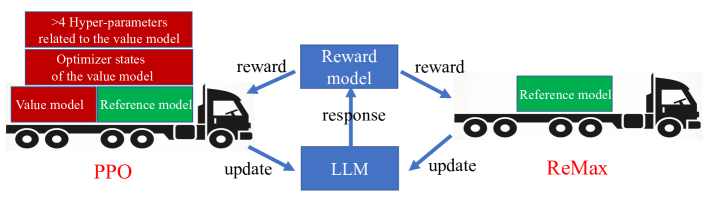
Figure shows a greedy control rollout. From the original paper; copyright remains with the authors.
Core equation
Reported results
The paper reports about 46% less GPU memory than PPO for 7B training. Mistral-7B reaches 94.78% AlpacaEval win rate and 7.739 MT-Bench. No production A/B.
Local reproduction
Local accuracy 0.1641→0.7031, reward 0.3126→0.7554, KL 0.0000→0.7939. Metrics. Greedy candidates stand in for autoregressive decoding. No Mistral-7B, distributed training, memory benchmark or AlpacaEval reproduction.