Dr. GRPO: Remove length and group-variance bias
Isolated RL update, not paper-scale long reasoning.
Paper information
| Field | Details |
|---|---|
| Paper | Dr. GRPO (arXiv 2503.20783) |
| Institution | SAIL research team. |
| First public release | 2025-03-26 |
| Author code | sail-sg/understand-r1-zero. |
| Local adapter or method key | dr-grpo |
| Local reproduction code | src/auto_research/post_training/ |
Paper method and evidence
GRPO's response-length averaging and within-group standard deviation can introduce length and problem-difficulty biases. Remove both normalizations while keeping centered group-relative reward so trajectories retain their scale.
flowchart LR
  G[Group rewards] --> C[Center without dividing by std]
  C --> U[Clipped update without per-response length average]
Original paper figure
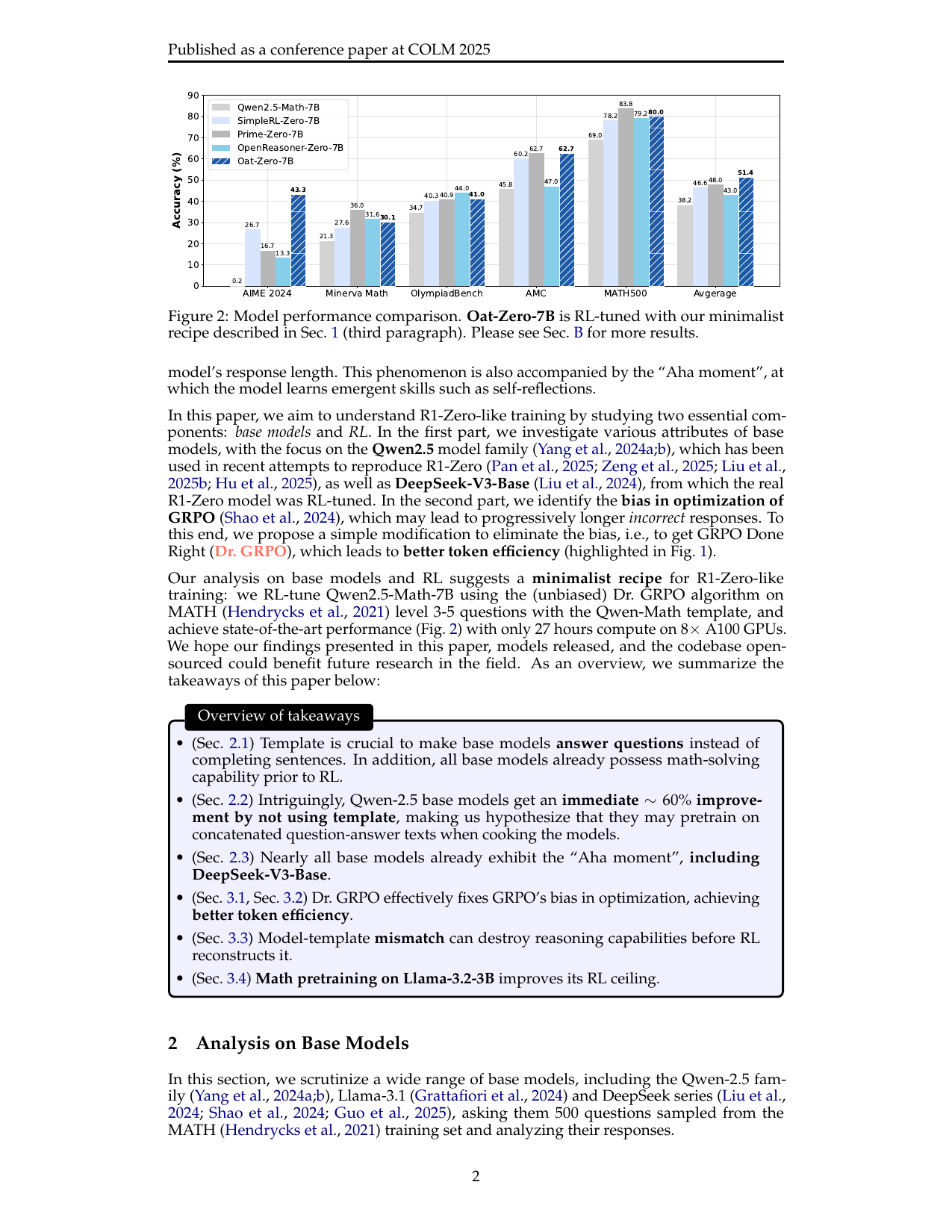
The original figure documents the GRPO normalization analysis. From the original paper; copyright remains with the authors.
Core equation
Reported results
The paper reports better token efficiency without losing reasoning performance and 43.3% AIME24 using a minimal R1-Zero recipe on a 7B base. No online A/B.
Local reproduction
On the same GSM8K candidate policy, steps and seed, remove group std and proxy-length normalization and compare update statistics to GRPO.
auto-research post-train --algorithm dr-grpo --dataset gsm8k-candidate --maximum-examples 256 --steps 120 --seed 42
Fixed-seed summary. Candidate policies do not freely generate response lengths; proxy lengths expose normalization effects, not token-level long-CoT training.