Sparse OPD: Distilling One or Two Key Tokens per Trajectory
Core mechanism evidence. Paper and local evaluations are separate.
Paper information
| Field | Value |
|---|---|
| Paper | arXiv 2609.04565 |
| Affiliations | Amazon / Duke University; work during Amazon internship |
| First public release | 2026-09-03 (arXiv v1) |
| Authors' code | No public code repository found as of 2026-09-07. |
| Adapter / method | sparse-opd |
| Local code | src/auto_research/post_training/latest_20260907.py |
Original paper
Background and contribution
Instead of supervising every generated token, choose one or two key positions (about 0.05%). Largest positive differences work particularly well, suggesting targeted correction rather than word-for-word matching.
flowchart LR
  Y[Student trajectory] --> D[Teacher-student differences] --> K[Select sparse positions] --> L[Masked distillation]
Key figure from the paper
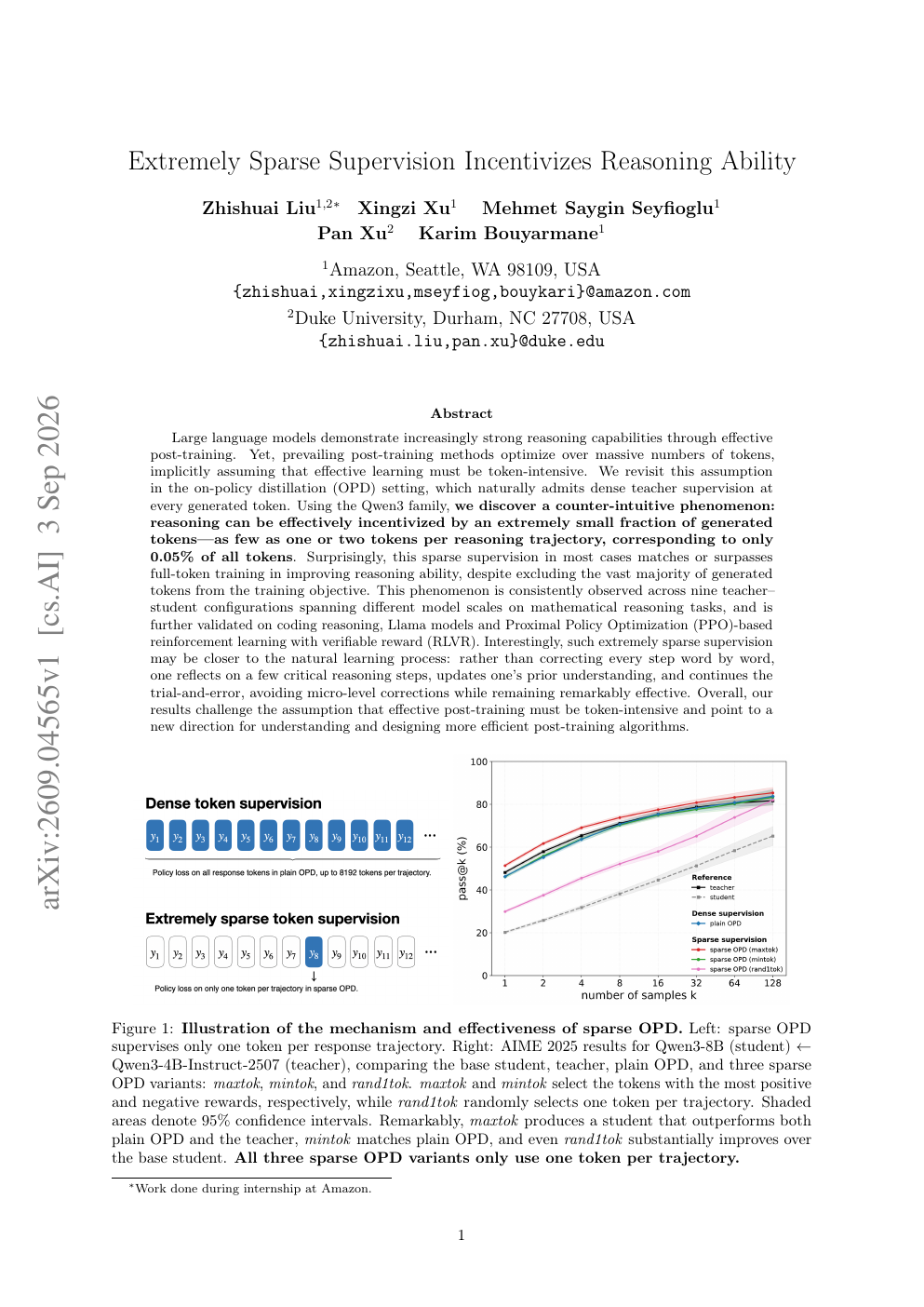
Original Sparse OPD figure. From the paper; copyright belongs to the authors. Not a local result.
Core mechanism
On student trajectory \(y\), compute teacher–student differences \(d_t\). Select \(S_k=\operatorname{TopK}_t(d_t)\) and optimize \(\mathcal L=-|S_k|^{-1}\sum_{t\in S_k}\log p_T(y_t|y_{<t})/p_\theta(y_t|y_{<t})\).
Paper results
Nine Qwen3 teacher/student pairs, math/code, Llama, and PPO-RLVR. Single-token maxtok exceeds dense OPD and the teacher in an example.
Local reproduction
The shared runner implements maximum/minimum difference and random sparse selection. Arithmetic-smoke seeds 42/43/44 record counts, ratios, selection gaps, and objective values.
Reproduction limits
Loss-mask/selection check only, not AIME/LiveCodeBench or full Qwen/Llama OPD/PPO. No advertised CUDA path.