MaD-RL: Matching Category Distributions with Reinforcement Learning
Google/Meta priority reference linked to existing experiments. Full study too costly; not reproduced (review DONE). Mechanism evidence is not original math/code capability.
Paper information
| Field | Value |
|---|---|
| Paper | arXiv 2609.31644; Meta publication |
| Affiliation | First author Sourabh Kulkarni, Meta Superintelligence Labs |
| First public release | 2026-09-12 11:12:59 UTC, arXiv v1. Meta catalog date is September 24; PDF date does not override submission. |
| Authors' code | No release found in checked paper and official sources; unrelated robotics MAD is not this implementation. |
| Adapter/key | adapter: null; reference/existing CLI mad-rl; separate GPU diagnostic mad-rl-qwen-choice |
| Local code | Existing src/auto_research/post_training/mad_rl.py and scripts/mad_rl_qwen_choice.py; unchanged |
Original paper
Background and contribution
Per-example correctness can collapse output categories. MaD-RL matches category frequency to a target, rather than merely raising token entropy. L2, forward KL, reverse KL, or JSD rewards derived from group frequencies combine with correctness for GRPO. Measure distribution fit and accuracy separately. See Section 2.
flowchart LR
 P[Policy samples group freely] --> C[Fixed category extractor]
 C --> F[Empirical frequencies including invalid outputs in denominator]
 T[Target distribution] --> R[Divergence reward]
 F --> R
 R --> G[Correctness mixture and GRPO] --> P
Key figure from the paper
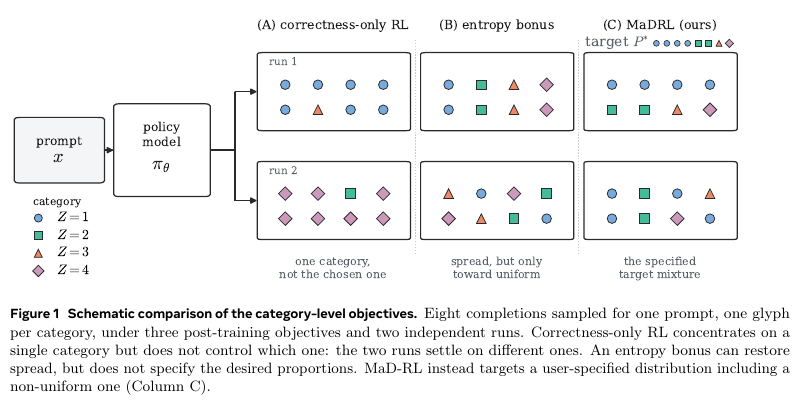
Original page 2 compares correctness, entropy, and target distribution matching. From the paper; copyright belongs to the authors, not a local result.
Core equations
For empirical \(p\) and target \(q\), rewards are q_z-p_z (L2), q_z/p_z-1 (forward KL), log(q_z)-log(p_z) (reverse KL), and 0.5*(log((q_z+p_z)/2)-log(p_z)) (JSD). Treat empirical frequencies as fixed during updates. Handle zero target probabilities by smoothing; unsampled categories cannot receive on-policy reward. Group normalization, clipping, and mixing with correctness differ from the population gradient.
Paper results
Synthetic category selection, multilingual math, and multilingual programming measure fit–accuracy tradeoffs. No production A/B. The complete math/code benchmark was not reproduced.
Local evidence
The existing experiments and negative results are the source of record. Character GRU and Qwen3-4B five-choice diagnostics are not free-form math/code. The three Qwen arms tied on validation; no distribution-reward difference was observed. The A100 receipt remains bound to mad-rl-qwen-choice, not this catalog key. No new CUDA implementation or run.
Cost decision
Section 3.2 uses 6,000 steps, group 32, and 48 Qwen3-4B synthetic runs; math/code uses 1,200 steps, group 16, multiple recipes and three seeds. Too costly; not reproduced (review DONE). No automatic retraining, removal of negative results, or Evolve claim; this entry links the catalog and dates only.