LSPD: Least-square policy distillation from an RL perspective
L1 mechanism and real checkpoint CUDA path; no full reasoning training gains.
Paper information
| Field | Details |
|---|---|
| Paper | An RL View of OPD: Least Square Policy Distillation for Sample-Efficient LLM Reasoning |
| Institution | University of North Carolina at Chapel Hill (first author). |
| First public release | 2026-09-28 (arXiv v1) |
| Author code | UNCSciML/LSPD. |
| Local adapter or method key | lspd |
| Local reproduction code | src/auto_research/post_training/latest_20260930.py |
Paper method and evidence
Use teacher–student log-probability residuals, squared near zero and linear in the tails, with reuse of historical query–response trajectories.
flowchart LR
  Q[Query and response] --> S[Student log-prob]
  Q --> T[Detached teacher log-prob]
  S --> R[Robust residual]
  T --> R
  R --> E[Subtract entropy reward]
  E --> U[Update student and replay]
Original paper figure
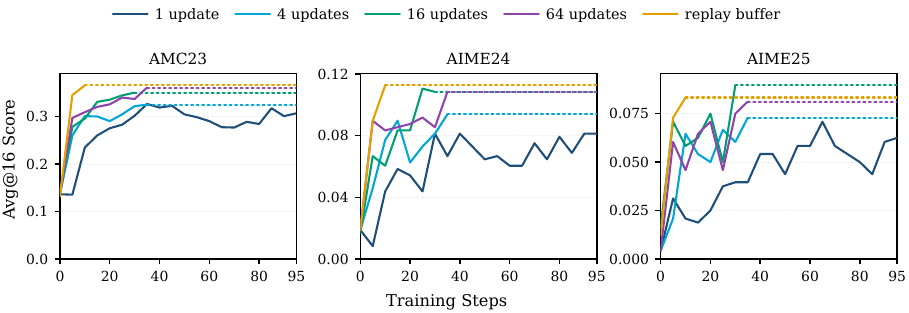
The original method figure shows the RL interpretation and replay flow. From the original paper; copyright remains with the authors.
Core equation
For \(d_t=\log\pi_\theta(y_t)-\operatorname{sg}(\log\pi_T(y_t))\), use \(d_t^2\) if \(|d_t|\le c\), else \(2c|d_t|-c^2\), then subtract entropy regularization. Average valid tokens per response, then responses equally.
Reported results
Reasoning benchmark and sample-efficiency claims belong to the paper. Local three-seed metrics only test teacher stop-gradient, tails, masks and replay. A100 receipt.
Local reproduction
lspd_objective and LSPDReplayBuffer support direct training use; the generic post-training CLI is an L1 candidate-policy analog. Aggregated metrics. No full reasoning data pipeline, large teacher rollout or Evolve integration; real controller updates plus isolated validation are required.