From Dissonance to Orchestration: Teacher Intervention in On-Policy Distillation
L1 mechanism diagnostic. Top-k coverage/Bhattacharyya PDS, no teacher rollout generation.
Paper information
| Field | Value |
|---|---|
| Paper | arXiv 2609.37510 |
| Affiliations | Nanyang Technological University, first author's affiliation |
| First public release | 2026-09-29 (arXiv v1) |
| Authors' code | MAESTRO |
| Adapter / method | maestro-opd |
| Local code | src/auto_research/post_training/latest_20261001.py |
Original paper
Background and contribution
Compute per-token disagreement with teacher top-k coverage and Bhattacharyya similarity, emphasizing positions near the response start. Intervene where disagreement is high rather than paying for full teacher rollouts.
flowchart LR
  I[Teacher and student distributions] --> P[Coverage and disagreement] --> W[Position weights] --> S[Intervention selection]
Key figure from the paper
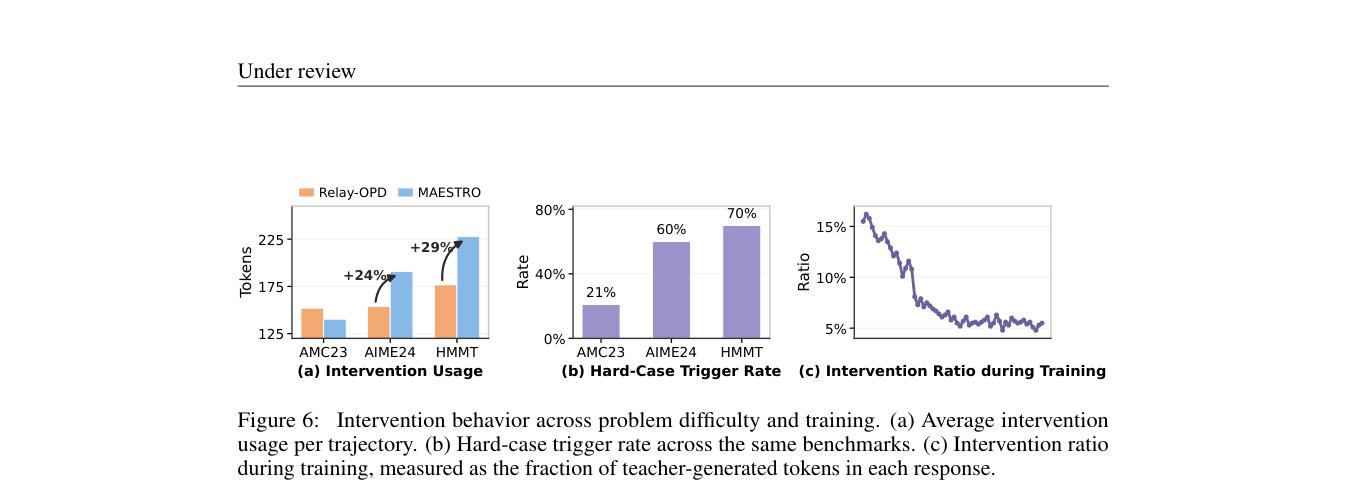
Original Figure 6: training and teacher intervention. From the paper; copyright belongs to the authors. Not a local result.
Core mechanism
\(PDS_t=1-C_tB_t\); \(C_t\) is the teacher probability covered by the student's top-k and \(B_t\) the Bhattacharyya coefficient of normalized top-k distributions.
Paper results
Qwen3 0.6B/1.7B report the best macro averages across eight math benchmarks and about 67.3% shorter responses than standard OPD.
Local reproduction
Compare disabled/default and enabled. Three-seed diagnostics verify only mechanism invariants and transitions (diagnostic_only=true).
Reproduction limits
PDS calculation only, not teacher rollout generation or full benchmark training.