简体中文 · English
My FAULT: Self-Diagnosis as Credit Assignment in Self-Evolving Agentic Reinforcement Learning
L1 core mechanism diagnostic. Verified diagnosis, error costs and credit-conserving redistribution execute. The policy and diagnostic model were not trained jointly.
Paper information
| Field | Details |
|---|---|
| Paper | arXiv 2610.01161 |
| Institution | Alibaba Group (first author affiliation) |
| First public release | 2026-10-01 (arXiv v1) |
| Original source code | No public author implementation found as of 2026-10-02. |
| Adapter | my-fault |
| Local reproduction code | src/auto_research/post_training/latest_20261002.py |
Original paper summary
Background and main changes
A self-diagnoser proposes error categories and locations. Only claims verified by evidence enter online error pricing. Learned relative costs redistribute terminal credit to steps while conserving its total.
flowchart LR
  I[Input and current state] --> M[Verified diagnosis and credit redistribution]
  M --> A[Auditable intermediates]
  A --> O[Output or state update]
Key figure from the paper
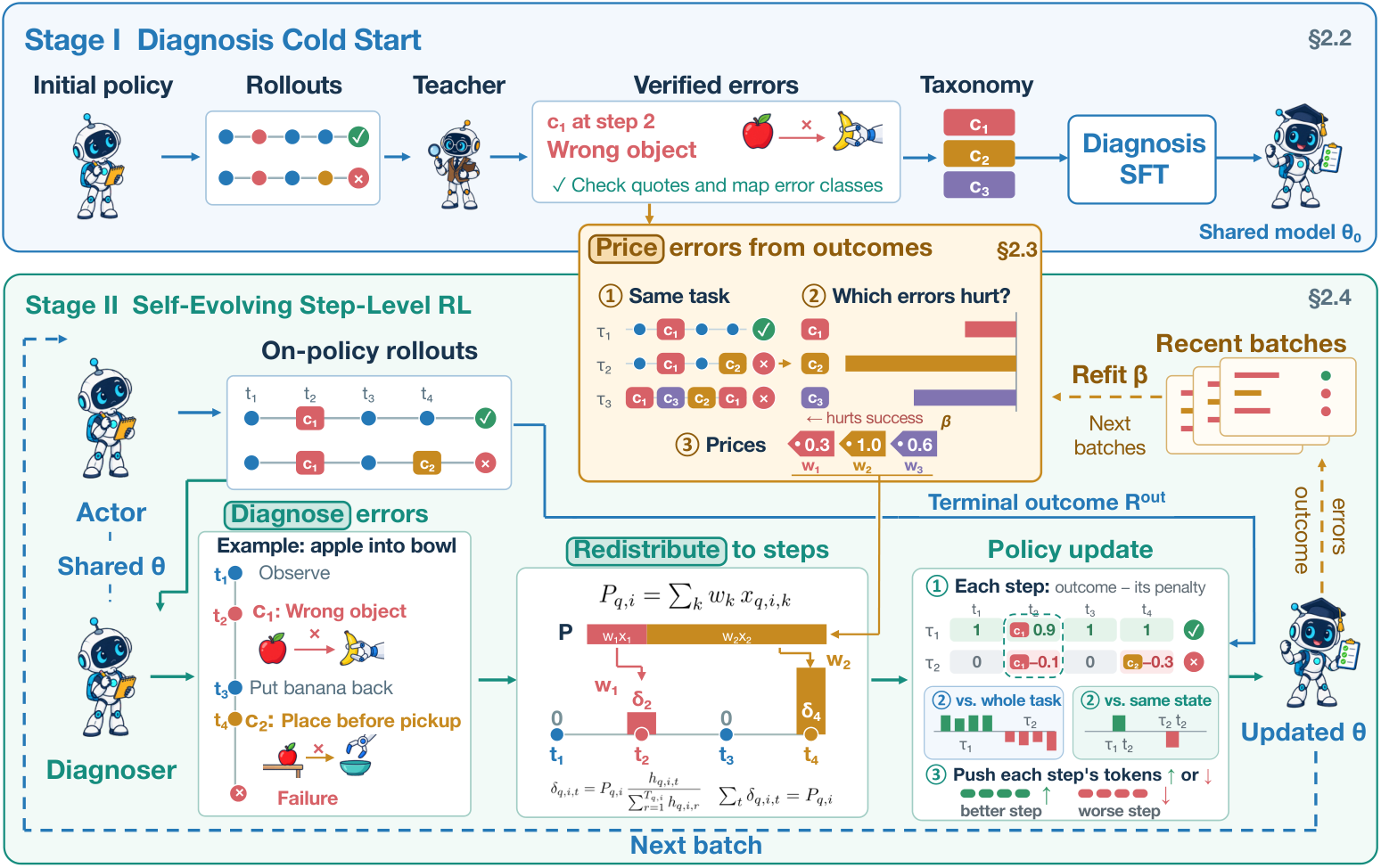
Paper figure: Core architecture, training flow or protocol. From the paper; copyright belongs to the authors. Click for the source.
Core equations
\(\sum_t r'_t=R\), with \(r'_t=R(1/T+\bar p-p_t)\).
Offline and online results
The paper reports ALFWorld signal coverage of 95% versus 41% for GRPO and 72% for GiGPO, and large improvements on ALFWorld and WebShop.
Local reproduction
Comparison protocol: Disabled or default mechanism versus enabled operator. Relative percentages are not applicable; this checks invariants, gradients or state transitions, not paper-scale effects.
- Three-seed diagnostic:
metrics/mechanism-seeds42-44.json. diagnostic_only=true; excluded from formal capability rankings.
Scope
Verified diagnosis, error costs and conserving redistribution execute. No joint policy/diagnoser training.