Range-GRPO: Policy Optimization via Pairwise Relations among Reward Intervals
L1 mechanism diagnostic. Pairwise interval relations and point-limit behavior, no fitted conformal judge or large-model GRPO.
Paper information
| Field | Value |
|---|---|
| Paper | arXiv 2610.01548 |
| Affiliations | Yonsei University, first author's affiliation |
| First public release | 2026-10-01 (arXiv v1) |
| Authors' code | No public author implementation found as of 2026-10-02. |
| Adapter / method | range-grpo |
| Local code | src/auto_research/post_training/latest_20261002.py |
Original paper
Background and contribution
Use conformal reward intervals instead of point judge scores. Give a directional signal only for determinately ranked pairs; overlapping intervals do not create spurious preference.
flowchart LR
  I[Reward intervals] --> P[Pairwise comparison] --> A[Group advantage] --> O[Policy objective]
Key figure from the paper
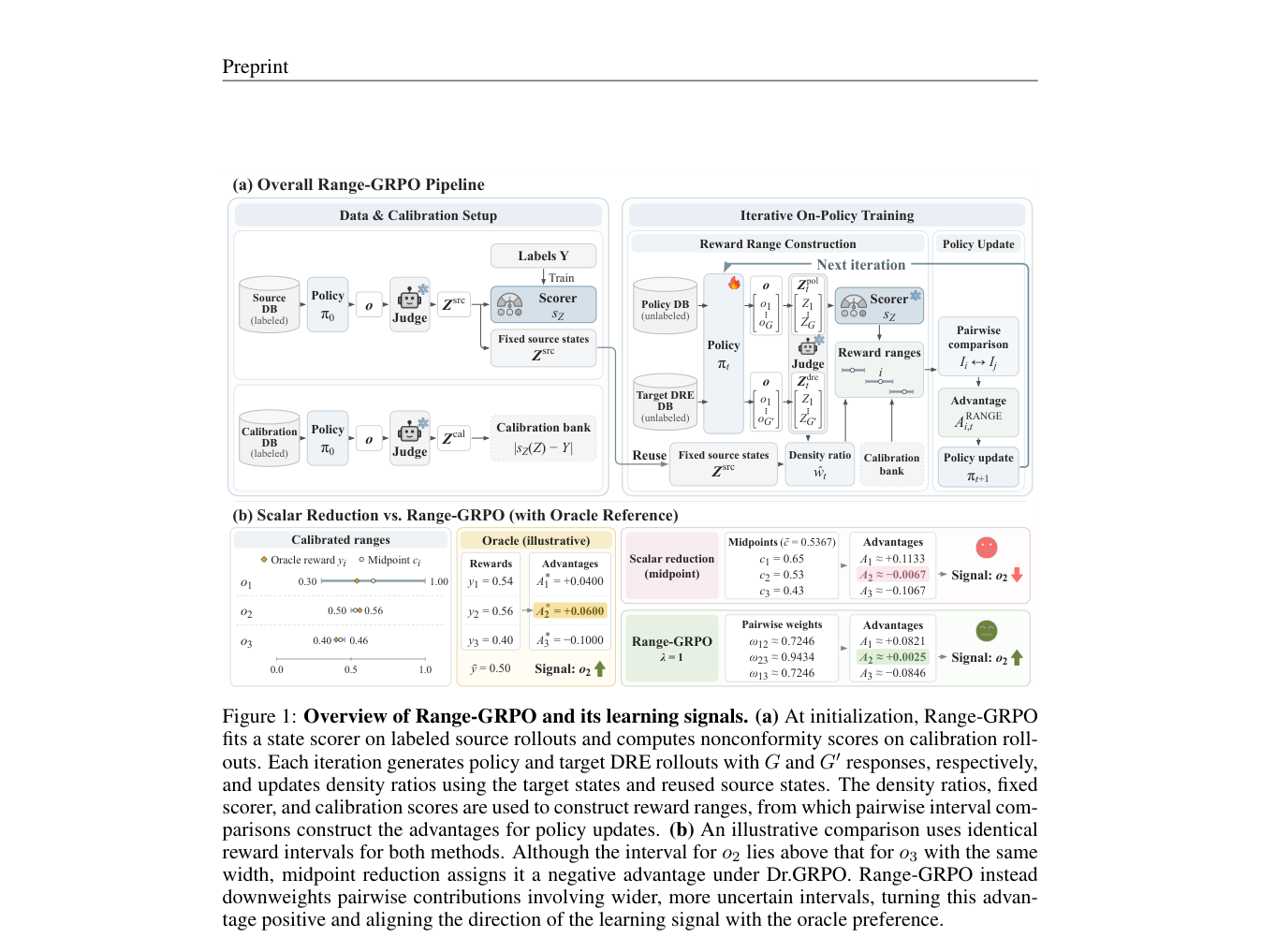
Original Range-GRPO protocol diagram. From the paper; copyright belongs to the authors. Not a local result.
Core mechanism
\(A_i=G^{-1}\sum_j relation([l_i,u_i],[l_j,u_j])\). Collapsing intervals to points recovers DR-GRPO.
Paper results
The paper reports the best mean in- and out-of-distribution results among evaluated semi-supervised methods, with fewer training resources.
Local reproduction
Compare disabled/default to enabled. Three-seed diagnostics check invariant, gradient, and state behavior, not paper-scale effects (diagnostic_only=true).
Reproduction limits
Pairwise interval/point-limit checks only; no judge fitting or large-model GRPO.