Where-OPD: Spatially Guided On-Policy Self-Distillation of MLLMs with Synthetic Scenes
L1 mechanism diagnostic. Spatially masked teacher KL, without scene generation or an MLLM.
Paper information
| Field | Value |
|---|---|
| Paper | arXiv 2610.02117 |
| Affiliations | Valeo.ai, first author's affiliation |
| First public release | 2026-10-01 (arXiv v1) |
| Authors' code | Where-OPD |
| Adapter / method | where-opd |
| Local code | src/auto_research/post_training/latest_20261002.py |
Original paper
Background and contribution
Procedural scenes supply object identities and coordinates. Give the teacher textual spatial privilege while the student sees only image and question. Distill teacher scores on the student's on-policy tokens.
flowchart LR
  G[Privileged spatial description] --> T[Teacher scores]
  I[Image and question] --> S[Student rollout]
  T --> K[Masked KL]
  S --> K
Key figure from the paper
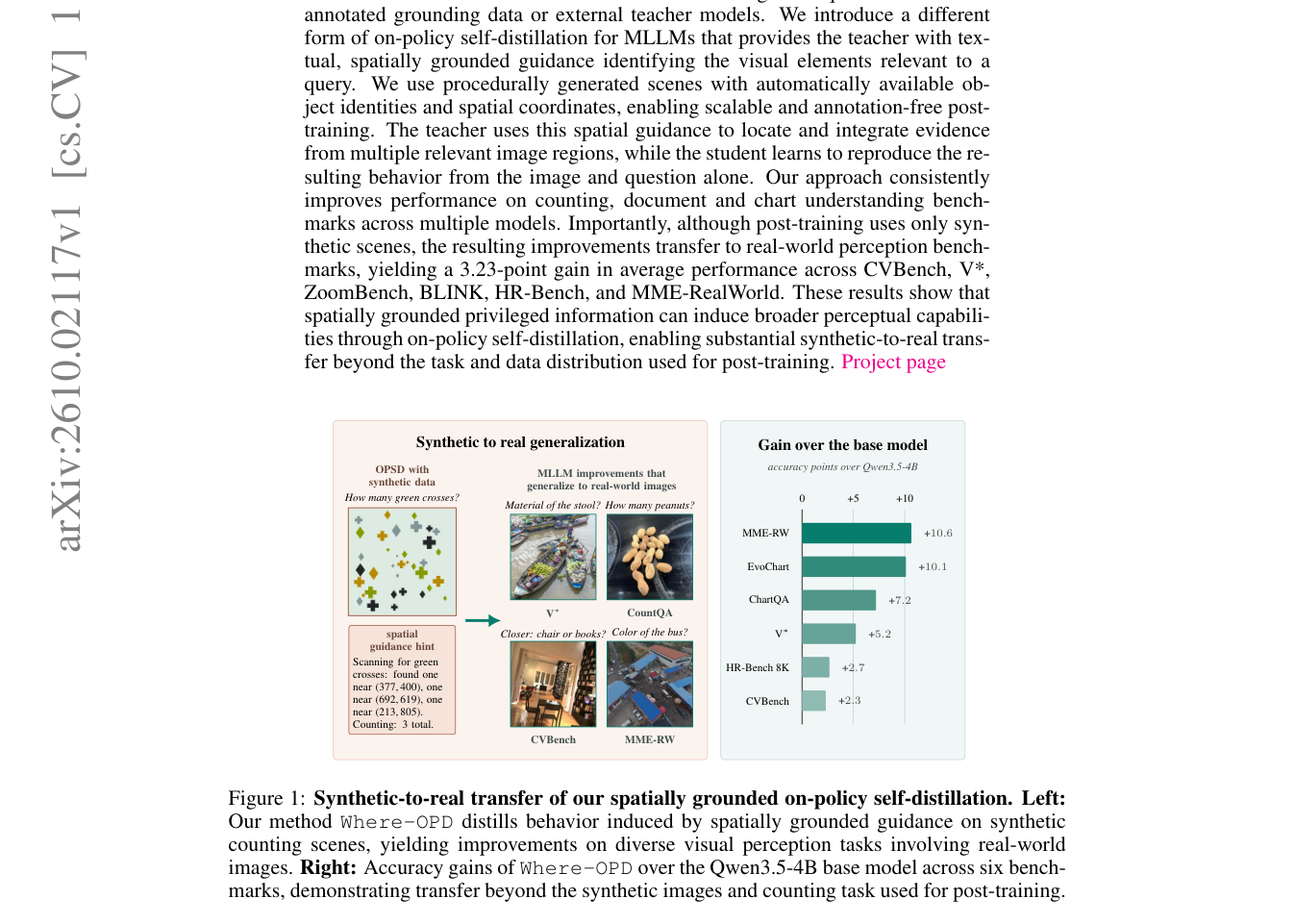
Original paper diagram of spatially guided distillation. From the paper; copyright belongs to the authors. Not a local result.
Core mechanism
\(L=\sum_t m_t KL(\pi_T(\cdot|x,g),\pi_S(\cdot|x))/\sum_tm_t\).
Paper results
Training only on synthetic scenes reportedly gains 3.23 points on average across six real vision benchmarks.
Local reproduction
Compare disabled/default and enabled mechanisms. Three-seed diagnostics are diagnostic_only=true, checking invariant, gradient, or state behavior only.
Reproduction limits
No synthetic scenes were generated locally and no MLLM was loaded. Random logits are not visual results.