Follow the Winners: conservative policy improvement from elite trajectories
L1 core-mechanism diagnostic. Implements Algorithm 2's FIFO trajectory pool, repeated minibatch top-\(K\) selection, and KL-regularized cross-entropy policy projection. Runs only on a synthetic two-armed bandit, not the paper's LLM-agent training.
Paper information
| Field | Details |
|---|---|
| Paper | arXiv 2610.03361 v1 |
| Organization | Trent AI Limited (first author Joery A. de Vries; collaborators also affiliated with the University of Cambridge) |
| First public release | 2026-10-02 (arXiv v1; announced October 5) |
| Authors' code | Not released. The reproducibility statement says code, models, and data will not be released before acceptance and internal legal review. |
| Local adapter | follow-the-winners, standalone L1 mechanism API, not registered as a full reproduce adapter |
| Local reproduction code | src/auto_research/post_training/follow_the_winners.py; scripts/run_follow_the_winners_20261005.py |
Original paper
Motivation and method
In stateful tool environments, repeatedly generating equivalent rollouts for one prompt can be expensive, while a PPO critic requires extra model resources. FTW uses no value estimates and does not need GRPO-style groups for the same question. It stores real trajectories from recent policies in a FIFO pool, repeatedly samples minibatches, imitates only the \(K\) highest-return trajectories in each batch, and constrains updates with KL. Reselection counts naturally weight past trajectories, rather than cutting the entire pool once.
flowchart LR
  A[Current policy collects trajectories] --> B[FIFO replay pool]
  B --> C[J uniform draws of C trajectories]
  C --> D[Keep top K by terminal return]
  D --> E[Cross-entropy over selected trajectories, including repeats]
  E --> F[Add policy-reference KL and update]
  F --> A
Key figure from the paper
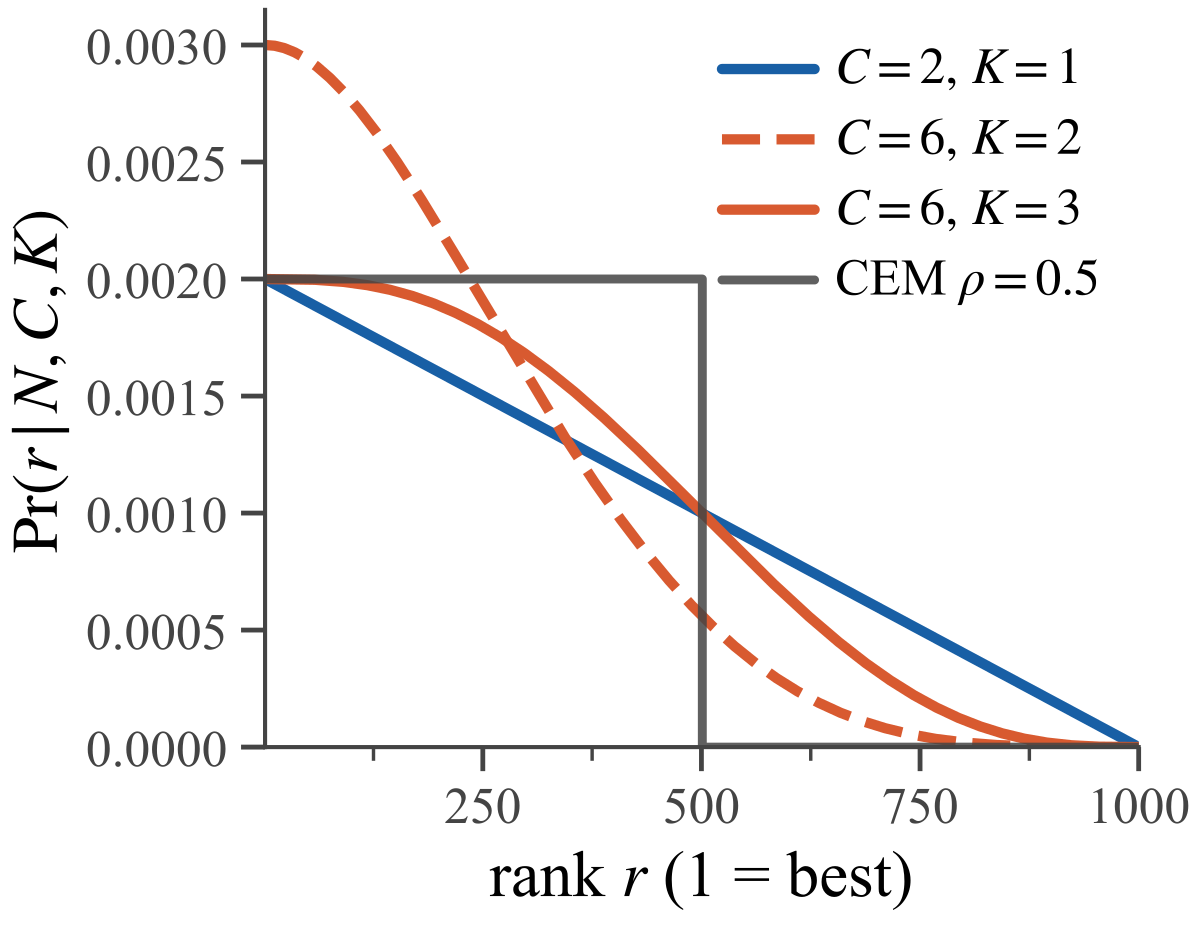
Figure 1: Probability of retaining a trajectory by return rank under different \(C,K\). \(C\) controls concentration and larger \(K\) softens selection. From the original paper; copyright remains with the authors.
Core equation
For a pool of capacity \(N\), rank \(r=1\) has the highest return. Sampling \(C\) without replacement and retaining \(K\) gives the normalized rank occupancy of Equation (5):
The implementation checks that the probabilities sum to one. \(K=C\) reduces to uniform sampling, and \(C=N\) to full-pool CEM. Training averages action log likelihood across \(J\) batches of elites and adds KL against the reference policy. The same trajectory can be selected in multiple batches as part of the original selection distribution.
Paper results
On Search-R1 with Qwen2.5-3B-Instruct, the paper reports 35.46% ± 0.15% exact match, versus PPO and GRPO baselines of 32.5% and 33.6%. Sokoban results are close to PPO/GRPO in some \((C,K)\) settings, but collapse occurred with \(K=3,C=5\). With many tied binary rewards, selection can mistakenly imitate failures. These are paper results, not local measurements. No production online A/B test is reported.
Local reproduction
PYTHONPATH=src python scripts/run_follow_the_winners_20261005.py
python -m pytest tests/test_follow_the_winners_20261005.py
The deterministic three-seed local artifact reports that the probability of selecting the optimal arm in the synthetic continuous-reward two-armed bandit rises from 0.5 to approximately 0.968. This is an instructional-scale mechanism check, not a comparison with Search-R1. Tests also cover Equation (5) normalization, repeat elite selection, FIFO expiration, and gradient direction.
Reproduction boundaries
The implementation did not train Qwen, run Sokoban or Search-R1, or compare with PPO/GRPO at matched budget. Known bandit means are diagnostic only, not validation/test tuning or capability evaluation. The artifact is diagnostic_only=true and formal_comparison=false, ineligible for public capability claims or evolve promotion. A formal comparison would need actual tool trajectories and reproducible terminal returns, matched sampling budgets, and multi-seed baselines. A claimed CUDA path would also need A100/A30 execution and a sanitized receipt.