Semi-OPD: When Do We Need On-Policy Distillation? Distilling on Offline Student Rollouts Is Often Better
Core mechanism. Short-budget runs on real checkpoints validate the training path, not paper-scale capability.
Paper information
| Field | Details |
|---|---|
| Paper | Original paper |
| Organization | First-author affiliations: UCLA / NVIDIA (internship noted in the paper) |
| First public release | 2026-10-08 (arXiv v1) |
| Authors' code | No author-released code was found as of 2026-10-10. |
| Local adapter | semi-opd |
| Local reproduction code | oct10_objectives.py, oct10_checkpoint.py |
Original paper
Motivation and method
The initial student generates responses once. Teacher scores are cached and reused unchanged. Each update recomputes current student probabilities and token advantages; caching old advantages would change the method.
flowchart LR
  A[Initial student samples] --> T[Teacher scores once] --> C[Immutable cache] --> S[Current student rescores] --> R[Refresh advantages] --> U[Update student]
Key figure from the paper
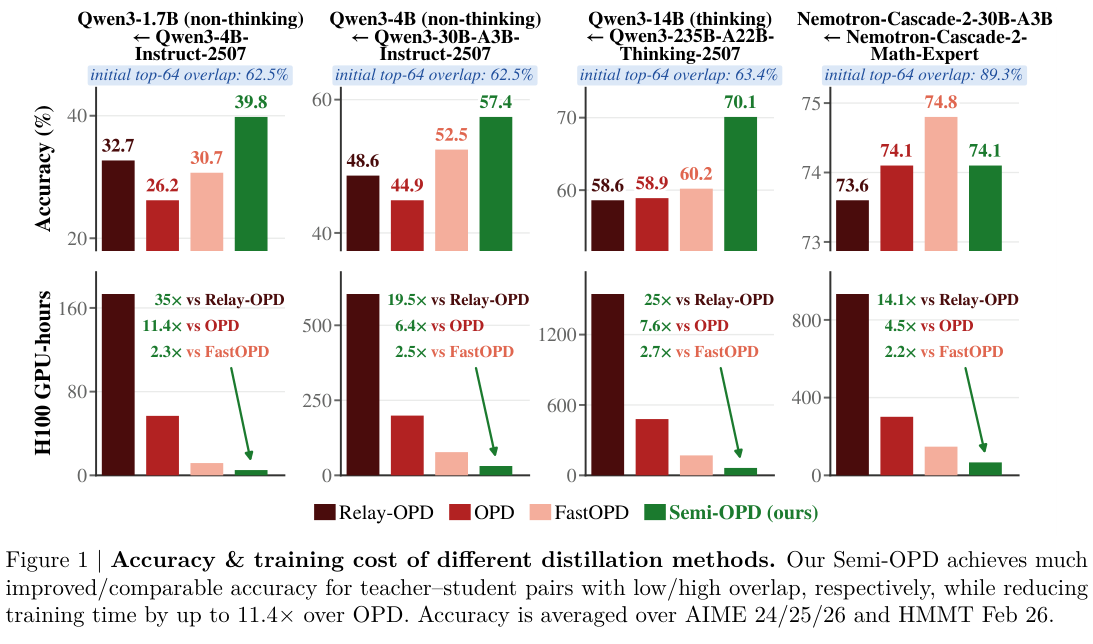
Figure 1: Accuracy and H100 training time at different teacher–student overlaps, including advantages of offline student rollouts and the high-overlap exception. These are paper results, not local accuracy or speed measurements. From the original paper; copyright remains with the authors.
Core equations
\(\mathcal D_0=\{(x,y):y\sim\pi_0\}\) is fixed. Recompute \(A_t=\log\pi_T(y_t|s_t)-\log\pi_\theta(y_t|s_t)\) at every step, with objective \(-\operatorname{sg}(A_t)\log\pi_\theta(y_t|s_t)\).
Paper results
Fourteen of 17 teacher–student pairs beat OPD, with gains up to 13.6 percentage points and training speedup up to 11.4×. Top-64 overlap is a diagnostic, not a universal automatic switching threshold. No online A/B test is reported.
Local reproduction
See the checkpoint guide for installation, data formats, and commands.
The core entry points are SemiOPDCache / semi_opd_loss / topk_overlap. For real checkpoint execution use scripts/run_oct10_post_training.py --objective semi-opd.
Provide a local checkpoint path, public model ID/revision, public GSM8K train and validation JSONL, data revision, and output directory. See python scripts/run_oct10_post_training.py --help for all options. The runner does not automatically download models or upload private data. Teacher and student vocabularies must align token for token. It supports causal LMs with q_proj and v_proj; base parameters stay frozen and LoRA trains.
Data protocol and results
The generator reads only questions. Answers are reserved for the external numerical verifier. Train/validation question overlap raises an error; isolated validation runs after training and does not select hyperparameters. Reports save seed, data hashes, checkpoint revision, token counts, losses, and actual parameter changes.
A real NVIDIA A100 ran two steps of LoRA training for a Qwen3-4B student and public MOPD teacher, seed 42. The student had two effective gradient steps and adapter parameter change of 0.020374 in \(L_2\). Exact match was 0.5 on only two isolated validation questions, so this does not establish a gain. See measured results and sanitized GPU evidence.
Short truncations, few questions, and one seed establish a runtime smoke test only, not improved mathematical capability.
Code mapping and reproduction limits
oct10_objectives.py contains formulas and selectors; oct10_checkpoint.py handles LoRA, rollout, teacher scoring, optimization, and validation. Contract tests are tests/test_oct10_objectives.py and tests/test_oct10_checkpoint_contracts.py. Original training data, full budgets, and multi-benchmark controls are not reproduced. The method is not integrated into the multi-round evolve controller; an index label does not establish integration.