GRPODropout: Less is More for Online Reinforcement Learning Rollouts
Core mechanism. Short-budget runs on real checkpoints validate the training path, not paper-scale capability.
Paper information
| Field | Details |
|---|---|
| Paper | Original paper |
| Organization | First-author affiliation: Harbin Institute of Technology (Shenzhen) |
| First public release | 2026-10-08 (arXiv v1) |
| Authors' code | Public implementation |
| Local adapter | grpo-dropout |
| Local reproduction code | oct10_objectives.py, oct10_checkpoint.py |
Original paper
Motivation and method
GRPODropout removes some high-probability, positive-advantage responses from a same-prompt GRPO group, then recenters retained advantages using old-policy probabilities. This is not random dropout and does not change the generation budget.
flowchart LR
  A[Multiple responses to one prompt] --> B[Verifier reward and old-policy probability] --> C[Greedy entropy-contribution filter] --> D[Restore nonpositive advantages] --> E[Probability-weighted centering] --> F[GRPO update]
Key figure from the paper
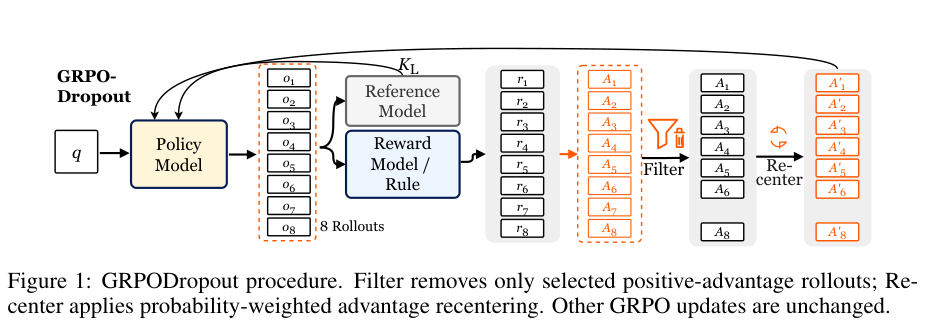
Figure 1: Selectively filters positive-advantage rollouts from the same question and recenters the rest using probability weights. Other GRPO update steps are unchanged. From the original paper; copyright remains with the authors.
Core equations
\(s_g=-\sum_t\log p_{g,t}/T_g\) and \(h_g=A_g(s_g-\bar s)/G\). Remove the most negative contributions first, then restore all \(A_g\le0\). Compute \(b=\sum_{keep}e^{-s_g}A_g/\sum_{keep}e^{-s_g}\) and update with \(A_g-b\).
Paper results
Across three models and ten benchmarks, the paper reports a mean gain of 1.55 percentage points. Restoring nonpositive-advantage responses does not guarantee that the final subset still satisfies the original entropy constraint. No online A/B test is reported.
Local reproduction
See the checkpoint guide for installation, data formats, and commands.
The core entry points are grpo_dropout / clipped_actor_loss. For real checkpoint execution use scripts/run_oct10_post_training.py --objective grpo-dropout.
Explicitly provide a local checkpoint path, public model ID/revision, public GSM8K train and validation JSONL, data revision, and an output directory. Run python scripts/run_oct10_post_training.py --help for the full options. No automatic downloads or private data uploads. Teacher and student vocabularies must align token by token. Only causal LMs with q_proj and v_proj are supported; base parameters are frozen and LoRA trains.
Data protocol and results
The generator reads questions only; answers go to an external numerical verifier. Train/validation overlap is rejected. Isolated validation runs after training and is not used for hyperparameter selection. Reports retain seed, data hashes, checkpoint revision, token counts, loss, and measured parameter changes.
A real NVIDIA A100 ran a Qwen3-4B student on the first 10 public GSM8K training questions, four sampled responses per question, up to 512 tokens, seed 42. Question 5 had mean group reward 0.75, reward variance 0.1875, and a nonzero student gradient of 0.118643. Rewards were identical within most other groups, leaving one effective policy-gradient step out of ten. Parameter change in \(L_2\) was 0.028784; AdamW weight decay can also change parameters, so that alone does not establish effective training.
This run did not delete responses; at least four remained throughout. Formula tests cover deletion, but the GPU run does not show its benefit. Both isolated validation questions were correct, insufficient for a capability claim. See measured results and sanitized GPU evidence. Truncation, few questions, and a single seed support only a runtime smoke test.
An extension to 12 questions with the same fixed training order still triggered no deletion for seed 42. For seed 43, question 5 retained 1/4 responses, executing the filtering branch. Its single negative advantage was recentered to zero, so this seed had no effective policy gradient. This is a real negative result, not model improvement. Neither seed was used for tuning or test selection, and they are not pooled as a formal comparison.
Code mapping and reproduction limits
oct10_objectives.py contains the formulas and selector; oct10_checkpoint.py handles LoRA, rollout, teacher scoring, optimization, and validation. Contract tests are tests/test_oct10_objectives.py and tests/test_oct10_checkpoint_contracts.py. Original training data, full budgets, and multi-benchmark comparisons are not reproduced. The method is not integrated into the multi-round evolve controller; an index label does not establish integration.